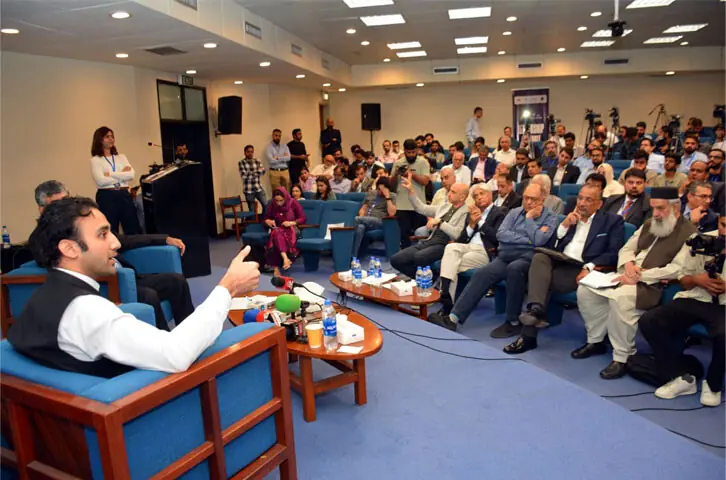
LAHORE: State Minister and Pakistan Virtual Assets Regulatory Authority (PVARA) Chairman Bilal Bin Saqib has said Pakistan is moving ahead with developing a regulatory framework for digital assets as the adoption of blockchain-based technologies continues to expand.
Addressing policymakers and experts at Leadership Summit on Blockchain and Digital Assets, hosted by the Lums Centre for Digital Assets Research, on Saturday, Mr Saqib stressed that the government must act decisively to bring the growing number of digital asset users into the formal financial system. Regulation should enable innovation while ensuring consumer protection, he added.
The state minister said that around 40 million Pakistanis are already engaged with digital assets, largely through informal platforms operating outside regulatory oversight, creating both opportunities and risks.
“The universe rewards action, not intelligence,” he remarked, underscoring the importance of timely execution in responding to rapidly evolving technological shifts.
PVARA chief says blockchain can enhance efficiency of remittance inflows
A key priority, he said, is integrating users from informal systems into the formal economy to reduce exploitation and strengthen financial inclusion.
Highlighting the economic implications, he pointed to Pakistan’s annual remittance inflows of around $38 billion, saying these could be made more efficient through blockchain-based settlement systems.
Mr Saqib also referred to the expanding freelance economy, arguing that regulatory clarity could enhance global competitiveness.
Pakistan has developed a regulatory approach for digital assets within a short timeframe, driven by institutional support and policy direction, he added. The framework, he said, will follow a risk-mitigated model, including sandbox environments to test emerging technologies.
Asset-backed tokenisation has been identified as an initial focus area, which could widen access to investment opportunities by enabling smaller-scale participation in real estate and financial instruments.
He warned that delays in regulation could deepen reliance on unregulated systems, given the scale of existing adoption. Pakistan, he added, now has an opportunity to help shape global discussions on digital finance rather than simply adopting external frameworks.
Calling for collaboration, he urged banks, technology firms, academia and regulators to work together to build capacity and develop skilled human resources.
“The biggest gap at the moment is talent,” he observed, stressing that continuous learning and institutional coordination will be essential for long-term progress.
Published in Dawn, May 3rd, 2026