Hormuz stays flashpoint amid reopening move


 0
0
• Iran asks US to lift blockade, warns of response if ‘piracy’ continues
• Macron wants full reopening of strait in ‘coming days and weeks’
• Turkiye, Germany agree to de-mining missions
TEHRAN/ANKARA: As a blockade of the Strait of Hormuz by the US and Iran led to energy shortages, efforts were afoot to restore freedom of navigation in the vital maritime route, with multiple countries offering to de-mine the strait once peace was restored.
After the US and Israel attacked Iran on Feb 28, Tehran responded by shutting down the strait and later announced it would charge vessels using the maritime route. The US earlier this month blockaded Iranian ports to stop its oil exports and returned over 30 ships leaving Iranian ports.
Despite an extension in a recent ceasefire between the two, Hormuz remained a flashpoint, proving a major hurdle in the resumption of talks.
Iran’s military said it would respond if the US maintained its blockade of Iranian ports, calling it “banditry” and “piracy”. In a statement carried by state-run media outlet IRIB, the military’s central command Khatam Al-Anbiya said that if “the invading US military continues blockading, banditry, and piracy in the region, they should be certain that they will face a response from Iran’s powerful armed forces”. “We are ready and determined, while monitoring the behaviour and movements of enemies,” it added.
‘In the same boat’
On the other hand, French President Emmanuel Macron reiterated that he was focused on efforts to reopen the Strait of Hormuz, a day after the head of TotalEnergies warned of global energy shortages if the Iran war continued for months.
Mr Macron, speaking at a news conference in Athens alongside Greek Prime Minister Kyriakos Mitsotakis, said panic caused by geopolitical uncertainty can in itself lead to shortages.
“Our goal is to achieve a full reopening in the coming days and weeks, in accordance with international law, guaranteeing freedom of navigation without tolls on the Strait of Hormuz. Then things can gradually return to normal,” he said.
TotalEnergies CEO Patrick Pouyanne pressed on Friday for the reopening of the strait, through which about a fifth of the globe’s oil and gas supply normally flows.
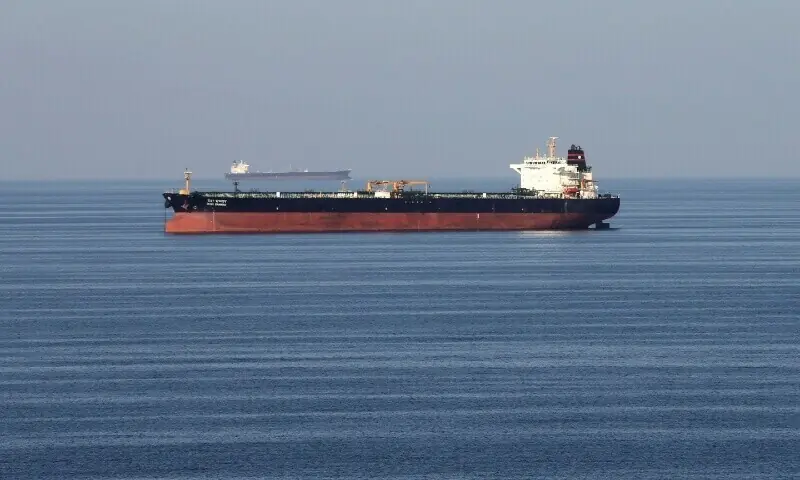
Movement through the strait, which is also a key transport route for goods, including fertilisers and pharmaceuticals, has been choked due to the US-Israeli war with Iran, as Iran has seized container ships and the United States has mounted a blockade on Iranian ports.
More than a dozen countries said they were willing to join an international mission led by France and Britain to protect shipping in the strait when conditions permit, even as US President Donald Trump had said he did not need allies’ help.
“We’re all in the same boat, and it’s not a boat we chose, if I may say. We’re victims of geopolitics and we’re victims of this war that started several months ago,” President Macron said on Saturday.
De-mining missions
Turkiye and Germany also appeared interested in Hormuz missions. Turkish Foreign Minister Hakan Fidan said Ankara could consider taking part in demining operations in the Strait of Hormuz following a possible peace agreement between Iran and the United States.
Mr Fidan, speaking to reporters in London on Friday evening, said a technical team was expected to carry out mine-clearing work in the strait after any agreement, adding that Turkey viewed such efforts positively in principle as a humanitarian duty.
Turkiye would have “no problem” with participating in mine-clearing operations under those conditions, he said, adding that it would reassess its position if any future technical coalition of countries became a party to renewed conflict. Mr Fidan also said he believed issues related to Iran’s nuclear programme could be resolved at the next round of talks in Pakistan.
Germany will soon send a minesweeper to the Mediterranean for a possible mission in the Strait of Hormuz after the end of the US-Iran war, a defence ministry spokeswoman told AFP on Saturday.
The German navy’s “Fulda” will be deployed “in the coming days”, the spokeswoman said. The aim was to make a “significant and visible contribution to an international coalition seeking to protect freedom of navigation in the Strait of Hormuz,” she said.
Minesweepers are specialised vessels used to detect and set off naval mines. The ship will be stationed with a crew of about 45. But any deployment in the Strait will only happen after “a lasting end in hostilities” and approval from the German parliament’s lower house.
Published in Dawn, April 26th, 2026