In letter to UNSC president, Dar draws attention to 'grave' consequences of Indus Waters Treaty suspension by India

WASHINGTON: Pakistan on Thursday urged the United Nations Security Council (UNSC) to take up the dispute over the Indus Waters Treaty (IWT), warning that India’s continued unilateral suspension of the treaty carries “grave peace and security, and humanitarian consequences” for South Asia.
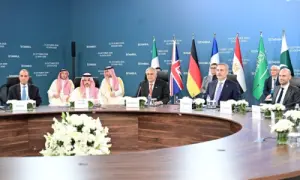
Pakistan’s Permanent Representative to the UN Ambassador Asim Iftikhar Ahmad handed over a letter from Deputy Prime Minister and Foreign Minister Ishaq Dar to the Security Council president, Ambassador Jamal Fares Alrowaiei of Bahrain.
A statement issued by Pakistan’s Mission said the letter drew the UNSC’s attention to the matter “one year after India’s illegal decision to hold the Indus Waters Treaty in abeyance” and highlighted the move’s “grave peace and security, and humanitarian consequences”.
The Security Council was urged “to take cognisance of the alarming situation and call upon India to restore the full implementation of IWT, resume all Treaty-mandated cooperation and data-sharing without delay, desist from any form of water coercion, and comply fully with its international obligations in good faith”.
The statement said Ambassador Ahmad also briefed the Security Council president on “the regurgitation of baseless allegations and propaganda by India at a time when Pakistan is engaged in serious mediation efforts to promote regional and international peace and security”.
He further underscored that “the unresolved Jammu and Kashmir dispute — a longstanding item on the Security Council’s agenda — was the root cause of instability in South Asia that necessitated a just and lasting settlement in accordance with relevant Security Council resolutions and wishes of the Kashmiri people”.
A treaty under strain
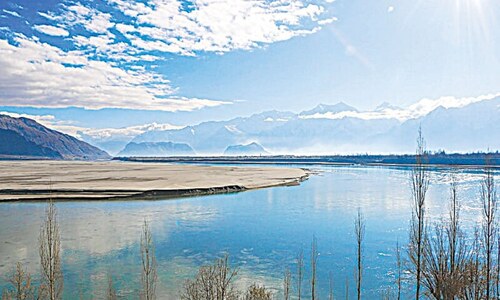
The Indus Waters Treaty, brokered by the World Bank in 1960, regulates the distribution of the Indus river system between India and Pakistan. It allocates the eastern rivers — Ravi, Beas and Sutlej — to India, while the western rivers — Indus, Jhelum and Chenab — are largely allocated to Pakistan.
The agreement has long been considered one of the most durable frameworks of cooperation between the two countries, surviving wars and repeated crises. However, it has come under strain since India announced in 2025 that it was placing its treaty obligations in abeyance.
India announced a unilateral suspension of its obligations under the IWT in April last year following an attack on tourists in occupied Kashmir’s Pahalgam that killed 26 — an incident New Delhi blamed on Islamabad without evidence. For its part, Pakistan strongly denied the allegations and called for a neutral investigation.
In June 2025, the Permanent Court of Arbitration — an organisation that provides a framework for international disputes — had issued a Supplemental Award of Competence, stating that India could not unilaterally hold the treaty in abeyance.
India has maintained that it will keep the treaty in abeyance until Pakistan ends alleged support for cross-border terrorism — an accusation that Islamabad denies.
New Delhi has also argued that climate change, technological advances, and demographic pressures warrant modifications to the treaty. Pakistan, however, insists the agreement remains fully in force and binding, citing the 2025 Court of Arbitration ruling that reaffirmed its validity.
Pakistan warns of humanitarian impact
Pakistan has repeatedly warned that politicising water poses serious humanitarian and economic risks. At a UN World Water Day event in March, Federal Minister for Climate Change and Environmental Coordination Musadik Malik said India’s decision undermined decades of cooperation and violated international law.
“For us, water is nature. Water is humanity. Water is our civilisation. For us, water is agriculture,” he said, noting that 25–30 per cent of Pakistan’s GDP and nearly half its workforce depended on agriculture linked to the Indus basin.
He said water insecurity was not only a legal issue but a humanitarian one, affecting food systems, women, and children. He added that over 61pc of women’s employment in Pakistan was tied to agriculture.