
THE erasure of modern Iran has been 120 years in the making. It began with the Anglo-Russian Convention of 1907, when two imperial powers — the United Kingdom and Czarist Russia — divided Iran into spheres of influence. Russia got the north and the UK received the south.
The subsequent discovery of oil by the Anglo-Iranian Oil Company made it a Persian version of the East India Company — a body corporate with imperial purposes. During both world wars, Iran tried to remain neutral. The Allies decided otherwise. In 1941, they ousted Reza Shah Pahlavi and exiled him, installing his pliable 22-year-old son Muhammad Reza Shah on the unstable peacock throne.
Ten years later, Iranian prime minister Mohammad Mossadegh nationalised the Iranian oil industry. Within two years, the CIA engineered a coup, toppling Mossadegh and restoring the Shah. For the next 26 years, the Shah reigned while the US ruled Iran. “I believe that my alliance with the West was based on strength, loyalty and mutual trust,” the Shah wrote in his autobiography Answer to History, adding sourly, “Perhaps that trust had been misguided.”
Just how ‘misguided’ the Shah learned when, after effectively abdicating in 1979, he fled to Egypt. Later that year, his plane touched down at the wrong airport in Fort Lauderdale, US. Instead of the royal reception he expected from an ally (president Jimmy Carter had lauded the Shah’s Iran as “an island of stability”), the Shah was met by an American agricultural inspector who asked whether the Shah had brought “any plants” with him.
Leaders today should heed lessons in political expediency.
In time, the Shah found himself defending claims by the new government to refund $20 billion. In an interview with Barbara Walters, the Shah admitted to wealth of only “between $50-$100 million”. The rich enjoy the luxury of not having to calculate their wealth. “If you know how rich you are, you aren’t rich,” Mrs Imelda Marcos said, after she and her husband president Ferdinand Marcos had been eased into exile by the US. In 1986, they landed in Hawaii with $717m in cash, 300 crates of assorted jewellery, a large trunk full of pearls, and deposit slips to banks in the US, the Cayman Islands and Switzerland worth $124m.
The Swiss government later reluctantly returned $684m of Marcos’ money to the Philippines. Ironically, their only son Ferdinand ‘Bongbong’ R. Marcos Jr, has been Philippines’ president since 2022. He is lauded as Trump’s “model ally”.
Shakespeare’s Iago confessed: “I am not what I am”. Pakistan has its own experience of Betrayal, Inc.’s duplicity — Generals Ayub Khan in 1969, Yahya Khan in 1971, Ziaul Haq in 1988, and Musharraf in 2008, with civilian governments in between. Each believed that he or she had the steadfast support of the US, until it vanished, as Khrushchev predicted of US-sponsored Cento, like “a soap bubble”. (Members of the Baghdad Pact (later Cento) included Iran, Turkiye, the UK and Pakistan but not the US).
Should such lessons in political expediency be heeded by today’s leaders? They should, especially when, as the social philosopher Roman Krznaric wrote in his History for Tomorrow, “We live in an era dominated by the present tense”. Krznaric admits that history is at best “a counsellor, not a clairvoyant”, but it is his conviction that “anyone who cannot draw upon 3,000 years is living hand to mouth”. The US is only 250 years old this year; Iran has 5,000 years of verifiable ancestry.
Krznaric quotes a Maori proverb: “I walk backwards into the future with my eyes fixed on the past.” The US, this time unsupported by its more pragmatic allies (except for the professional spoiler Israel), is blundering alone, “backwards into the future”.
The US has chosen yet again to battle in a foreign domain, far from its homeland. It lies continents away from Iran. A distant tenacious Iran has two closer, supercharged allies — Russia and China. Russia is a vengeful creature reassembled from the residual body parts of a defunct USSR. China — Napoleon’s “sleeping giant” — has awakened as he predicted to “shake the world”.
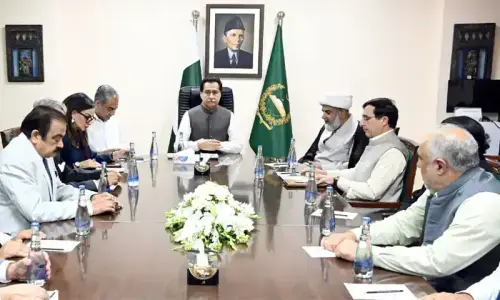
During the last fortnight, Pakistan’s civilian and military leadership have worked with tireless energy to bring Iran and the US sans Israel together. Are the promises extracted from both parties, like pie crusts, made to be broken? Pakistan’s nuclear power status may have reinforced its credentials as an armoured peacemaker. Will it emerge unscathed from this dangerous bout between combatants who, even while negotiating, keep their fingers on the trigger and thumbs on the doomsday button?
Nuclear Man should know by now that, while initially “we shape our tools, thereafter, our tools shape us”. Misshapen survivors from Hiroshima and Nagasaki should be lesson enough for today’s bellicose leaders.
The writer is an author.
Published in Dawn, April 23rd, 2026