In most economies, adding power capacity is a sign of progress. In Pakistan’s case, it has become part of the problem.
Pakistan’s power sector today stands at a peculiar crossroads. Installed capacity exceeds 40,000 megawatts, while peak demand rarely crosses 30,000. Yet, evening load shedding persists. This is not a story of scarcity. It is a story of misalignment between when electricity is produced and when it is needed, and between how the system is structured and how it is evolving.
The International Monetary Fund’s (IMF) recent staff-level agreement offers a revealing entry point. For the first time, the Fund has explicitly called for “rationalising capacity in line with demand while ensuring grid sustainability”. It recognises that Pakistan’s challenge is no longer adding megawatts, but managing excess ones efficiently.
The numbers tell their own story. Capacity payments now exceed Rs2 trillion annually, a fiscal burden anchored in long-term, take-or-pay contracts. Faced with this rigidity, the state has resorted to load shedding during peak hours, not because electricity is unavailable, but because it is too expensive to dispatch. In effect, scarcity is being manufactured to contain costs.
It is crucial to not merely reduce megawatts, but convert stranded capacity into usable flexibility
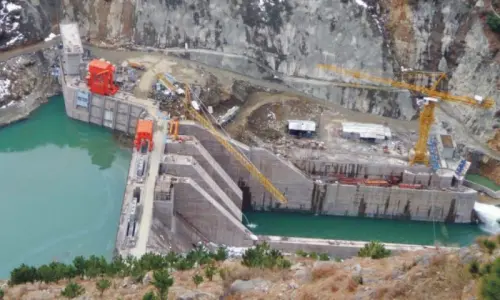
Yet, while the IMF is nudging toward rationalisation, Pakistan’s investment patterns continue to reflect an older doctrine. The Public Sector Development Programme (PSDP) remains tilted toward large-scale hydropower expansion, Tarbela, Dasu, Mohmand, and Jamshoro coal projects that are defensible in isolation but poorly aligned with the immediacy of the crisis. Hydropower is seasonal, coal is imported and far away from the load centres. It does little to address the evening peak, where the system’s stress is most acute.
The imbalance is not merely domestic. It is mirrored in international development thinking. The World Bank’s Country Partnership Framework, under Outcome 4: Cleaner Energy and Better Air Quality, emphasises scaling renewable energy capacity and reducing emissions intensity.
Thus, three narratives coexist uneasily: The IMF calls for rationalisation, the PSDP continues expansion, and development partners emphasise decarbonisation through additional supply. Each is individually coherent. Together, they pull the system in different directions.
Complicating matters further is the IMF’s own implicit objective: safeguarding the financial viability of the legacy grid.
Recent policy signals reflect this concern. Solar imports have been subjected to taxation, net-metering regulations have been recalibrated to lower buyback rates for new entrants, and battery storage, arguably the most critical enabler of renewable integration, remains without meaningful incentives.
From a fiscal standpoint, the logic is understandable. A rapid migration toward decentralised solar would leave fewer consumers to shoulder rising capacity payments, accelerating the utility death spiral. But in protecting the grid’s balance sheet, policy risks undermine the transition that could restore its operational logic.
The result is a paradox: a system that is simultaneously overbuilt and underperforming. This is precisely where the idea of capacity rationalisation must be redefined, not as a passive alignment of supply and demand, but as an active restructuring of the asset base itself.
Rationalising capacity cannot simply mean curtailing generation or suppressing demand. It must involve strategic reduction and repurposing of inefficient assets, particularly imported coal and RLNG-based plants that anchor both fiscal and external vulnerabilities.
These plants, built under a different economic logic, are now increasingly misaligned with Pakistan’s energy trajectory. They rely on imported fuels, expose the economy to geopolitical shocks, and operate within a system that no longer requires their full output. Yet, their financial obligations persist.
The solution, therefore, lies not in abandoning these assets but in transforming their function.
Early retirement and repurposing offer a pragmatic pathway. Imported coal and RLNG plants can be progressively retired and converted into grid-level Battery Energy Storage Systems or hybrid flexibility hubs. Instead of generating expensive electrons, these sites can store and dispatch cheaper, renewable energy precisely when it is needed, during the evening peak.
This is capacity rationalisation in its truest sense: not merely reducing megawatts, but converting stranded capacity into usable flexibility.PSDP allocations must be reoriented away from additional generation toward grid modernisation and storage infrastructure.
The IMF, too, must extend its definition of viability. Until policy, planning, and financing converge around this reality, the system will continue to exhibit the same symptoms: load shedding amid surplus, rising tariffs amid falling demand, and investment amid inefficiency.
The writer has a doctorate in Energy Economics and serves as a research fellow at the Sustainable Development Policy Institute.
Email: khalidwaleed@sdpi.org
Published in Dawn, The Business and Finance Weekly, April 20th, 2026