No date set for second round of US-Iran talks, FO says


 1
1
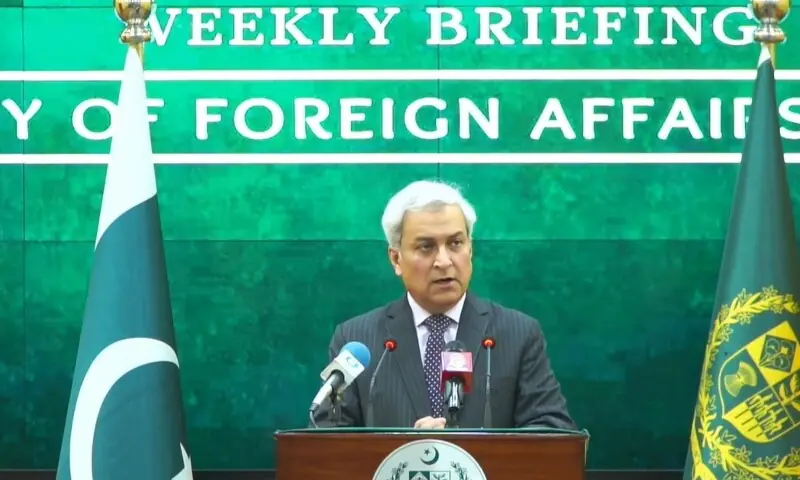

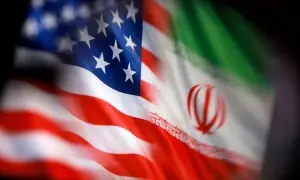
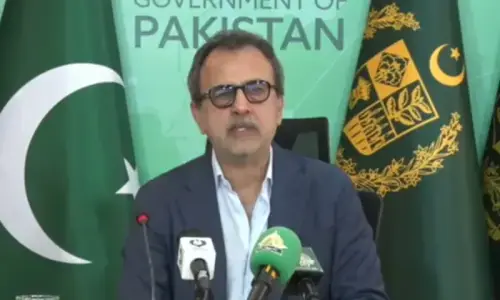
No dates have been decided for the second round of talks between the United States and Iran, FO spokesperson Tahir Andrabi said on Thursday.
“Nuclear issues are among the subjects being discussed by the countries,” he said while responding to a question during his weekly briefing.
“We will not comment on the positions of Tehran and the parties involved in the negotiations. This is part of the parties’ trust in us,” Andrabi said, urging the media to refrain from speculations.
The FO spokesperson further noted that the talks were ongoing with a high level of trust and “secrecy”.
“It is essential for us to keep the negotiations confidential,” he added.
When asked about the arrival and composition of the delegations for a second round of dialogue, he said, “Who will come, how large the delegation will be, who will stay, and who will leave — this is for the parties to decide.”
“The details and information of the negotiations that we had were entrusted to us by the negotiating parties,” he added.
He further stated, “I do not have an official announcement to make in this regard. We would announce the timing of these talks as and when it is decided”.
“Peace in Lebanon is essential for [US-Iran] peace talks,” Andrabi stressed, echoing Pakistan’s stance that the ceasefire included Lebanon.
“We are encouraged by the fact that there have been some improvements on the Israeli-Lebanon front in the last two days,” Andrabi added.
Andrabi further asserted that the FO’s policy for local and international media was the same during the Islamabad talks. He maintained that Pakistan’s role as “mediator and facilitator did not stop when the Islamabad talks, i.e. this last round, concluded”.
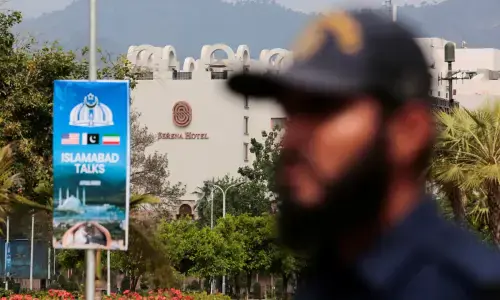
Pakistan’s civil and military leadership has been engaged in feverish diplomacy, seeking to bring the US and Iran back to the negotiating table after the Islamabad Talks over the weekend yielded no result.
Prime Minister Shehbaz Sharif is on a four-day tour to Riyadh, Doha and Istanbul, while Chief of Defence Forces (CDF) and Chief of the Army Staff Field Marshal Syed Asim Munir is leading a delegation to Tehran.
The two-week ceasefire between the US and Iran, brokered on April 8 after over a month of conflict, is set to expire on April 22. While technically intact, it is increasingly precarious.
US President Donald Trump said on Tuesday that talks between Washington and Tehran could resume over the next two days and that “we’re more inclined to go” to Pakistan, according to The New York Post.
Iran on Wednesday said that exchanges with the US via Pakistan had continued following negotiations in Islamabad, and termed Field Marshal Munir’s visit to Tehran a “continuation of the discussions in Islamabad”.
‘Negotiations process was intensive and extensive’
At the outset of the briefing, the FO spokesperson noted, “Pakistan has been recognised for its constructive diplomatic engagement in supporting de-escalation, ceasefire efforts, and the broader pursuit of stability between the United States and Iran.”
“Through sustained interaction with both Washington and Tehran, Islamabad has sought to encourage dialogue, facilitate the exchange of messages, and help create conditions and space for conducive to meaningful negotiations,” he highlighted.
Andrabi noted that the approach underscored Pakistan’s “consistent commitment to regional stability and international peace, reflecting our preference for principled, dialogue-oriented diplomacy in addressing complex geopolitical challenges and managing complex disputes”.
Asked whether China and Saudi Arabia were part of the upcoming talks, Adrabi responded: “Both Saudi Arabia and China are very close, trusted partners in the peace talks”.
He further stated that the two countries were “supportive” of Pakistan’s efforts. “They are our close partners, and our numerous interactions with them at the highest level are a demonstration of this fact,” he said.
Speaking about the Islamabad Talks held from April 11-12, he stated: “The talks continued for 21 hours – that is the duration of actual negotiations. Overall, the process continued for about 30 hours if we count movement of delegations and momentary breaks for meals and coffee.
“As such, the entire negotiation process was intensive and extensive, both in terms of scope and timelines.”
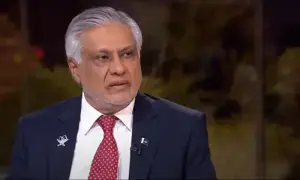
He further stated that under the leadership of Prime Minister Shehbaz Sharif and “with the active involvement” of Deputy Prime Minister and Foreign Minister Ishaq Dar, as well as CDF Munir, “Pakistan has maintained open channels of communication with the concerned parties as part of its facilitative role”.
Referring to PM Shehbaz and Dar’s three-nation trip and the army chief’s Iran visit, Andrabi said the “initiatives reflect Pakistan’s longstanding position that sustainable peace is best advanced through dialogue and cooperation”.
During his briefing, the FO spokesperson listed PM Shehbaz’s phone calls with his counterparts across the globe as part of “intense diplomatic exchanges” on the Middle East situation.
He also mentioned some of the telephone conversations held by FM Dar over the past two weeks.
Between April 2 and April 14, these included five calls each with Saudi Arabia’s FM Prince Faisal bin Farhan, Egypt’s FM Badr Abdelatty and Turkiye’s FM Hakan Fidan.
UAE ‘trusted partner’
Asked about the relationship with the United Arab Emirates (UAE) following the decision to return a $3.5 billion loan to the Gulf state, Andrabi said the UAE was Pakistan’s “trusted partner, our friend, our brotherly country”.
On April 4, it emerged that Pakistan had decided to return $3.5bn in debt to the UAE before the end of this month. The funds were part of external financing support extended by the UAE in 2019 to help stabilise Pakistan’s balance of payments.
The FO spokesperson went on to dismiss “any notion that there exists any gap or any difference between our countries” over the return of the loan, clarifying that the amount to be returned was “under discussion much before this (Iran) conflict”.
“If you recall, this matter was discussed since last year, and it then materialised into a concrete transaction plan subsequently,” Andrabi stressed.
“This issue predates the Iran-US recent conflict, so I would very respectfully urge you not to conflate the two,” he said.