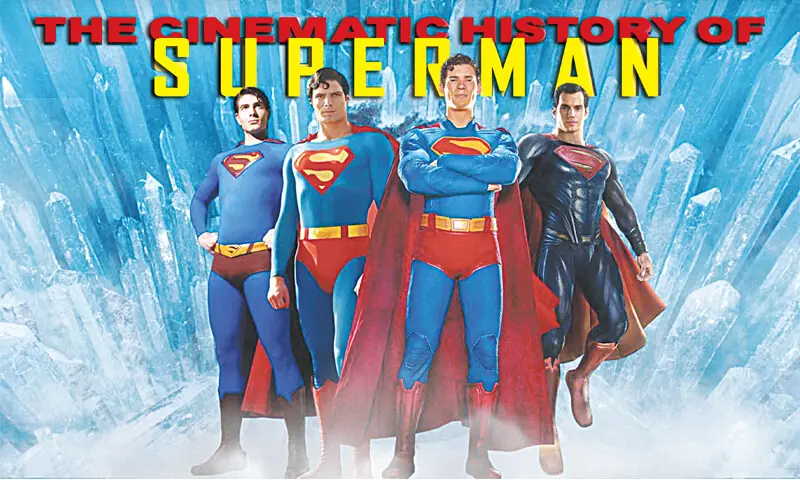


From Kirk Alyn to David Corenswet, the Man of Steel has had a long cinematic history. So in honour of Superman Day today, April 18, which celebrates the Man of Steel’s debut in Action Comics #1 on April 18, 1938, let’s take a look back at the cinematic history of Superman.
Since making his first appearance in Action Comics #1, Superman (created by Jerry Siegel and Joe Shuster) has inspired generations. By using his superhuman abilities to help ordinary people, he became a symbol of hope, kindness and strength, building a fandom rivalled by few other superheroes. Generations of fans have followed his journey across comics, films, television and animation.
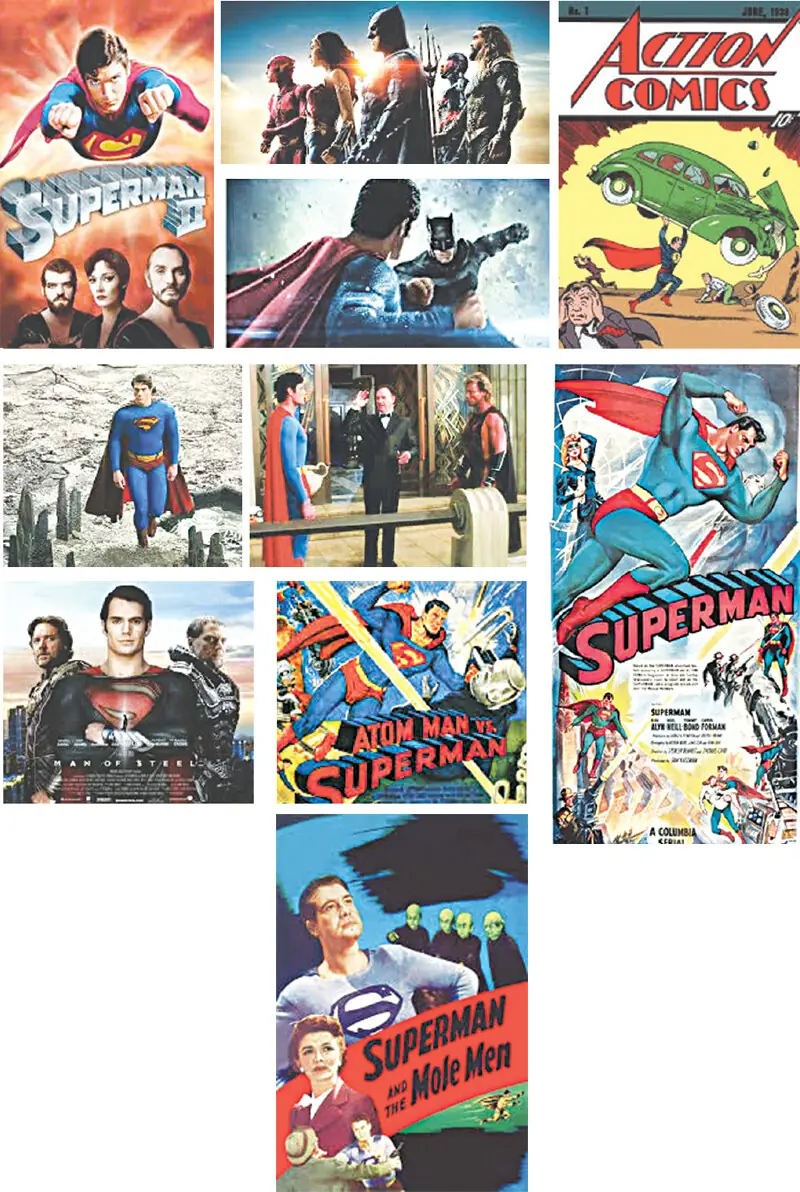
Superman enjoyed success in comic strips and even a hugely popular radio series, The Adventures of Superman, but it took a decade for the man from Krypton to appear in live-action motion pictures. Columbia Pictures released a 15-part film serial, Superman, starring Kirk Alyn as the titular character, with Noel Neill as Lois Lane. Going over his origin, the serial was a commercial success and led to it receiving a sequel.
Kirk Alyn returned in 1950’s Atom Man vs. Superman, another 15-part film serial, where Superman faces his iconic arch-nemesis, Lex Luthor. Here, Luthor takes on the persona of the Atom Man as he plans to reduce Metropolis to atoms. As Superman saves the day, he is accompanied by his colleagues at the Daily Planet, Lois Lane, Jimmy Olsen and Perry White.
From black-and-white serials to billion-dollar blockbusters, Superman has come a long way. Let’s revisit the films and faces that brought this iconic hero to life
Following the success of the Superman serials, 1951’s Superman and the Mole Men was the first feature film based on a character from DC. George Reeves portrayed the Man of Steel, as the Mole Men emerge from the oil well, terrifying the townsfolk. Clark realises that they mean no harm and protects them from the paranoid townspeople.
Superman and the Mole Men served as the pilot for The Adventures of Superman TV series, with George Reeves returning as Superman. It ran for six seasons, but with the sudden death of the star George Reeves, the show had to be cancelled in 1959.
After the end of The Adventures of Superman, it took many, many years for Superman to hit the big screen once again. Finally, in 1975, a new Superman movie went into production with Richard Donner set to direct. After long auditions, unknown actor Christopher Reeve was cast as Superman in 1978’s Superman (sometimes referred to as Superman: The Movie).
Reeve starred alongside Gene Hackman’s Lex Luthor and Marlon Brando’s Jor-El. Donner’s unique take on Superman, focusing on both his Kryptonian heritage and life in Smallville/Metropolis, connected viewers with Clark and his inner conflict as a hero. Further, the iconic John Williams score filled hearts with hope.
Whilst breaking records at the box office, Superman also went on to win the Special Achievement Academy Award for Visual Effects. Bringing out both the humour and gravitas of Superman to the big screen, people fell in love with Reeve’s take on the big blue, leading to it receiving a sequel in 1981’s Superman II.
Following the release of Superman, tensions developed between producer Pierre Spengler and director Richard Donner, leading to Donner’s firing and the hiring of Richard Lester to direct. The majority of the cast returned as the film focused on the arrival of General Zod from Krypton, who seeks revenge against Superman for imprisoning him.
Despite the off-screen conflicts, Superman II was released to strong acclaim from both fans and the press, continuing the inspirational tone of Superman while reconnecting Clark with his Kryptonian heritage. Following the success of Superman II, Lester returned to direct Christopher Reeve in 1983’s Superman III.
In the third instalment, Superman faced CEO Ross Webster, who used computer programmer Gus Gorman’s supercomputer to kill the Man of Steel. However, as the computer gained sentience, Superman had to destroy it before it could end the world.
Superman III did not do as well as its predecessors, repeating the tropes of the first two movies. Despite this, it still received a sequel in 1987’s Superman IV: The Quest for Peace, with Christopher Reeve returning as the titular character.
In this movie, Superman has to fight Nuclear Man, a genetically modified clone of himself, created by Lex Luthor. Superman traps Nuclear Man in the core of a nuclear power plant, converting him into energy for the power grid.
As these movies began to bore audiences, with the latter two less well-received than the first, Bryan Singer, director of 2000’s X-Men, was brought on to helm 2006’s Superman Returns, which retconned the events of Superman III and Superman IV and continued the story post Superman II, with Brandon Routh playing the version of Superman originally portrayed by Christopher Reeve.
Superman Returns follows Superman as he returns to Earth and witnesses how everyone close to him has moved on. As Lex Luthor, portrayed by Kevin Spacey, is released from prison, he plans to steal Kryptonite and Kryptonian crystals to form a new landmass in the Atlantic Ocean, killing billions along the way.
Superman confronts Luthor, but is weakened by the Kryptonite. As he regains his strength, Superman lifts the entire landmass as Luthor escapes. Although Superman Returns was more successful than the previous few films, the sequel was cancelled when Superman was rebooted in 2013 with Man of Steel, launching the DC Extended Universe.
With director Zack Snyder, Man of Steel starred Henry Cavill as Superman. It depicts Superman’s origin from his birth on Krypton to his life in Metropolis. He faces General Zod, played by Michael Shannon, who plans to terraform Earth into Krypton. Superman has to battle with himself as he decides whether to have a part of his home planet on Earth while risking humanity’s extinction.
Upon destroying Zod’s ship, Superman is forced to kill him as he planned on ending the human race. Scored by Hans Zimmer, Man of Steel depicted Superman as the saviour of Earth. The movie received mixed reviews from viewers, with some appreciating its cinematography and filmmaking, whilst others argued it veered too far from Superman’s character, making him edgier than usual.
The commercial success of Man of Steel led to a 2016 sequel in Batman v Superman: Dawn of Justice. The film focused more on Batman as he faced the consequences of the events of Man of Steel, swearing revenge on Superman. Whilst Batman prepares to fight the Man of Steel, mastermind Lex Luthor creates a threat bigger than them both.
Finally, when all the heroes came together in 2017’s Justice League, Superman teamed up with his fellow heroes to defeat Steppenwolf. Henry Cavill’s Superman also reprised his role in 2021’s Zack Snyder’s Justice League, a retelling of the theatrical cut that aligned with Snyder’s vision. However, as the DCEU came to an end, Superman was once more rebooted with a new actor taking on the mantle.
In 2025’s Superman, director James Gunn brings the character back to its roots as the bright beacon of hope we’ve come to expect. Superman, played by David Corenswet, has to stop a clone of himself while Lex Luthor, played by Nicholas Hoult, uncovers a secret from his past. This time, Superman is also supported by the Justice Gang, laying groundwork for the future DC Universe.
The score from John Murphy and David Fleming exudes hope and humanity, immersing you in the world of Superman. With the success and popularity of this film, a follow-up is in production in the form of 2027’s Man of Tomorrow.
Ultimately, over the decades, Superman has appeared on the silver screen in many different forms, from the hopeful tone of the Reeve-era movies to the darker themes of Zack Snyder’s films. As the years go on, Superman will continue to brighten our hearts across all mediums.
Published in Dawn, Young World, April 18th, 2026