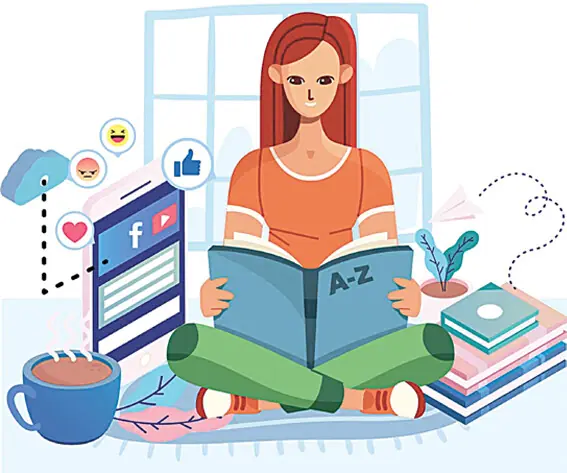
On a Sunday afternoon, I decided to study. It was the preparation week for my exams, and I knew I had a lot to cover. I took out my books, arranged my study materials neatly on the table and kept my phone beside me.
Before starting, I thought, why not watch some motivational videos to feel productive and maybe get ideas on how to plan my study routine for the upcoming week? But that was the mistake I made.
I opened YouTube and started watching videos of students who wake up at 5 am, follow perfect routines and study for hours without distraction. Their desks were clean, their lives seemed organised and everything about them looked perfect. For a moment, I felt bad about myself, but then something inspired me.
Right then, a notification popped up from Facebook. One of my friends had posted a story. I opened it and saw that she was enjoying time with her cousins, laughing and playing. One story led to another. Then another. I kept scrolling, completely unaware of how time passed. It felt like just a few minutes.
After some time, my mother came into my room and said, “Come for lunch.” That was when I looked at the clock. Almost two hours had passed! I felt a sudden wave of guilt. I had planned to study, but instead, I had wasted my time scrolling through social media.
During lunch, I couldn’t stop thinking. My mind was filled with questions. How do people manage everything so perfectly? How do they study, enjoy life, spend time with family and still achieve good grades?
At night, I tried to study again. I managed to focus for about half an hour, but my mind was still distracted. Soon, I gave up and went to bed. But as usual, before sleeping, I picked up my phone. It had become a habit.
I opened Instagram and started scrolling. My friends, their families, having perfect faces, perfect people, happy lives, achievements and success stories. Everything looked smooth and flawless. It felt like everyone was moving forward in life, doing something meaningful, becoming someone important.
And here I was, lying in bed, doing nothing. The same thought kept repeating in my mind: why am I not like them?
After a couple of hours, when my eyes started hurting, I put my phone aside. But I didn’t feel relaxed. Instead, I felt exhausted, not physically, but mentally. It was as if all that scrolling had drained my energy instead of giving me motivation.
The next morning, I went to college. I was sitting with my friend and somehow the topic of social media came up. I mentioned her Facebook story and told her how perfect everything looked. I also shared how I felt that everyone seemed to have everything under control, and I didn’t.
My friend looked at me and laughed, not in a rude way, but in a way that made me curious.
“Oh my dear, it’s just a part that we see online. It’s captured for that purpose only. It’s not the complete reality,” she said.
Then she opened her profile and showed me a picture from her birthday. She was wearing a beautiful white dress and smiling brightly. She looked truly happy.
“I was actually sick that day,” she said. “And I had a big argument with my brother, so I didn’t even feel like talking to anyone.”
I was shocked. The picture looked perfect. I would have never guessed.
Then she added, “Yesterday, my youngest sister fell and was bleeding from a cut in her head. We were at the hospital, all worried. But in my stories, didn’t you see me smiling at the ice cream parlour?”
I was speechless. People only share their best moments, the ones they want others to see. They don’t show their struggles or problems.
That moment changed my thinking. I realised I had been comparing my real life, full of ups and downs, with someone else’s carefully selected moments. And that was why I always felt like I wasn’t enough.
From that day, I decided to change my perspective. I didn’t stop using social media, but I started using it more carefully. I noticed how certain posts made me feel. If something inspired me, I appreciated it. But if something made me feel insecure, I tried to avoid it.
I also started managing my time better. I reduced my screen time, especially during study hours and avoided using my phone before bed. Instead, I focused more on my own routine and goals.
I stopped comparing myself to others. I realised that everyone has their own journey, their own pace and their own struggles.
Today, I still use social media. But now, I understand the difference between real life and reel life. Real life is not perfect, it has ups and downs, good days and bad days, success and failure. But it is real and that’s what makes it meaningful.
Published in Dawn, Young World, April 18th, 2026