Rumpelstiltskin, a fairy tale by the Brothers Grimm, tells the story of a poor miller’s daughter, who was locked up each night to turn straw into gold until the king found her worthy of becoming his bride.
The only way she achieved this was with the help of a dubious character, Rumpelstiltskin, but this help came at a price: first for her necklace, then her ring and then the promise of her first-born child.
It is tempting to see the king as exploitative nations, the miller and his daughter as the exploited and enslaved, and Rumpelstiltskin as the international agencies that offer loans, forcing countries into the trap of eternal debt servicing.
The miller’s daughter escapes from her debt to Rumpelstiltskin by identifying his hidden name. The world, too, is finally exposing the well-guarded truths and the identities of hidden forces that have enslaved nations, largely by controlling the narrative.
The lofty edifices that filled the world with awe and wonder prove to be a mere facade, hiding a foetid world symbolised by the likes of Jeffery Epstein, the myth of European ‘enlightenment’ and liberalism. The world is experiencing an emotional paralysis. Everything we were led to believe about the leading institutions, systems and ethical values — entrusted to the best of the best — have fallen short of their promises and commitments.
As faith in global institutions erodes, must a new hegemon rise or is an alternative possible?
The pundits speculate about who will emerge to form the new dominant world order, with many assuming it will be China and Russia. But, perhaps, we are done with the need for a dominant world order.
Today, social scientists suggest that we are living in a global empire — interconnected, urbanised and with advanced technological systems. However, that only describes the perspective of the dominant developed world — about 20 percent of the world population. While an estimated 80 percent of the world has access to the internet, it only makes them acutely aware of what they do not have.
If we cast an eye back to a pre-Western world, we discover many alternative models. The West has dominated the world for only 300 of the 5,000 years of civilisations and empires stretching across the world, from China to Mesoamerica.
Empire has always been about power, but the philosophy of empire has varied. China’s emperors subscribed to tianxia, meaning “all under heaven” or “for all people”, a worldview prioritising harmony and global coexistence over conflict.
Ashoka, emperor of Magadha, intended that “the people of the unconquered territories beyond the borders might think: ‘What is the king’s intentions towards us?’ My only intention is that they live without fear of me, that they may trust me and that I may give them happiness, not sorrow.”
The Muslim empire under Umar, the second caliph of Islam, was focused on the welfare of all those in his realm. According to him, “Even if a dog dies hungry on the banks of the Euphrates, I fear that Allah will hold me accountable for it.”
However, empires also waged wars and succumbed to corruption. The famed Mauryan political advisor Chanakya/Kautilya, in his guide to rulers, the Arthashastra [The Science of Material Gain], prescribed policies to conquer enemies, expand territory and manage empire, often with war, assassinations and spying.
Civilisations, on the other hand, are not bound by the rise and fall of empires. They reflect the ideas and cultures of people. Civilisations share knowledge and culture naturally and, for the most part, this exchange is a peaceful process.
Trade has been the keystone of civilisational exchange. Today, trade is weaponised with tariffs and sanctions, a legacy of the one-way trade of colonialisation, which the Indian political leader Dadabhai Naoroji called the “Drain Theory.” Today, the US argues that what is in its own interest is also in the interest of the world.
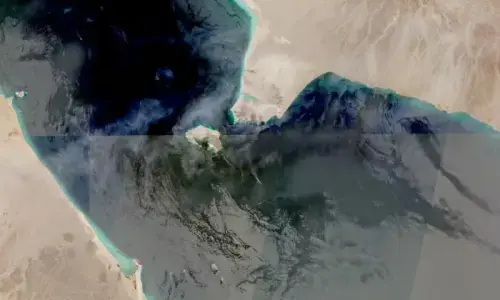
Yet the maritime trade system of the Indian Ocean was once the world’s largest trading network — from 500 AD until the rise of Western European maritime dominance in 1800 AD. This was a self-regulating global economy, sustained by Persians, Arabs, Africans, Javanese, Jews, Indians and Chinese, without any one dominating the other. The sea was the common heritage of humankind. The right to trade was no one’s monopoly.
Given that political rhetoric today is a disguise for trade interests, perhaps the world needs to work once again towards a polycentric global order, where individual nations can thrive across the world.
Durriya Kazi is a Karachi-based artist.
She may be reached at durriyakazi1918@gmail.com
Published in Dawn, EOS, April 12th, 2026