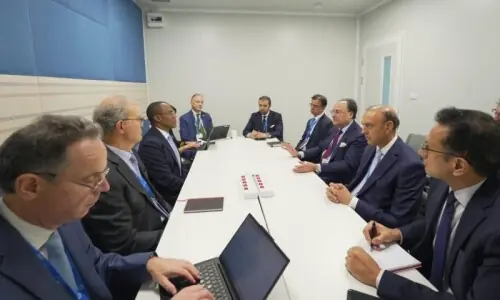
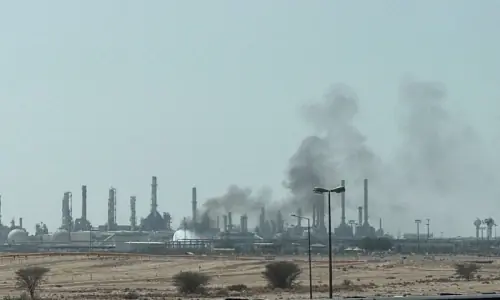
THE creation of the National Coordination and Management Council — labelled a ‘war council’ — can be read as an acknowledgement by the authorities that the crisis of governance cannot be addressed piecemeal. For weeks, Pakistan has struggled to manage the economic fallout of the Middle East war through multiple committees operating in silos, as is common in officialdom here. The NCMC appears to be an attempt to correct that flaw by centralising authority, and aligning economic, security and communication strategies on one platform. It reflects an awareness that geopolitical shocks, especially the ones stemming from war in a neighbourhood as important as the Middle East, are no longer sector-specific. Oil prices, remittances, shipping routes, exchange rate stability and internal security all move together. Disruptions in marine traffic in the Strait of Hormuz are not merely an energy issue but also a balance-of-payments risk, a fiscal stress test and a potential trigger for long-term economic instability in the country. The issue, therefore, requires a coordinated response. Moreover, the move underscores the importance of time in crisis management. The previous multi-committee arrangement had created coordination gaps. Decisions on fuel supply, subsidies, logistics and exports were taken at the same time, but were seldom in sync. In volatile conditions like the one in which oil prices fluctuate daily and remittance flows shift abruptly, such delays can amplify shocks and their impact. Thus, a centralised structure can compress decision-making and response timelines.
There is, however, a deeper institutional implication that cannot be overlooked. The breadth of the NCMC’s mandate spanning economic management, security coordination, trade policy and narrative control suggests that it could evolve into a super structure for policymaking, potentially eclipsing the role of the federal cabinet in the longer run. We have already seen the creation of the SIFC as a platform to fast-track investment and align civil-military priorities on economic revival. The new body appears to go a step further: it is designed to decide, monitor and enforce policy across virtually all major domains. The NCMC’s rise raises concerns about institutional overlap and governance clarity. While centralised decision-making could improve coordination and reduce bureaucratic delays, it may, on the other hand, sideline ministries and concentrate too much authority in a single body, thus undermining existing structures.
Published in Dawn, April 10th, 2026