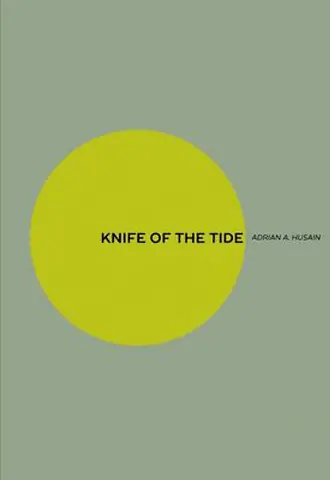
Knife of the Tide
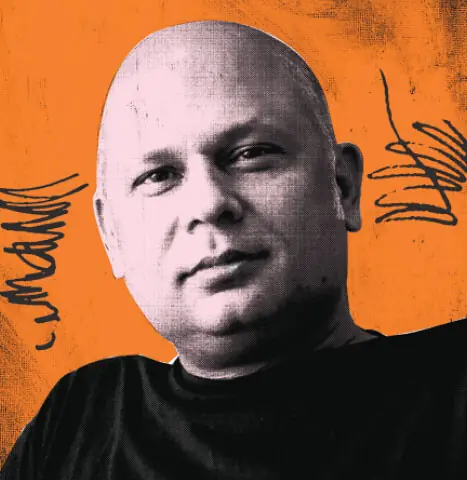
By Adrian A. Husain
The Peepul Press
ISBN: 978-969-23860-0-5
104pp.
In the second act of Oscar Wilde’s The Importance of Being Earnest, Miss Prism likens memory to a “diary that we…carry about with us.” Challenging her governess’s lofty claim, Cecily Cardew reveals how memory doesn’t present an accurate record of past events, as it is notoriously unreliable.
Knife of the Tide, Adrian H. Husain’s second collection of sonnets, builds on a similar motif by exploring the intricate structure of memory. The act of remembering the past can be fragmented rather than a uniform process based on a linear trajectory. As a result, memory emerges as ambiguous, impermanent, inconsistent and wildly paradoxical. The concept of time is equally unpredictable. Shaped by memory and emotion rather than by clock measurements, time exists as a fluid continuum across crucial moments — past, present and future.
Husain demonstrates an acute awareness of these concepts and uses the 14-line sonnet as a space for philosophical inquiry into their implications. The sonnet, however, isn’t unfamiliar terrain for the poet. His previous collection, titled Italian Window, also ventured into this creative territory to trace the marital discord that clouded his parents’ marriage during his father’s ambassadorial tenure in Italy in the 1950s.
Despite their confessional tone, the sonnets in Italian Window weren’t fuelled by a conscious attempt at ‘life writing.’ On the contrary, each sonnet offers a structured setting to revisit a brutal past, even if the act of recalling incidents produces fragmentary snapshots. In an effort to make the narrative survive as an accessible piece of writing, he frames himself as the narrator of each sonnet, while his parents are fashioned into protagonists.
By contrast, Knife of the Tide is broader in its ambit, as the subject matter is more varied and the tone is stripped of the intense urgency evident in Italian Window. In his latest work, Husain is less focused on the destinations of artistic time travel and more attentive to the meandering paths that must be navigated to reach them. In a succinct preface, the poet writes of “the need to understand the processes that give my work significance or make it possible as art.” Knife of the Tide is a study of these processes and the sinuous pathways one must follow when recalling the past.
Husain’s new collection of sonnets is admittedly a “sprawling and diverse entity” that had to be tamed through form. Structured like a fluid quartet, Knife of the Tide is unconcerned with linearity, but flows to the arbitrary rhythms of memory and time.
The first section, titled ‘The Severing’, evokes the lingering echoes of a pre-Partition milieu — albeit with measured restraint. In ‘Egg’, memory acts as a conspirator that opens a portal and allows the past to seep through indiscriminately. Steered back to the ancestral home in India, the poet is drawn back towards a childhood recollection of observing his grandfather eat an egg during breakfast. That trivial, everyday ritual of tapping open an egg carries its own violence and emerges as a quiet prelude to the other dangers that rupture his childhood.
Husain writes:
“The child trapped in a spell, caught between
guilt and wonder, fecund and whole, the scene
vanishing, yielding to others, creating
havoc — and a silent music.”
The quiet melody steers Husain towards other memories. ‘Testament 1, 2 and 3’ summons the indomitable, unconventional spirit of a grandaunt who must acquiesce to the vicissitudes of time. The next sonnet, titled ‘Threshold’, reveals a startling transition from intensely private recollection to those that appear hauntingly communal, punctuated with references to “killer mobs” and “flames” — the turmoil and upheavals of Partition.
Unlike the poems about Partition by Pakistani poets such as Waqas A. Khwaja and Moniza Alvi, Husain’s sonnets aren’t guided by an impulse to reclaim those dark years. Instead, Husain eschews precise details of key events, recognising the power of memory to both reveal and deceive. In ‘Viscera’, he writes:
“I still can’t tell what prompted the flight west-
ward that morning — sky the palest blue,
no cloud, a sense of spring. There were rumours
of trouble on the way and air of haste
at home.”
This sonnet bears a portent of doom as “a pet dove [is] carried away by a mongoose” — an image that signifies the traumas, terrors and tragedies of a violent period. Subsequent sonnets in the first section draw attention to new beginnings in a different locale, where the future seems threatening and ambiguous, as though the script of life has been erased.
‘Exodus’ captures the subliminal effects of this murky phase and the poet’s unique position as an innocent witness to historical events:
“Mind searches
for the remembered, the known. A stillness
hangs in the intervals. Latecomer
to history, I wait — innocent of regret.”
From this austere period, we are hurtled towards “an orphaned time” in ‘Lapsed Narratives’, the second section of Knife of the Tide. In the cluster of sonnets that constitute this section, the poet appraises the enduring impact of the displacement and loss induced by Partition.
The nine-part ‘Storyteller’ sonnets are the centrepiece of the section and allow Husain the freedom to foreground time as a compelling and curious subject. Memory assumes the shape of an artist and paints an almost lifelike portrait of the eponymous storyteller who anchored the poet’s youth in a “space [that was] loveless [and] bare.”
In ‘What images return, O my daughter’ — the third section — Husain propels readers towards “measured days” characterised by travel and new experiences. The sonnets in this section are an ode to a peripatetic existence, but they don’t uniformly represent a happy interlude. Time still “distorts, muddies [and] muddles” and memories emerge, fade and coalesce, unveiling a “deeper, more telling, wound.”
Even so, time and memory are the instruments through which the poet navigates reality. In ‘Markings’, Husain admits that:
“Memory is the place I scour for hints
of who I once was. Young, game for life —
earnest, purposeful — moving, knife-like,
through places unknown, leaving footprints
real or imagined.”
The final section explores these concepts in a darker vein, lamenting how the inevitability of loss and change renders memory and time even more fragile, yet indispensable. The poet wonders whether memory resides in spaces that are inaccessible to most people or if it lingers in the “dark deep of the mind” until it is summoned to perform yet another dance of deception.
Rooted in individual and communal traumas, Knife of the Tide dissects the origins, mutability and efficacy of memory. Through this rich, sophisticated collection, Husain conquers new ground by using the sonnet as a site for introspection and a conduit for exploring spiritual and artistic meaning.
The reviewer is the author of the critically acclaimed novels Typically Tanya and No Funeral for Nazia.X: @TahaKehar
Published in Dawn, Books & Authors, April 5th, 2026