0
0

KARACHI: As rising geopolitical tensions and the ongoing US-Israel-Iran war cast a shadow over global stability, speakers at a seminar on Friday warned that the crisis could further strain Pakistan’s already fragile economy.
The seminar, held at the office of the Human Rights Commission of Pakistan (HRCP), focused on the current international situation and its implications for Pakistan.
Speaking on the occasion, Qazi Khizer, vice president of the HRCP, said that the people of Pakistan were already grappling with severe hardships, including inflation, poverty and unemployment, adding that the current US-Iran war is making things worse and leaving little capacity to absorb further shocks.
“The ongoing geopolitical tensions pose a significant threat to our fragile economy,” he said and stressed that to mitigate the consequences of potential widening of the war, Pakistan must develop a self-sufficient welfare system. “This would not only cushion the impact of external shocks but also uplift our marginalised communities,” Mr Khizer emphasised.
HRCP seminar discusses US war on Iran, its implications for Pakistan
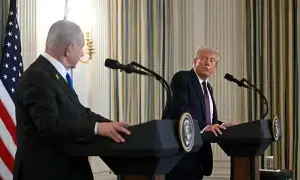
The main address was delivered by academic Dr Riaz Sheikh, who said that major global powers, particularly the United States and Israel, were driving an increasingly aggressive geopolitical environment and their strategic interests often outweigh humanitarian concerns.
He was also of the view that global concerns appeared more focused on oil routes like the Strait of Hormuz than on the human cost of conflict.
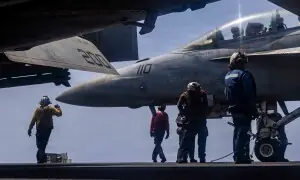
Dr Sheikh pointed out that the United States leads the world in military expenditure, far exceeding countries such as China, of which many speak of being the next superpower. Such a trend, he observed, is likely to increase militarisation and wars in the world.
Speaking about Pakistan, he said that despite democratic structures, power remains concentrated among capitalist elites and the ‘establishment’, which has always hindered self-sufficiency in the country’s economic growth.
He said Pakistan is a dependent economy with limited industrial development and a weak middle class. He was of the view that Pakistan’s heavy reliance on remittances, particularly from the Middle East, poses risks. “Around 56 per cent of remittances come from the region. Any disruption during the current crisis would directly impact ordinary citizens,” he warned.
Moreover, he said the country’s exports to the Middle East had declined in the last few weeks, which could lead to layoffs in domestic industries, while the informal sectors would also face pressure. He also cautioned that reduced development spending under the Public Sector Development Programme (PSDP) over recent years had already affected employment opportunities, minimum wages and social security.
Speaking about the way forward, Dr Sheikh stressed the need to revive the economy through industrial development and by focusing on being self-sufficient. “We have good opportunities at our ports. Port activity has increased at Karachi Port but it has capacity issues, which should be resolved. We also need to build other ports to benefit from available opportunities.”
He also called for progress on regional energy projects such as the Turkmenistan-Afghanistan-Pakistan-India (TAPI) pipeline and the Iran-Pakistan-India (IPI) pipeline, along with improved relations with neighbouring countries to ensure economic stability.
Published in Dawn, April 4th, 2026