0
0

HYDERABAD: Experts in the energy, environment and development sectors have recommended to the government to ensure low-cost electricity generation, reduction in taxes and a downward revision of tariffs.
They have also stressed on promoting local renewable energy sources and a review of Sindh Climate Change Policy.
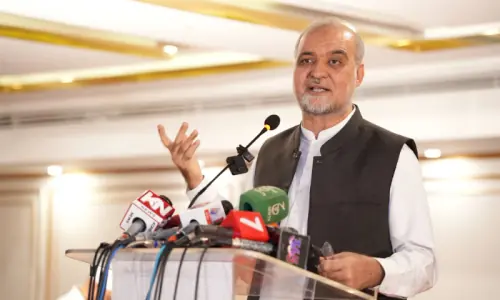
The recommendations were made at the two-day (March 25-26) conference on ‘Energy, Environment and Sustainable Development’, organised by the Mehran University of Engineering and Technology (MUET) in the auditorium of its Water Centre. Chaired by Dr Tanveer Hussain Phulpoto, the conference discussed importance of environmental issues that are posing various risks to the country.
Presenting the participating experts’ recommendations, Dr Phulpoto said that Pakistan is facing economic, security and environmental risks in the energy and environment sectors, and stressed that it’s the right time to implement these recommendations to secure the country’s future.
He said the experts suggest increasing low-cost electricity generation, promoting local renewable energy sources, reviewing Sindh’s climate change policy, reducing taxes and costs on electricity production, and revising tariffs.
MUET conference highlights risks to energy, environment and development sectors
They also recommend modernisation and digitalisation of power grid, promotion of mini-grids, inclusion of women in energy projects, and use of electric cooking methods to reduce the use of environmentally harmful fuels.
The conference underscored the need for developing ‘climate finance’ and adopting nature-based solutions for environmental protection. It suggested that carbon emissions released after fuel consumption should be properly measured using sensors and artificial intelligence (AI).
It recommended that climate change, renewable energy and environmental studies should be included in degree programmes.
Former MUET vice chancellor Prof Dr Mohammad Aslam Uqaili told the conference that closing down educational institutions to save fuel is unfortunate. He appreciated that despite difficult circumstances, the conference was successfully held. He added that the responsibility of experts and scholars is to conduct research and make recommendations while implementation is the responsibility of government. He remarked that “the country is weak in governance matters”.
He said that according to the government, 6pc electricity is being generated from alternative sources, whereas the public is already using much more alternative energy resources these days. He emphasised that discussion and dialogue were necessary, as informed debate leads to a safer and more aware future. He pointed out that energy is a federal subject, and that “sometimes certain federal institutions create hurdles in progress”.
Director General of the Sindh Environmental Protection Agency Waqar Hussain Phulpoto said that the theme of the conference is the need of the time in terms of environment, economy and technology. He said that the country had recently (in 2022) faced an unprecedented flood, effects of which are still visible today. He added that industrial units, especially sugar mills and textile mills, consume large amounts of water. Therefore, environment-friendly methods of water use and recycling must be adopted.
He noted that urbanisation is rapidly increasing and needed proper assessment, as it is growing so fast that even its accurate data is not available. “Industrial institutions must act responsibly, which is not being done fully at present,” he remarked.
He informed the participants that a separate directorate for climate change has been established and the Sindh Climate Change Policy has also been formulated. Sindh government is working on digitalisation, and recently an e-governance project titled, ‘Competitive and Livable City of Karachi (Click) has been launched.
He said that Sepa had issued around 130 environmental approvals to nine institutions through an online system, and applications are also being received online. He said that air quality monitoring has been started through automatic machines in Karachi, Hyderabad and Sukkur.
He remarked that “no institution, including Sepa, can achieve its targets unless all stakeholders play their active role”.
Professor Dr Abdul Razzaq Sahito said that this was the eighth conference, in which 130 research papers were received. After a review, 66 papers were accepted and presented, while 59 posters were also exhibited. He said that such conferences promote knowledge and wisdom which are essential for the betterment of society.
He added that the research conducted at higher educational institutions is very important for regulatory and industrial organisations, as it provides guidance and solutions.
Published in Dawn, March 28th, 2026