Farah was a reserved but calm girl, who was always timid when talking to anyone at school. Because of her withdrawn nature, her family had changed her school four times in a row.
Farah was now studying in a semi-government school, which she had initially opposed because she wanted to attend a more elite school. Although she had been studying in this new school for almost two months, her anxious habits made it difficult for her to adjust to the unfamiliar surroundings.
At the start of the ninth week of the first term, while wearing the crisp, pristine white uniform of her school, a deep sense of isolation and unease unsettled her from within. Despite the weight of the books causing pain on her shoulders, she still went to school to acquire knowledge. Little did she know what was yet to face her.
When she entered the classroom, she clenched and unclenched her fists as a source of relief from stress. The class was filled with chatter and loud noise, while she sat in the last seat of the room. She felt she didn’t belong there.
The first period was the maths class. The teacher, Miss Tahira, was the pupils’ favourite, but Farah’s least favourite.
“Today’s topic is geometry!” instructed Miss Tahira. “Open page number 131, and try to solve the first question.”
“But Miss, we have just started this chapter. How can we solve this exercise?” timid Zayan protested.
“Silence. This exercise is too easy. I expected you to know the basics of maths. Haven’t you studied this in your previous classes? Start solving now. And I do not need any more queries,” ordered Miss Tahira in a stern voice.
Farah did not even know the format for maintaining the maths notebook, because the teacher had not taken regular classes and had explained it on a day when Farah was absent.
She wanted to ask the question that had been troubling her, but she grew even more frightened when Miss Tahira announced, “This lesson is 45 minutes long, out of which 15 minutes have passed. At the end of the lesson, I will collect your notebooks, and those who have not completed anything will have their notebooks sent to the Section Head.”
Terrified yet hesitant, she raised her hand. “Miss, I have a question.”
“Yes!”
“What is the format for maintaining the maths notebook?”
“What? Are you in your senses? Is this even a question? Oh, I see. You must have bunked the class in which I explained that. Now start doing your work silently and collect your notebook from Ma’am Bushra, the Section Head. Learn something from Misha. Every teacher, including Ma’am Bushra, praises her.”
Farah was unaware that asking such a simple question would lead to such a reprimand. Her classmates quietly laughed and ridiculed her.
After recess, when she went to the Section Head’s office, she was surprised by the kindness of Ma’am Bushra, whom the whole school considered strict.
“Good morning, ma’am,” said Farah in a feeble voice.
“Good morning, dear. From your notebook, I can tell you are a new student. And even if you aren’t, mistakes are made by humans, right? I will give you and your classmates a chance to improve and present it again. Now go and enjoy your break,” she said kindly.
“Thank you, ma’am.”
Farah felt relieved, but when she returned to class, her classmates bullied her and called her names she could hardly bear. The rest of her day passed heavily, both at school and at home. That night, she sobbed, thinking about the humiliation she had faced.
Time passed quickly, and soon only a week remained for the first-term exams. Farah had been preparing well since the beginning of the term.
On the first exam day, everyone felt anxious, including Misha, the so-called star student. During the exam, it became clear that Misha was cheating from her best friend in the MCQs.
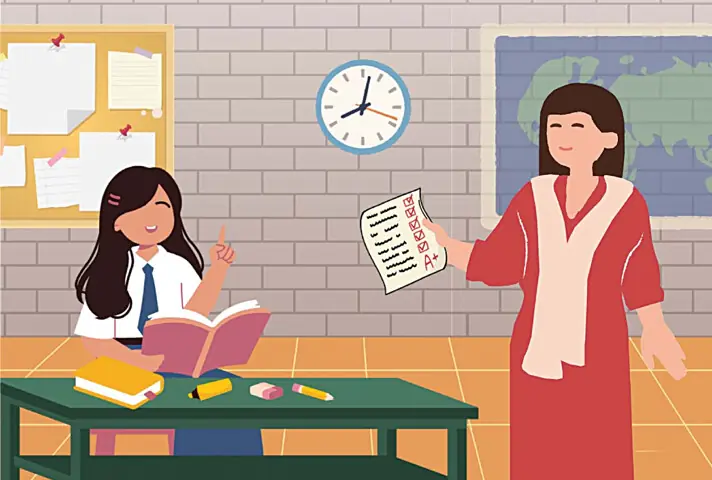
After the exams, when the papers were checked, Miss Tahira noticed that Farah, the girl she had mistreated, had topped the maths exam. When the results were announced, Miss Tahira appreciated Farah for everything, from her notebook to her outstanding performance. Deep inside, however, she felt regret for how she had treated her. Misha’s misconduct also came to light.
Farah was still quiet, but she was slowly becoming more confident in herself and her abilities. She worked hard every day, improving gradually. Her classmates began to respect her dedication, and her teachers noticed her determination.
Ma’am Bushra felt proud of her growth and reminded the teachers that every student, whether struggling or excelling, should be treated with kindness, not harshness.
Life had taught Farah that mistakes can be made not only by children, but by adults too, and that forgiving others is the key to building confidence and achieving success.
Published in Dawn, Young World, March 28th, 2026