War is presented as an integral part of human society. There are wars for territorial expansion, wars of resistance, punitive or wars of revenge, and wars for liberation. Some wars are fierce, aimed at annihilation of the enemy. Some are wars of attrition, much like the sieges of the past, aimed to exhaust the adversary’s capability to fight, depleting resources and morale.
Wars seem easy to start, but few know how to negotiate the peace. While there have been many truces, there have been very few successful peace treaties.
The oldest surviving peace treaty is the Treaty of Kadesh, signed around 1259-1269 BC between Egypt and the Hittites, to end a war that lasted two centuries to gain mastery over the lands of the eastern Mediterranean. The treaty was honoured until the end of the Hittite empire, 80 years later.
In Europe, the Peace of Westphalia, signed in 1648, ended over 100 years of wars, and established borders of sovereign states. The treaty lasted for over 150 years.
History shows that wars are easy to begin but far harder to end, yet the rhetoric of violence still prevails over the pursuit of peace today
The Misaaq-i-Medina [Charter of Medina] in 622 AD, the Treaty of Najran in 631 AD, and the Pact of Umar in 637 AD are three examples of peace treaties in early Islamic history. Non-Muslims living under Islamic rule were given religious freedom, protection of their property and places of worship. They paid a tax [jizya] for this protection and were exempted from military duty, in return for loyalty.
Under the Pax Mongolica (1279-1368) the dreaded Mongols replaced their “surrender or die” policy with administrative stability. The Mongols recognised that trade brought in more wealth than war and plunder. They protected the Silk Road, allowing for unparalleled cultural, technological and diplomatic exchanges and, over a period of time, were seamlessly absorbed into the religion and culture of the lands they occupied.
The American anthropologist Douglas P. Fry argues that war is not intrinsic to humankind. The Indus Valley Civilisation, lasting over 2,000 years, is considered one of the most peaceful, with little to no evidence of war or organised conflict. Fry has identified 74 communities today that have never experienced war. The Semai people of Malaysia living in mountain rainforests do not even have a word for war.
At the height of colonialism, voices for peace became louder. The French lawyer Emile Arnaud coined the term “pacifism” and helped establish the International Peace Bureau in 1891. Pacifism was not merely the absence of war, but a proactive commitment to creating a peaceful world.
Some years after he wrote War and Peace, Leo Tolstoy’s 1893 The Kingdom of God Is Within You became a seminal work in the pacifist movement, profoundly influencing Mahatma Gandhi’s philosophy of non-violent resistance. Gandhi, associated with Satyagraha or non-violent protest, in turn influenced Martin Luther King Jr, Nelson Mandela and the many anti-war movements from the 1960s onwards. Francesco Goya’s 1820s’ Black Paintings brought home the brutal horrors of war in shocking graphic expression.
Yet, the voices that keep war alive have been louder. The US achieved peace after a brutal civil war and the European Union chose peace after centuries of war. However, while these countries established peace within, they continue to wage wars in other countries, and develop increasingly lethal weaponry and war strategies.
They fed the Cold War, ensuring the world stays divided. Any country that was different was designated as a potential threat, to be neutralised culturally and/or militarily. Countries across the world are pitted against one another and persuaded to panic-buy military equipment. Violence is glorified in cinema, street talk or disguised as corporate ambition. Three billion people play video games with an average age between 18 and 34, with war games topping the list.
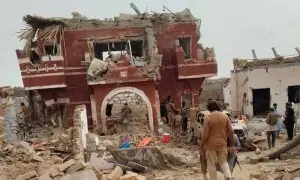
The insanity and irresponsible recklessness of the US-Israeli attack on Iran at a time when the world is sickened with the genocide in Gaza is a consequence of normalising violence and dressing it up as bravado. Who pays the price? The haunting image of a distraught man holding the severed hand of a schoolgirl in Iran is a tragic symbol of who truly pays the price of war.
Until the rhetoric of violence is expunged, and peace is not seen as weakness but strength, humanity will continue to mistake destruction for power.
Published in Dawn, EOS, May 15th, 2024