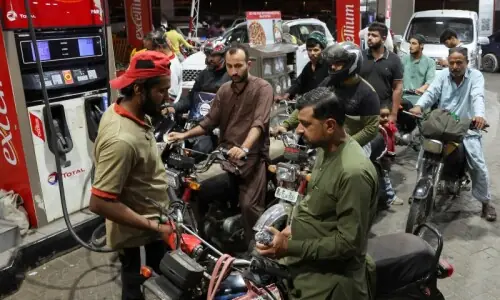


ISLAMABAD: Amid a zero-bid response to spot tenders for oil imports and the oil industry’s demand for special permission for unusual war-risk insurance cover-based oil imports, including crude and refined products, a parliamentary panel on Monday decided to investigate whether the recent 20pc increase in petroleum prices benefited the exchequer or resulted in unreasonable inventory gains for private companies.
Also, the oil industry in the prevailing extraordinary market conditions demanded that district administrations stop high-handed actions against retail outlets that temporarily run out of stocks. Such actions, reportedly taken under the prime minister’s instructions to curb malpractices, were counterproductive and aggravating supply disruptions.
On the other hand, the government’s recent decision to increase petroleum prices despite the availability of existing stocks drew attention of the Senate Standing Committee on Economic Affairs.
Headed by Senator Saifullah Abro, the parliamentar panel expressed serious concern over the 20pc price hike and questioned the rationale behind the move and the burden it placed on the public, particularly low-income groups.
Mr Abro directed the petroleum division to provide complete details of oil marketing companies (OMCs) to determine whether the benefit of the price increase accrued to the government or to the OMCs.
Earlier, in a letter to various federal government entities, the Oil Companies Advisory Council (OCAC) said, “In the prevailing circumstances, obtaining adequate marine and war-risk insurance cover has become extremely difficult. This challenge was recently reflected in the Pakistan State Oil (PSO) spot tender floated on the Gallop platform on a C&F basis, where no bids were received for MS, HSD and JP-1 cargoes.”
In view of the constraints in arranging insurance under C&F terms, the OCAC proposed that imports be temporarily allowed on a CIF (Cost, Insurance and Freight) basis instead of the current Cost and Freight (C&F) arrangement. The special permission for unusual war-risk insurance-cover-based imports should cover all oil imports, including crude, refined products and associated materials, to ensure a smooth supply chain in extremely volatile circumstances.
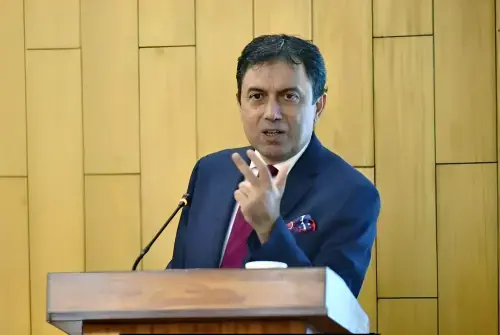
In the letter to the State Bank of Pakistan (SBP), the ministers for finance and petroleum, and the chairman of the Oil and Gas Regulatory Authority (Ogra), OCAC Secretary General Dr Syed Nazir Abbas said that due to the rapidly evolving geopolitical situation in the Middle East, international oil and shipping markets had become extremely volatile. Freight rates, insurance costs and the availability of vessels had been severely affected, he wrote.
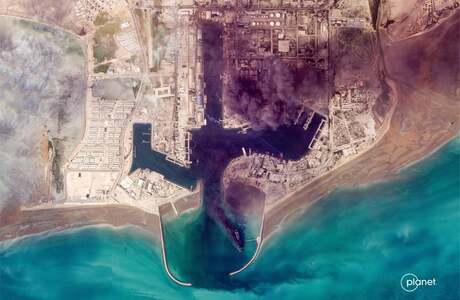
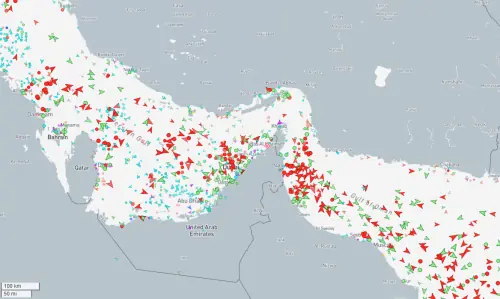
Mr Abbas pointed out marine insurers had either withdrawn or sharply increased war-risk coverage for ships operating in the Persian Gulf and the Strait of Hormuz due to the ongoing Iran-Israel-US conflict.
“Freight rates for vessels operating in the Gulf region have reportedly increased by almost fourfold, while war-risk insurance premiums for Gulf voyages have surged dramatically, making tanker chartering extremely difficult and expensive,” he said. Under the current regulatory framework, refineries and oil marketing companies (OMCs) are required to import petroleum products on a C&F (Cost and Freight) basis, under which the supplier arranges and pays for freight up to the destination port, while the buyer is responsible for arranging and bearing the cost of product insurance, including any war-risk coverage.
According to the SBP Foreign Exchange Manual (Chapter 13 — Imports), approval for CIF imports is normally granted on a case-by-case basis. However, given the exceptional circumstances and the potential risk to national fuel supply, the OCAC requested a temporary general allowance for petroleum cargoes, including crude oil, refined petroleum products, base oil and allied materials, for a period of up to two months.
Published in Dawn, March 10th, 2026