‘They are extremely accurate’: Trump offers Latin American leaders US missile strikes to hit drug cartels

US President Donald Trump on Saturday urged Latin American nations to use military power against the “cancer” of drug cartels and offered to support them with US missile strikes targeting narco kingpins.
Trump, currently waging a war with Iran, laid out a muscular position for advancing Washington’s interests in the Western hemisphere, pronouncing that communist-led Cuba was “in its last moments of life” and advocating tough action by allies against organised crime blighting the region.
He formally launched a 17-nation “counter cartel” coalition, which the White House described as a pledge from governments in the region to use “hard power” against security threats.
“We’re working with you to do whatever we have to do. You want us to use a missile? We’ll use missiles. They’re extremely accurate,” Trump told a dozen right-wing leaders from Latin America and the Caribbean at his Doral golf club near Miami.
“‘Piu,’ right into the living room,” he said, suggesting the sound of a missile in flight.
“That’s the end of that cartel person. But we’ll do whatever you need.”
Trump has already staked bold claims in Latin America with the capture of Venezuela’s authoritarian leader Nicolas Maduro and working with his replacement, Delcy Rodriguez, to claim Venezuelan oil reserves for America.
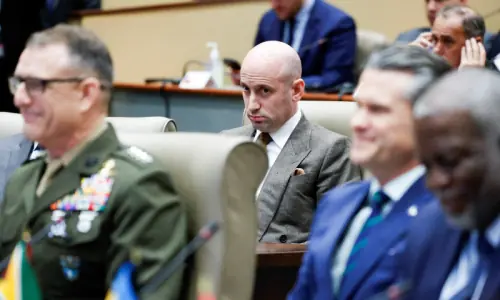
Among the leaders attending the “Shield of the Americas” summit are Argentina’s libertarian President Javier Milei, Ecuador’s Daniel Noboa and El Salvador’s Nayib Bukele — whose security crackdown is seen as a model for many in the region.
Irene Mia, a Latin America expert at the International Institute for Strategic Studies, said the right-wing heads of state share concerns about the rising power of drug cartels, which have hit countries that until recently were considered fairly safe such as Ecuador and Chile.
The strained security situation, which has contributed to the Latin American right wing’s recent string of electoral victories, means the trend of US intervention has received less pushback than in the past, Mia told AFP.
Trump urged regional leaders to use military force to stamp out criminal organisations, which he likened to a cancer, saying: We don’t want it spreading.”
“The only way to defeat these enemies is by unleashing the power of our militaries. We have to use our military,” he said.
‘They have no money’
Trump doubled down on his recent warnings toward Cuba, whose officials were not invited to the gathering and which he has implied could be “next” after taking out leaders in Venezuela and Iran.
“I’ll take care of Cuba,” Trump told leaders.
“They have no money, they have no oil. They have a bad philosophy, they have a bad regime that’s been bad for a long time,” the US president said, adding, “Cuba’s in its last moments of life”.
That warning comes a week after Trump, with Israel, launched devastating strikes against Iran, sparking a regional conflict, upending the world’s energy and transport sectors, and bringing chaos to usually peaceful areas of the Gulf.
Also this week, the United States and Ecuador announced joint operations to combat drug trafficking that has turned one of the region’s safest countries into one of the deadliest in just a few years.
Late Friday, the US military and Noboa separately released video of a house exploding in a forested area of Ecuador, calling it a successful blow against “narcoterrorists.”
In addition to Milei, Bukele and Noboa, Trump hosted the leaders of Bolivia, Costa Rica, the Dominican Republic, Guyana, Honduras, Panama, Paraguay, and Trinidad and Tobago — as well as Jose Antonio Kast, the president-elect of Chile.
The analyst, Mia, pointed to some glaring absences: Mexico and Brazil, which are currently led by leftists Claudia Sheinbaum and Luiz Inacio Lula da Silva.
“Without Mexico and Brazil, it’s not going to be very successful in tackling those issues” of narcotrafficking and counterterrorism, she said, given that Mexican cartels play a key role in the trafficking supply chain and Brazil’s ports are critical narco-trafficking routes to Europe.
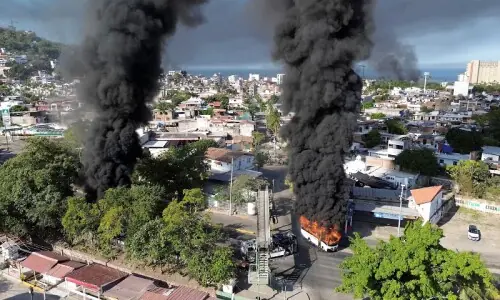
Last month, a Mexican drug lord Nemesio Oseguera, better known as El Mencho, was killed in a military raid, which led to widespread violence in Mexico. Gunmen suspected to be his supporters blocked highways across several states and set cars and businesses ablaze.