DPM Dar says Pakistan ready to facilitate talks between Iran, US
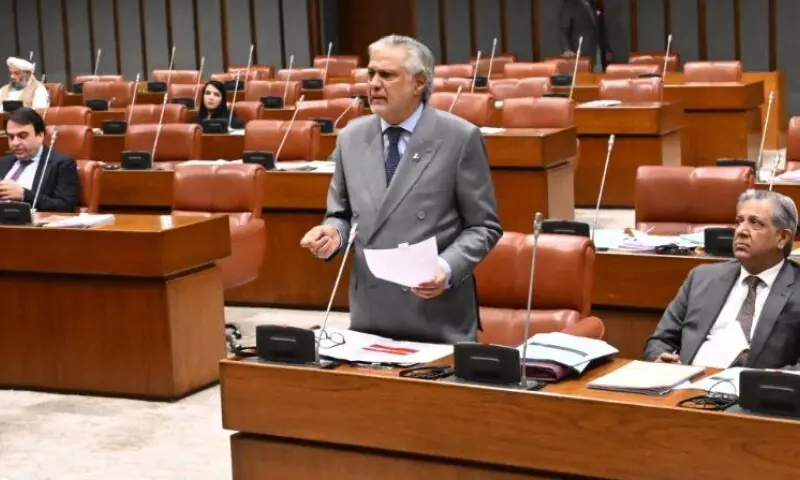


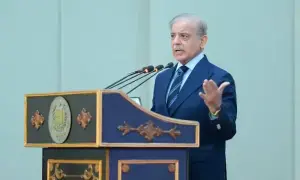
ISLAMABAD: Deputy Prime Minister and Foreign Minister Ishaq Dar on Tuesday said that Pakistan was ready to facilitate dialogue between the United States and Iran.
“Pakistan is ready to facilitate dialogue between Washington and Tehran in Islamabad,” Dar said while speaking in the upper house of Parliament.
He noted that both Prime Minister Shehbaz Sharif and Chief of Army Staff Field Marshal Asim Munir had played a “very active and positive role” in diplomatic and defence-level engagements aimed at defusing tensions.
He also told the Senate that Iran had agreed not to build nuclear weapons, but said the US was pressing for the complete dismantling of Tehran’s nuclear programme.
In his speech, he also recalled that the dialogue process between the US and Iran was initially progressing “successfully”. He also highlighted Prime Minister Shehbaz Sharif’s visit to Austria, where he held a meeting with the International Atomic Energy Agency (IAEA) chief, who Dar said was “optimistic that dialogue was heading in a positive direction”.
The foreign minister also recalled his conversation with the foreign minister of Oman last night, where he was told that the last round of talks between the US and Iran had ended “on a positive note”.
“He told me that after the talks, the Omani foreign minister flew to Washington, where he met the vice president and told him that the dialogue was going in a positive direction,” Dar said.
Expressing concern at the “sudden” attack in light of the above-mentioned developments, he said, “It was a repeat of what happened in June last year,” referring to the 12-day war between Israel and Iran in June.
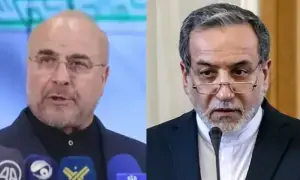
Dar recalled that last year in June, he, along with Iran’s Foreign Minister Abbas Araghchi, was in Istanbul at the meeting of a multilateral forum.
“Tensions were building up, and I remember Field Marshal Asim Munir sahib was on his way from the US to Pakistan and Araghchi suggested that I should ask the field marshal to come to Istanbul,” he said.
“So on June 12, the field marshal and I had a meeting with Araghchi, where we tried to convince him to resolve things through diplomacy and dialogue,” he said.
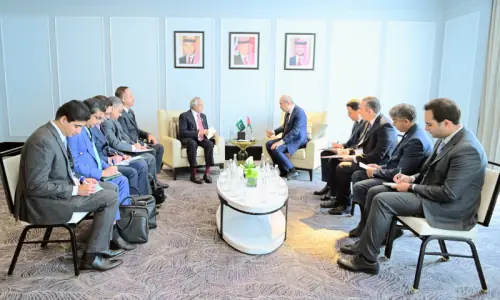
The foreign minister also recalled his August 2025 meeting with US Secretary of State Marco Rubio, where Dar said he had taken up the issue of Iran.
“I received a positive response,” he said, adding that Pakistan, on its part, had tried to ensure that the issue was resolved.
He said Pakistan objected to the US demand of no enrichment, arguing that “peaceful use of nuclear energy was a legitimate right”.
He recalled that it was agreed that “there should be surveillance of two to three countries, and Iran was happy with that”.
“It was then decided where the talks should be held, with one party suggesting Oman and Islamabad, while the other suggested Doha and Islamabad.”
“Islamabad was common in both suggestions; they were to be engaged in Islamabad, and we were happy to mediate,” Dar recalled.
Talking about Iran’s counter-attack on “so-called US bases,” the minister noted that “there have been attacks on infrastructure and airports as well”.
“Had this not happened, we would have rallied these countries to stand up and have a joint voice against Israeli and US actions,” the minister said.
Dar claimed that Pakistan was the only country which had condemned US-Israeli coordinated attacks, stating that “it took me 15 minutes to decide that we had to condemn”.
Dar also noted Pakistan’s Strategic Mutual Defence Agreement with Saudi Arabia, saying Pakistan told Iran to “please keep that in mind”.
“They (Iran) asked for some assurances,” he said, stating that Tehran asked for reassurances that Saudi “soil should not be used”.
“I got them the assurances,” Dar said, noting the “minimal reaction” on Iran’s part against Saudi Arabia and Oman.
“I am grateful they were able to understand my point, and in accordance with that, we secured assurances for them,” the minister said.
Turning his attention to repatriation efforts for Pakistanis in Iran, the minister said that a total of 35,000 Pakistani nationals were currently in Iran.
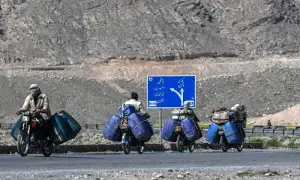
He detailed that “792 Pakistanis have been repatriated so far, out of which 694 crossed through the Taftan border”.
“We also remain engaged with the Baku government so that Pakistani nationals in the northern parts of Iran can cross the border,” the minister added.
He further detailed that the Ministry of Foreign Affairs remained “active in all regions”.
He also gave reassurances that Pakistan’s “position on Iran has not changed, stating that the work of the leadership at this point should be to manage people’s sentiments”.
“Do not let people get swayed,” he added.
Meanwhile, PTI’s Parliamentary Leader in the Senate Ali Zafar said that the US and Israel were treading on dangerous ground and had set a precedent which could have far-reaching consequences.
“If such actions are normalised, it will open the door for states to justify the assassination of presidents, ministers, and officials merely because they are politically opposed or disliked,” he remarked.
He stated that under the United Nations charter and established principles of international law, a country was authorised to use force against another state under two circumstances: when authorised by the United Nations Security Council or in self-defense against an armed attack.
“Any use of force outside these two situations is illegal,” he said. Zafar said that in this case, there was no evidence of self-defence.
He further said that it had been acknowledged before the US Congress that there was no evidence that Iran was about to launch an imminent attack on either the US or Israel.
The PTI leader also said negotiations between the US and Iran were progressing towards a potential resolution before being abruptly being abandoned in favour of military action.
He concluded that there was no legal justification for the war and that it was a war of choice, not necessity. He urged all responsible nations to use every diplomatic and lawful means at their disposal to stop what he described as an “illegal war”.
Zafar further said that previous wars, including those in Vietnam, Iraq, Libya, and Syria, were later widely criticised for being based on flawed premises. He argued that Iran had shown willingness to engage in compromise and dialogue, yet it was attacked.
Senator Zafar urged restraint, a return to diplomacy, and immediate efforts to de-escalate tensions before the conflict expands further. He emphasised that peace, legality, and international order must prevail over unilateral force.
In her speech, PPP Parliamentary Leader Senator Sherry Rehman outlined the fundamental principles that must guide Pakistan’s foreign policy amid evolving regional and global challenges.
She said that the first and foremost objective of an effective foreign policy must be the protection of Pakistani citizens.
“The second principle is safeguarding the sovereignty and territorial integrity of the state, while the third is advancing Pakistan’s national interests in an impartial and balanced manner, alongside condemning attacks wherever they occur,” she said.
Referring to developments in Iran, Senator Rehman said that Pakistan expressed sorrow over the assassination of Iran’s Supreme Leader Ayatollah Ali Khamenei and strongly condemned the incident.
She noted that Pakistan was the only Muslim country to formally condemn the assassination, underscoring the country’s principled stance.
She reaffirmed that Pakistan continues to maintain deep and constructive relations with Gulf countries and underscored Pakistan’s longstanding policy of brotherhood and cooperation toward Afghanistan.
She reiterated that wars were ruthless and never a solution to disputes, emphasising that dialogue remained the only sustainable path forward.
She said that the PPP had always raised its voice against injustice, but responsible leadership required ensuring that actions do not alienate friendly or brotherly nations.
She cautioned against alarmist narratives describing the situation as tantamount to a third world war, urging leaders to avoid inflammatory rhetoric.
“Public representatives must speak responsibly, as citizens follow their example,” she stressed.
Senator Rehman reaffirmed that Pakistan’s territory was for its citizens and must not be used against any other country. She warned that attempts to undermine national unity must be resisted, emphasising that Pakistan’s solidarity and cohesion must prevail above all political differences.