KARACHI: It is easy to be wise after the event. Hindsight is a luxury. On Sunday morning, March 1, two police patrol vehicles (mobiles) are parked outside Gul Plaza: one, on M.A. Jinnah Road, the other, at the back of the ill-fated shopping centre which caught a harrowing fire on Jan 17, taking scores of innocent lives, compelling the media to focus on the issue for a couple of weeks.
As is the practice, an inconsequential blame game began the moment the tragedy occurred. ‘So and so institution is to blame’, ‘so and so administrative body is to blame’… Who is to blame? No one knows. All of that was followed by promises. Have they been kept? It’s too early to ascertain that.
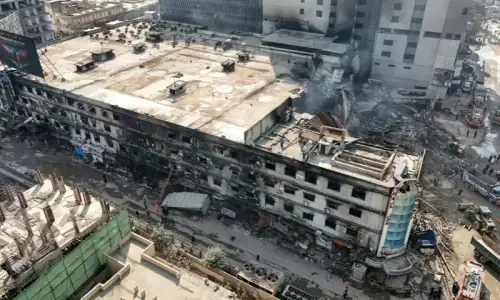
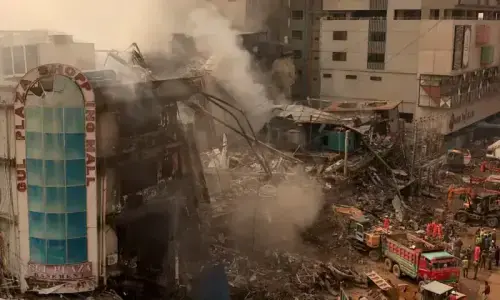
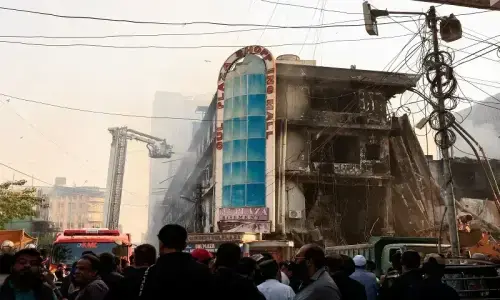
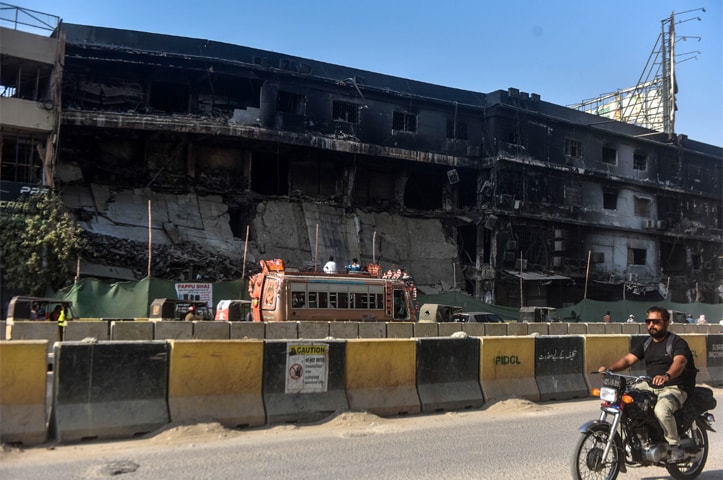
From the M.A. Jinnah Road side, Gul Plaza now cuts a hair-raising picture, right out of a horror movie made to instil fear in the hearts of the young and old alike. Green safety nets cordon off the remains of the buildings; it’s blackened, hollowed out façade stares at passers-by in a ghostly manner. It is difficult to keep looking at the building for more than a few minutes. There’s no use. There’s nothing there, and it’s scary.
Once you move to the back of the structure, the horror increases manifold. Rubble — big and small chunks of concrete — lie over each other, in a slanting position. The charred walls give off a strange vibe with iron rods jutting out of them as if they have been yanked out of Gul Plaza with unimaginable power. Iron grilles covering the front portions of some of the shops have gathered soot that seems to have changed the metal’s properties.
Nothing, of course, can be done about it. Damage is done. However, the thing that needs to be taken into account is the rubble that majorly shapes the remaining look of the building. How dangerous it is to stay there for a long period? If it is dangerous at all, what types of dangers does it have? Surely, the administration must be thinking about it. Certainly, in this case, hindsight is not a luxury.
Published in Dawn, March 3rd, 2026