South Korea plans to deploy AI, drones to breach enemy minefields
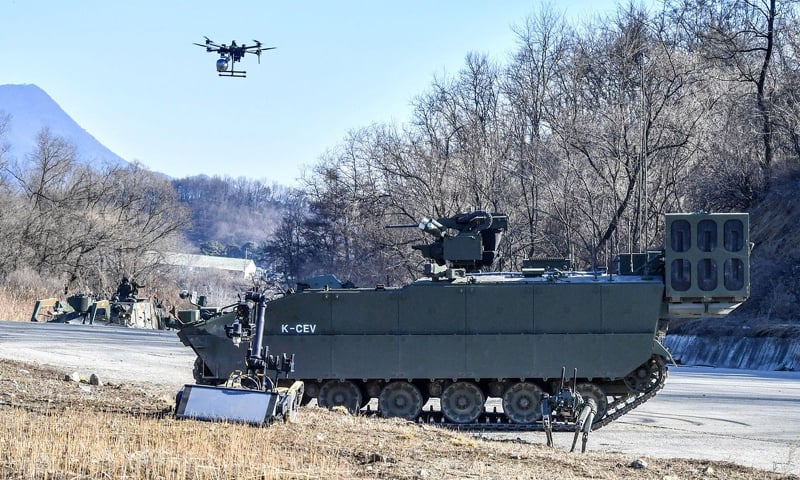

YANGPYEONG: Once reconnaissance drones transmitted live footage of suspected enemy positions — identifying troops and possible landmines ahead — a column of armoured vehicles began advancing toward hostile terrain.
Uncrewed systems moved first. Four-legged robotic platforms and explosive-ordnance disposal robots scanned the ground for hidden threats, while drones hovered overhead maintaining surveillance.
Behind them, an armoured vehicle equipped with an artificial intelligence-based remote weapon control system locked onto targets, followed by a Korean Combat Engineer Vehicle clearing a safe passage for advancing forces.
The scene unfolded during the Army’s first live operational drill featuring the Korean Combat Engineer Vehicle, or K-CEV, at the Yangpyeong Integrated Training Ground in Gyeonggi Province on Thursday. The drill offers a glimpse into how the military envisions future battlefield operations centered on artificial intelligence and staffed-unstaffed teaming.
According to the military, the exercise simulated wartime conditions in which mechanised units must penetrate enemy territory believed to be saturated with landmines, obstacles and hostile troops.
“The drill was designed to demonstrate how unmanned systems could reduce risk to personnel while accelerating battlefield maneuver amid declining manpower and rapidly evolving combat environments,” an Army official explained.
The K-CEV is an upgraded armoured platform designed for mechanized combat engineer units operating in urban and mountainous terrain. Built on the chassis of the Army’s K21 infantry fighting vehicle, the platform measures 6.9 meters in length and 3.4 meters in width and can carry up to seven personnel, including crew members. Limited unstaffed operation is currently possible within visual range.
Published in Dawn, March 2nd, 2026