Onion exports plunge as India floods market
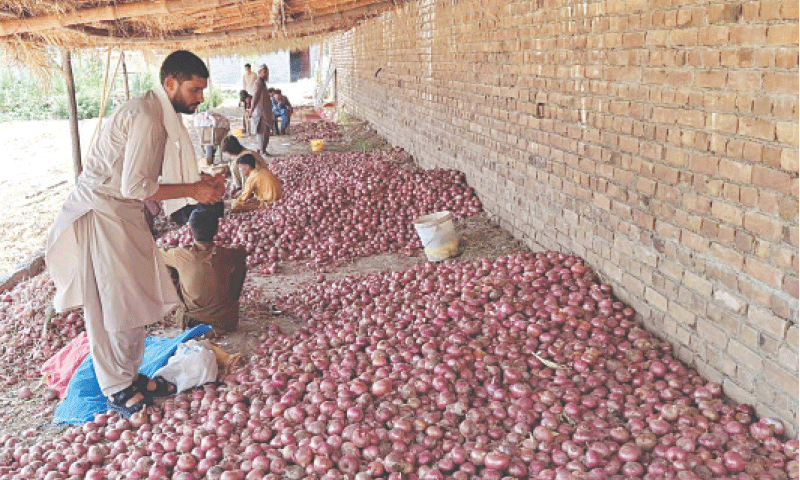

LAHORE: Onion export volume has plunged to around 10 per cent of last year’s levels, as India’s bumper harvest floods international markets and crowds out Pakistani shipments, according to Shoaib Ahmad Basra, who runs a major fruit and vegetable company.
Saying Pakistan’s onion export sector is facing a sharp downturn, he notes that onions are produced in the country throughout the year, with staggered harvests across Sindh, Balochistan, Punjab, and Khyber Pakhtunkhwa.
Sindh and Balochistan contribute roughly a third of total output between June and November, forming the backbone of exports. Punjab and Khyber Pakhtunkhwa add another 27pc during off-peak periods.
In the past, Pakistan benefited when competing suppliers faced shortages, but such openings have largely disappeared, he says in a statement.
Despite the slump, demand for Pakistani red onion remains in parts of Asia and the Middle East. Varieties such as Phulkara – known for its medium-to-large bulbs, uniform red skin, pungent flavour, and long shelf life – are favoured for both fresh consumption and processing.
Nasarpuri, with its deep-red skin, firm texture, strong taste, and good storage performance, is also well suited for extended transit. Careful curing practices help maintain tight skins, reduce sprouting, and preserve high dry matter content, making these onions suitable for South Asia, GCC, and Central Asian markets.
Basra says shipments to Afghanistan and Central Asia typically move overland in bulk mesh bags or retail packs, while sea freight supplies destinations including the UAE, Sri Lanka, Malaysia, and African markets. Prices from Sindh and Balochistan have recently stabilised at around $135 per ton FOB. However, higher freight rates and India’s advantages in quality, production scale, established buyer networks, and lower shipping costs continue to weigh heavily on Pakistan’s competitiveness.
According to Basra, Pakistan gains ground only when Indian onions become expensive, scarce, or subject to export restrictions.
Geographic proximity to Afghanistan and pricing aligned with regional preferences offer some advantage, but structural issues persist. Flooding since 2022 has affected soil conditions in Sindh and Balochistan, reducing yields and quality. Limited storage facilities result in post-harvest losses, while border disruptions with Afghanistan periodically halt trade. Inconsistent grading and branding among smaller exporters, along with repeated phytosanitary rejections, further complicate the sector’s prospects.
Basra stresses that government intervention is critical. He calls for improved access to high-yield seed varieties, stronger promotion in Far East and Middle Eastern markets, and freight subsidies to level the playing field.
Published in Dawn, March 2nd, 2026