Diverting wastewater away


 0
0
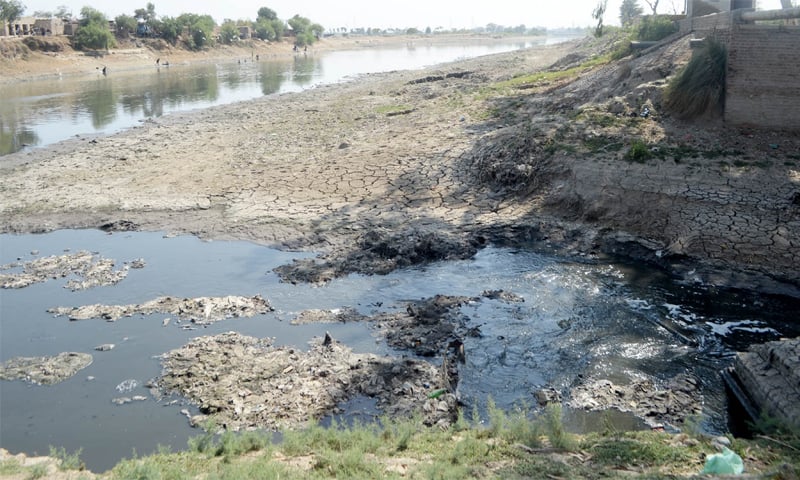
Work on a multibillion-rupee drainage scheme, estimated at around Rs4–5 billion, has begun. The project aims to divert the industrial effluent and domestic wastewater of Hyderabad away from the Old Phulelli Canal at Kotri Barrage and channel it into the saline drain Karo Ghungro, which would outfall in the coastal district of Sujawal.
This proposed work will bypass the Old Phulelli canal, which receives domestic waste and industrial effluent of Hyderabad through the Darya Khan pumping station of the city’s civic agency. This freshwater canal serves, ironically, as a disposal point for domestic and industrial wastewater, notwithstanding the fact that the population living in Tando Mohammad Khan and Sujawal districts use it for drinking and agricultural purposes. Such hazardous discharge undermines the environment unabatedly.
Environmental watchdogs have expressed concerns about this exercise, calling it a threat to the environment and human life. The scheme would be implemented by the Sindh Irrigation Department.
Old Phulelli Canal has a designed discharge of 13,800 cusecs with a gross command area (GCA) of 778,281 acres and 768,076 cultivable command area (CCA). It is a non-perennial canal of the Kotri barrage that irrigates rice-growing areas in Sujawal and Tando Mohammad Khan districts during the Kharif season.
The project aims to divert Hyderabad’s industrial effluent into the saline Karo Ghungro drain
Excavation of the drain has started. It will run parallel to the canal up to Husri in Hyderabad, before turning towards Tando Mohammad Khan to divert the wastewater to the Karo Ghungro drain. The scheme dates back to 2022 but has now been revived, with a cost revision currently underway.
“Work on the construction of Darya Khan Branch Drain (DKBD) has started at Darya Khan pumping station in Hyderabad and a siphon in Tando Mohammad Khan for the disposal of wastewater in a drain known as Karo Ghungro, which would ultimately carry it to sea,” said Waseem Soomro, superintending engineer, left bank drainage circle.
The 82-mile-long drain, with multiple discharge components, will begin at the Darya Khan pumping station. For instance, the DKBD will have a discharge capacity of 400 cusecs, while the Karo Ghungro branch drain can carry up to 900 cusecs if needed.
However, the scheme has also worried growers in Tando Mohammad Khan. They fear it may prove detrimental to farmland and local ecology, given that the Karo Ghungro drain in question has never been desilted. The drain has inundated farmlands even after minor monsoon rains due to poor maintenance and the lack of much-needed rehabilitation. Any regulated discharge of effluent, they argue, could therefore harm farmland located around the drain. Growers questioned the scheme through protests, but finally reached an agreement a couple of weeks ago.
Farmers met with irrigation authorities at the DC’s office in Tando Mohammad Khan a few days ago, where certain points were agreed upon in the presence of irrigation officials. As per the decisions, desilting and widening of the Karo Ghungro at RD0–152 would be carried out prior to the commencement of ongoing work on the Darya Khan Branch Drain (DKBD), to ensure the smooth flow of water.
Sindh Chamber of Agriculture (SCA) vice president Nabi Bux Sathio told this scribe that the Karo Ghungro drain posed a threat to the environment, ecology, livestock, and the human population in its current state. “That’s why we are saying that the effluent and domestic wastewater of Hyderabad should be treated at the Darya Khan pumping station before it is disposed of in the Karo Ghungro [drain],” he remarked.
He confirmed that decisions taken in the meeting with officials included annual desilting of the Karo Ghungro wherever and whenever deemed necessary, based on technical assessments and site conditions. He added that the construction of bridges would also begin, and desilting would be carried out in the drain wherever required.
The initial cost of the drainage scheme was Rs3.2bn, but is likely to be revised to around Rs5bn. It has been approved at the pre-Provincial Development Working Party (PDWP) level — a government forum that technically vets schemes at the provincial level. The major drainage scheme includes the construction of the Darya Khan Branch Drain (DKBD), siphons, and the widening of the Karo Ghungro drain from 15 ft to 45 ft to carry saline water.
“A component of the DKBD is being executed separately under the Sindh Flood Emergency Rehabilitation Project (SFERP), but it forms part of the larger scheme,” said a drainage official. The SFERP section of the project would connect the drain to a dhoro — a natural waterway opposite the Zeal Pak Cement factory on the outskirts of Hyderabad — before heading towards Tando Mohammad Khan.
Hyderabad’s industrial effluent and domestic wastewater are pumped into the Pinyari Canal. A treatment plant was planned for the canal during the Pervez Musharraf regime to treat this wastewater, but it was not completed, primarily due to a lack of funding.
To address the issue, a multibillion-rupee federally funded sewerage treatment plant, the Eastern Sewerage Treatment Plant (ESTP), was designed over a decade ago by the erstwhile Water and Sanitation Agency (WASA) during the Pervez Musharraf regime.
However, the project was delayed after its launch in October 2007, with an initial completion date of June 2009. The timeline was later revised to June 30, 2025, subject to the availability of funds. Its original cost was Rs915.3 million. Although initially to be funded by the federal government, the project faced technical glitches.
The cost was later revised from Rs915.30 million to Rs3.51bn due to escalation a few years ago. With federal government releases suspended, work on the plant was halted. Only Rs660.08m had been released up to June 2024, achieving 44pc financial progress based on the original project cost-I of the scheme.
The erstwhile Water and Sanitation Agency (WASA) had planned a 22.5 MGD capacity treatment plant to treat sewage before releasing it into the canal. However, no allocation was made for 2025–26 in the federal government’s Public Sector Development Programme (PSDP).
While the federal scheme for the sewerage treatment plant remains pending, the irrigation department introduced its own drainage scheme last year to address the issue.
Published in Dawn, The Business and Finance Weekly, March 2nd, 2026