‘Junior’ PSP officer’s posting as Azad Kashmir IGP stirs seniority debate


 0
0
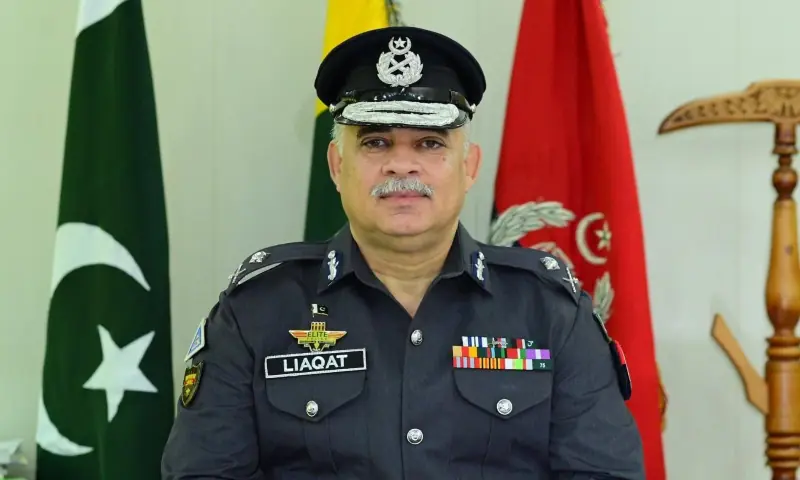

MUZAFFARABAD: The recent appointment of a “comparatively junior” Police Service of Pakistan (PSP) officer as inspector general of police (IGP) in Azad Jammu and Kashmir (AJK) has prompted six senior deputy inspectors general (DIGs) of the AJK police to formally raise concerns with Prime Minister Faisal Mumtaz Rathore, citing issues of seniority, merit and institutional morale.
Retired Captain Liaqat Ali Malik, a BPS-20 officer from the 33rd Common Training Programme (CTP), was transferred and posted by the Establishment Division on Sunday last against the top police slot under Clause VIII of the 1949 Karachi Agreement. He assumed his office on Tuesday and made a courtesy call on the prime minister on Thursday.
Clause VIII states that the “services of the officers loaned to the AJK government would informally be placed at the disposal of the AJK government, which would formally appoint them to office by notification in AJK’s Gazette.”
However, his posting drew criticism from top police officers, who claimed in a communication that they had “longer service records, higher academic credentials, and broader national and international exposure.”
“Elevation of a comparatively junior officer to the top position is a departure from established service norms and has caused unease within senior officers of the AJK Police. Such decisions can affect command dynamics and professional cohesion within the force,” read the communication, available with Dawn.
A senior AJK Police officer, speaking to Dawn on condition of anonymity, claimed that under the 1949 arrangement, the federal government was empowered to appoint IGPs in AJK at a time when suitably qualified local officers were not available.
However, he noted that in the late 1980s, direct recruitment of AJK Police officers as assistant superintendents of police (ASPs) through the AJK Public Service Commission (PSC) had begun. These officers underwent the CTP as well as the Specialised Training Programme alongside PAS and PSP officers recruited by the Federal Public Service Commission (FPSC), including those inducted from the armed forces.
Over the decades, AJK police officers had served both within the territory and on deputation to federal organisations such as the Federal Investigation Agency (FIA) and the Intelligence Bureau (IB), as well as in United Nations police missions. Several had risen to senior leadership ranks, including BPS-22, he said.
Official data showed that of the six AJK Police officers who were batchmates of Mr Malik from the 33rd CTP, one was serving as deputy inspector general (DIG) and five as senior superintendents of police.
In addition, of the five AJK Police officers from the 23rd CTP, one was serving as additional IGP in substantive BPS-21 and four as DIGs in time-scale BPS-21. Another four DIGs in the territory belonged to the 30th CTP.
In their meeting with Prime Minister Rathore on Wednesday, the six DIGs maintained that bypassing senior officers for the top slot had raised questions about merit, service fairness and institutional morale, and warranted reconsideration to safeguard professional standards and public confidence in the force.
They had also conveyed through different channels to the federal government that the appointment of Mr Malik as AJK’s police chief be reconsidered and a suitably senior PSP officer be posted to the position to uphold meritocracy, institutional credibility, morale and public confidence within both the AJK Police Service and the PSP cadre.
It was also learnt that these officers had been avoiding attending their office.
However, when contacted by Dawn, Chief Secretary Khushal Khan pointed out that, unlike the provincial police services, the seniority and cadre strength of the AJK Police Service were not determined in conjunction with the PSP.
“The provincial police services merge into PSP after promotion to BS-19, whereas AJK Police Service officers rise in their own hierarchy without any linkage with PSP officers,” he said.
“Moreover, the Common and Specialised Training imparted to AJK Police Service officers is aimed at capacity building and professional grooming. This training is not meant to determine seniority,” he added, expressing the hope that the AJK Police officers would resume the routine duties with the same diligence under the newly appointed IGP, whom he described as an “outstanding officer known for his impeccable service record.”
Published in Dawn, February 22nd, 2026