Amid the constant clamour of Circular Road, honking rickshaws, clanging workshops, the smell of frying parathas and engine oil, a tiny pocket of Lahore’s multi-layered, multi-faith past holds its ground.
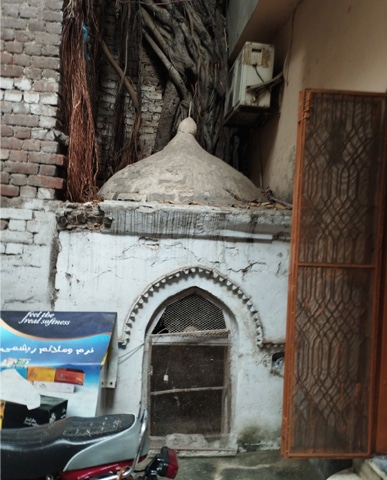
Just opposite Bhati Gate, down a narrow alley squeezed between brick houses and shops, stands a small domed structure almost swallowed by the city. Its low walls, cracked and patched with time, bear the weight of thick aerial roots cascading from a massive peepal [sacred fig] tree overhead.
To most passersby it registers as another piece of urban decay; to those who recognise its significance, it is a quiet testament to the Valmiki community’s enduring, if marginalised, presence in Lahore.
This site, often referred to locally as Takya Valmikian, serves as a modest spiritual and rest space tied to the Valmiki (Balmiki) tradition. Unlike the prominent Valmiki Mandir [temple] in Anarkali, widely regarded as one of Lahore’s oldest surviving Hindu sites, with roots possibly stretching back centuries, this Bhati Gate location served a humbler, more communal role.
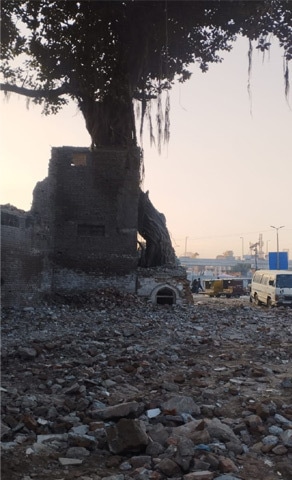
When demolition crews recently cleared the area around Lahore’s Bhati Gate, one small domed shrine survived — not because anyone intervened, but because a peepal tree’s roots had grown so deeply into its masonry that destroying one meant uprooting the other. The Takya Valmikian endures, for now…
Historical references to such takyas [community centres or smaller shrines] are sparse; brief mentions appear in compilations of Lahore’s lesser-known heritage. Oral accounts and fading community memory place it as a shelter point for travellers, sanitation workers and Valmiki families, who once lived and laboured around the city’s western gates.
A COMMUNITY CARVED FROM THE RIVER’S EDGE
Valmiki, in Hindu tradition, is the legendary poet-sage credited with composing the Ramayana, the ancient epic about Prince Rama — the avatar of the god Vishnu — and his wife Sita. Associated with forest hermitages and river settlements, he represents learning, moral awakening and spiritual discipline, Valmiki communities trace their identity to his legacy.
In Lahore, the community’s history is intertwined with the River Ravi’s banks, where traditions locate the sage-poet Valmiki himself. Before Partition, Valmikis were integral to municipal life, sweeping streets, cleaning drains, keeping the city habitable, yet their contributions rarely entered grand historical narratives. They built and maintained small temples, shrines and takyas that doubled as rest houses, community halls and places of worship.
While Anarkali’s Valmiki Mandir (also known locally as Neela Gumbad, which translates to blue dome) remains the central devotional site for the handful of Valmikis left in Lahore today — with around two dozen members gathering for prayers every Tuesday — peripheral takyas such as the one near Bhati Gate catered to everyday needs: shelter for migrant workers, space for gatherings and simple rituals.
The Bhati Gate site is now a silent relic — its bell unrung and its courtyard given over to the utilitarian needs of the neighbourhood.
WHERE STONE MEETS SACRED
In form, the structure matches classic descriptions of old Lahore takyas — small, domed chambers outside city gates, often with wells, courtyards and, sometimes, akhaarras [wrestling pits], as detailed in early accounts.
This includes descriptions in Syed Muhammad Latif’s Lahore: Its History, Architectural Remains and Antiquities (1892), which surveys the city’s gates and associated minor structures, including rest points for diverse communities. Similar peripheral sites are noted in compilations such as Old Lahore (early 20th-century observations reprinted in later editions), which describes the functional diversity of takyas beyond the walled city’s main monuments.
At the Bhati Gate takya, the single-room interior is intimate and worn: a low-vaulted ceiling shows exposed brick and fallen plaster; arched niches in the walls once likely held oil lamps or small sacred items. A metal bell hangs from a chain, its surface dulled. Light enters the room through small openings, illuminating dust motes and cobwebs that drape the space like forgotten veils. The most arresting feature is the tree; its roots, thick as arms, grip the dome and walls in an embrace that feels protective rather than destructive.
In South Asian sacred traditions, the peepal tree is revered as an embodiment of longevity and spiritual presence; here, the tree has literally become part of the architecture, holding crumbling brickwork together where mortar has failed.
Yet the site is far from preserved: the courtyard doubles as parking for motorcycles and storage for water cans, buckets and household items. A man washes at an outdoor tap, steps away from the shrine wall; laundry hangs nearby; plastic jerry cans and hoses snake across the ground near what may be an old, now-covered well.
SURVIVING THROUGH INERTIA
The takya at Bhati Gate is currently facing its most immediate threat. The area surrounding it was recently cleared and levelled, leaving a landscape of rubble. The shrine itself has survived by accident. The mechanical reach of the demolition crews was halted not by a preservation order, but by the peepal tree’s sheer physical defiance. Its aerial roots have woven so deeply into the masonry that the two are now one; to destroy the shrine would mean uprooting the massive tree, and so the dome remains, cradled in a wooden skeleton while the rest of the neighbourhood is swept away.
That the shrine survived at all is remarkable. But survival is not the same as safety. Even before the bulldozers arrived, a quieter erosion had been underway for decades.
Encroachment is not aggressive vandalism but the slow pressure of urban necessity, people living, working and surviving in tight quarters. Post-Partition migrations scattered many Valmiki families, leaving such minor sites without dedicated caretakers. Over the decades, they have faded into anonymity, surviving through inertia rather than active guardianship.
This neglect carries weight. The shrine challenges Lahore’s selective historical memory, one that celebrates forts, mosques and havelis [mansions], but overlooks spaces tied to working-class and minority communities. It is a reminder that the city’s pluralism once extended to these peripheral, everyday sacred places, where labour, faith and rest intertwined.
A MODEST PLEA
In an era of rapid infrastructure projects around the walled city, such sites face real risk, if not outright demolition, and then gradual erasure — in the name of modernisation and “clearance” of encroachments.
Preservation here need not mean reconstruction into a tourist spot. It could start modestly: official documentation by heritage authorities, a simple plaque acknowledging its Valmiki heritage and communal role, protection of the tree as an integral ecological-cultural element, and restraint from further informal building that threatens structural stability. The tree and shrine are intertwined; damaging one harms the other’s integrity.
Lahore grows by building on its roots, not burying them. As roots continue to cradle this small dome against collapse, the city must decide whether to extend the same quiet support to this memory, or let it slip away amid the dust and daily rush.
Recognising the Bhati Gate Valmiki shrine, in all its weathered humility, would affirm a more complete, inclusive story of the city, one where even the smallest spaces hold centuries of meaning.
Salman Tahir is Senior Project Manager at the Citizens Archive of Pakistan. He can be contacted at salmanhistorian@gmail.com
Tabish Arslan is an archaeologist and historian. He can be contacted at tabish.arslan@gmail.com
Published in Dawn, EOS, February 22nd, 2026