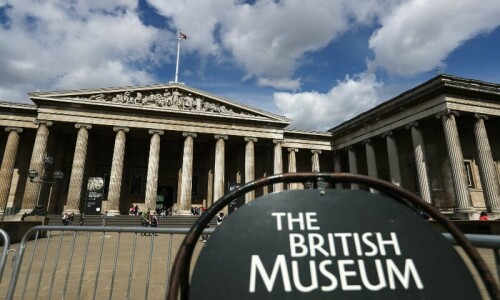
British Museum under fire after removing word ‘Palestine’ from some displays


 0
0

• Historian William Dalrymple criticises move, later says museum has not ‘cancelled’ the term wholesale
• Legal challenges instituted against campaign by UK Lawyers for Israel
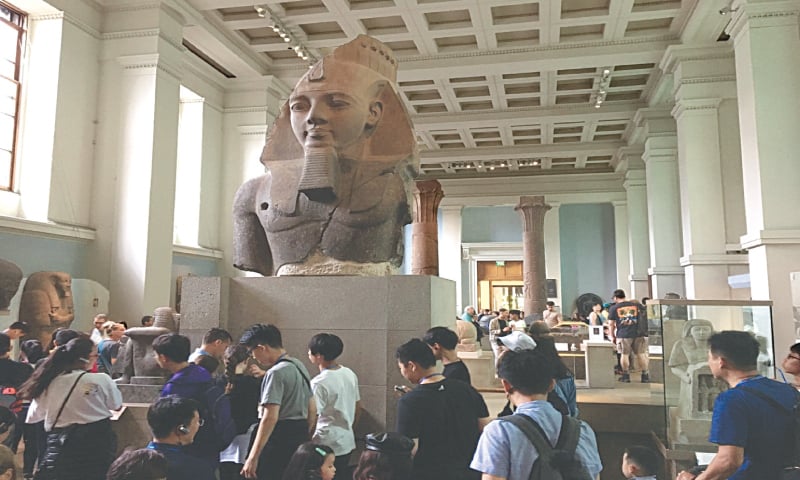
LONDON: The British Museum has removed the word ‘Palestine’ from some of its gallery displays, revising maps and information panels in its ancient Middle East collections on the grounds that the term was used inaccurately and is no longer historically neutral.
Reports in leading British papers, including The Guardian, said the changes affect displays in the museum’s ancient Levant and Egypt galleries, where parts of the eastern Mediterranean coast had previously been labelled as ‘Palestine’, and some individuals described as being of “Palestinian descent”.
At least one panel in the Egypt galleries was amended to replace “Palestinian descent” with “Canaanite descent”.
The revisions followed representations from UK Lawyers for Israel (LFI), a voluntary group of solicitors, which wrote to the museum’s director arguing that the retrospective application of the term ‘Palestine’ across thousands of years obscured historical change and erased the emergence of the kingdoms of Israel and Judah from around the first millennium BCE.
In its response, the museum said that while ‘Palestine’ had been widely used in Western and Middle Eastern scholarship since the late nineteenth century as a geographical designation, it no longer carried a neutral meaning and is now often understood as referring to a modern political territory.
The museum said it uses ‘Canaan’ for the southern Levant in the later second millennium BCE, UN terminology for modern political boundaries, and ‘Palestinian’ as a cultural or ethnographic identifier where appropriate.
The decision has prompted criticism from historians and members of the public, with more than 5,000 people signing a petition calling for the museum to reverse the changes and arguing that they contribute to the erasure of Palestinian presence from public memory.
The Guardian also noted that while several displays have been updated, the museum claims these changes were made last year after feedback and audience research. Historian and author William Dalrymple criticised the move, calling it ridiculous to remove the word ‘Palestine’, when it has a greater antiquity than the word ‘British’.
“The first reference to Palestine is on the Egyptian monument of Medinet Habu in 1186 BCE. The first reference to Britain is the 4th century BC when it appears in the work of the Greek traveller Pytheas of Massalia,” he wrote on X. In a subsequent post, Dalrymple said that after speaking with the museum’s director, Nicholas Cullinan, he had learned that reports about the museum cancelling the name ‘Palestine’ altogether were inaccurate.
Quoting Cullinan, Dalrymple wrote: “To reassure you we are not removing mention of Palestine from our labels. Indeed, we have a display on at the moment about Palestine and Gaza.”
According to the historian, the director of the British Museum had said that only two panels in the ancient Levant gallery were amended last year during a routine gallery refresh, and that the director had not been aware of the issue until it became public. Cullinan was quoted as saying he had not seen the letter from UK Lawyers for Israel until recently and was “disgusted by the whole thing”.
Criticism
Academics who spoke to Middle East Eye defended the historical validity of the term. Marchella Ward, a lecturer in classical studies at the Open University, said “ancient Palestine” was a legitimate scholarly descriptor. “I use the term ‘ancient Palestine’ frequently in my own research and will continue to do so,” she said, adding that claims the term is illegitimate are aimed at “the erasure of Palestinians”.
The campaign group Energy Embargo for Palestine accused the museum of hypocrisy, saying it claims to objectively communicate history while “preparing itself to rewrite history, to erase Palestine, and its millions of people, out of the history books”.
Critics also argue that the museum’s decision fits into what they describe as a broader pattern of pressure exerted by UKLFI on public bodies.
According to the European Legal Support Centre (ELSC), a forthcoming database documents hundreds of incidents of alleged anti-Palestinian repression in the UK between 2019 and 2025, with UKLFI appearing in a significant number of cases.
Giovanni Fassina, executive director at ELSC told Middle East Eye that the targeting of the British Museum was part of a “very clear pattern” of letters threatening legal action or alleging breaches of UK law.
ELSC and the Public Interest Law Centre have submitted a complaint to the Solicitors Regulation Authority over UKLFI’s alleged use of strategic lawsuits against public participation (SLAPPs).
The UK Charity Commission has also confirmed it is investigating the group’s charitable wing following complaints by advocacy organisations.
UKLFI had argued in its letter that describing ancient civilisations as Palestinian creates “a false impression of continuity”.
Published in Dawn, February 17th, 2026