Elections in Bangladesh are seldom calm civic exercises. More often, they resemble winner-takes-all contests in which the victor claims the spoils while the defeated braces for reprisal.
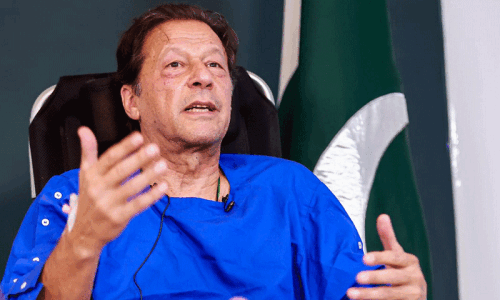
Our political history has long been trapped in a cycle of retribution between our two dominant dynastic forces, deepening divisions and weakening institutions. In the aftermath of a landslide victory that swept the Bangladesh Nationalist Party (BNP) back to power after 20 years, Tarique Rahman, party chairman and prime minister-in-waiting, has struck a note that is both welcome and urgent: unity over vengeance.
Speaking to the press in Dhaka, Rahman called for a “safe and humane Bangladesh.” His first address since BNP secured a two-thirds majority in the Feb 12 election avoided the triumphalism that so often curdles into retaliation. Instead, he congratulated all 51 parties that took part in the polls, from Jamaat-e-Islami to the Gono Odhikar Parishad, and urged his supporters to ensure that election-time tensions do not metastasise into “revenge or retaliation.”
The tone was deliberate and clearly aimed at resetting expectations in a country weary of political score-settling. Bangladesh emerges from years marked by the authoritarian excesses of the Awami League era. Rahman is inheriting a fragile economy and institutions weakened by partisanship.
Tarique Rahman’s call for ending politics of vengeance welcomed
In such an environment, the temptation towards tit-for-tat politics would be understandable. Rahman’s explicit warning against allowing disputes to slide into “revenge or retaliation” is therefore more than mere rhetoric, or so it seems. By declaring that “division is our weakness,” he may interrupt a destructive pattern in which state machinery has too often been wielded as a partisan weapon. We hope he means it.
In the same address, Rahman outlined three central priorities: reviving the economy, restoring law and order, and depoliticising state institutions. Each presents a formidable challenge. He inherits an economy strained by structural weaknesses —persistent inflation, sluggish investment, and a banking sector crippled by chronic loan defaults.
Re-establishing order will require curbing the recurring outbreaks of mob violence that accompany political transitions. Most difficult of all will be repairing institutions hollowed out by years of politicisation. Winning a landslide is easier than rebuilding a battered state.
Restoring the rule of law will be the true test. A credible commitment demands a judiciary independent enough to prosecute wrongdoing without becoming an instrument of political harassment. If the promise of depoliticisation is to mean anything, it must be visible in how power is exercised, not merely in how it is described. By framing unity as a “collective strength” and division as a national weakness, Rahman has set a new benchmark for his party. Words, however, are only the beginning. If he can impose the discipline he now demands and translate his party’s 31-point programme from aspiration into policy, he may fulfil the promise of this moment. Bangladesh has heard calls for unity before; what it needs now is proof.
Published in Dawn, February 16th, 2026