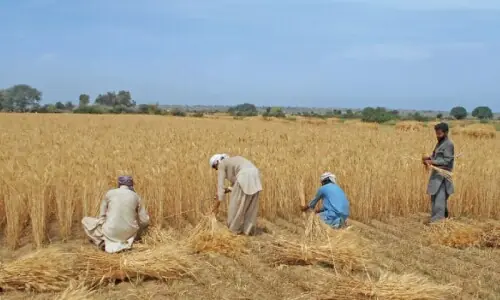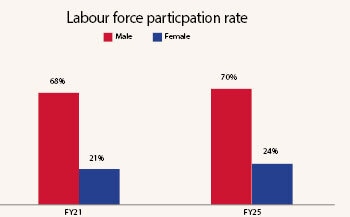
The world has changed dramatically over the past few years: a pandemic, the Russia-Ukraine war, Pakistan’s brush with default, climate shocks that displaced millions, and the arrival of ChatGPT. What has not changed in any meaningful way is Pakistan’s labour force participation. Men continue to dominate the workforce, even though women make up over 60 per cent of agricultural workers, but are largely confined to low-paid tasks such as weeding and picking.
Nearly one in three girls in Pakistan is married before the age of 18, according to the United Nations Population Fund, even though education, not marriage, can fundamentally alter life trajectories. At the recent International Women Leaders Summit, Unicef’s Representative in Pakistan, Pernille Ironside, shared the story of a girl who used a wheelchair. Completing the 8th grade enabled her to find online work and earn enough to support her family.
Kainat Ansari from The Citizens Foundation is another striking example. Raised in Orangi’s slums, she has been accepted to Harvard. Anum Fatima, also a TCF alumna, reached the same milestone though nearly a decade earlier. These stories are exceptions rather than the norm, underscoring both how rare such outcomes remain and what becomes possible when girls are given sustained opportunity.
Gallup Pakistan’s analysis of the Labour Force Survey 2024–25 shows that women’s work continues to be shaped by domestic responsibilities, restricted mobility, safety concerns, and entrenched social norms. Even when opportunities exist, women are clustered in low-paid, informal roles, such as home-based work, agricultural labour, and unpaid family contributions.
The scale of this exclusion means Pakistan’s economy is operating far below its potential. A 2023 International Growth Centre blog estimated that achieving parity in labour force participation could raise GDP by 60pc. However, not only has the needle barely moved, Pakistan has also fallen to the bottom of the World Economic Forum’s Global Gender Gap Index, indicating that improvement in gender parity numbers are superficial at best.
Published in Dawn, The Business and Finance Weekly, February 9th, 2026