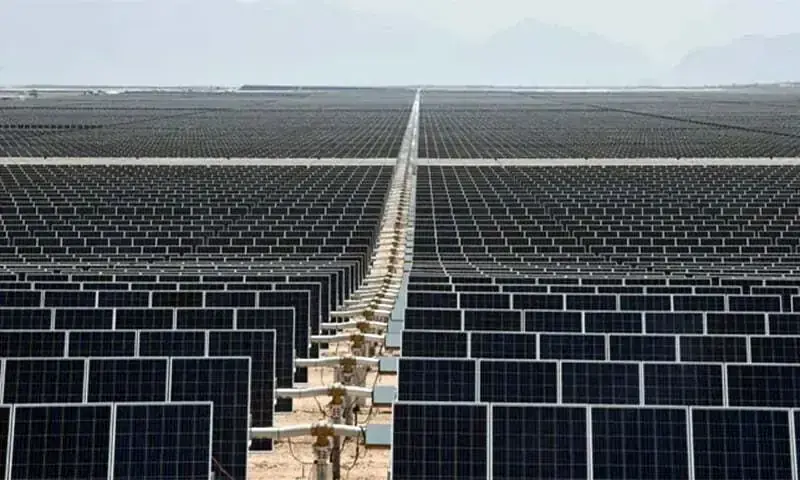

Pakistan has been experiencing an energy transition driven by a bottom-up solar revolution that is challenging the viability of the state-owned grid.
About 33 gigawatts of solar capacity have already been installed, as reported in the TransitionZero and Policy Research Institute for Equitable Development (PRIED) study, including 19 gigawatts from non-net-metered systems and 8.31 gigawatts from off-grid systems. This solar capacity transcends FY24’s peak grid demand. These figures also suggest that while net-metered solar has grown, the real transition is behind the metre, led by households, farmers, and small businesses.
The recent surge in solar energy reflects an economic shift, with people becoming prosumers (customers actively involved in managing their electrical input) and competing with state-owned electricity providers; a demonstration of energy democracy. It is rising costs and unreliable services that are driving this transition, allowing prosumers to escape the traditional power grid.
Net metering, once a key to solar growth, must evolve to fairly share system costs, maintain grid stability, and safeguard power distribution companies (Discos) finances. The challenge is no longer expansion but integration: how can Pakistan use solar without straining utilities or overburdening non-solar consumers?
The recent policy change could relieve grid stress and protect non-solar consumers from rising costs
The traditional grid, initially designed for a one-way energy flow, is now facing challenges from two-way flows caused by the increasing adoption of solar energy.
Net metering allowed prosumers to use the grid as a storage system without paying extra fees, exporting excess power onto the grid at noon and withdrawing it at night, creating a duck curve and high stranded costs.
The tariff design covers fixed infrastructure and capacity costs. As more people use solar energy, Discos’ sales decline, but the costs of maintaining the electricity grid and existing capacity remain the same. It means that fewer non-solar customers, often low-income, will pay these fixed costs. It creates a problem called the “utility death spiral”. When rates rise, more people leave the grid, which raises rates for the remaining customers.
The government says that non-solar consumers face a burden of Rs159 billion due to net-metered capacity. It could exceed Rs500bn in a decade if there are no reforms to the billing system. This structural imbalance led the National Electricity Regulatory Authority to introduce the Prosumers Regulation 2025: a shift from net metering to net billing.
Under the proposed net billing system, prosumers would be paying about Rs9 per unit for exported energy, while buying grid electricity at rates over Rs40 per unit.
The arguments against this policy change are that this devaluation will slow solar market growth, extending payback periods from two to five years. These concerns are valid as sudden policy changes can weaken investor confidence. Yet the current system, in which the power grid subsidises competitors, is also unsustainable. If Discos continue losing demand, it will become unmanageable.
But merely revising net metering regulations will not solve the sector’s challenges; high electricity prices, which push consumers toward solar energy, stem from structural issues such as operational inefficiencies, inflated capacity payments under long-term contracts, ballooning circular debt, and poor governance. Until these issues are resolved, consumers will continue to seek off-grid solutions.
Discos must reduce technical and non-technical losses, modernise metering and billing systems by adopting advanced metering infrastructure, optimise power procurement, develop grid-level battery energy storage systems (BESS), and be held accountable through a robust governance mechanism.
Currently, we are trying to manage a 21st-century decentralised energy system with 20th-century tools. Our interconnection policy relies on static assumptions, rejecting PV grid connection requests when a transformer reaches 80 per cent of its rated capacity. While this provides a simple safeguard, it does not fully reflect the operational flexibility of a modern power grid, which should use “Dynamic Hosting Capacity” analysis to utilise real-time data to assess safe power limits, freeing up significant resources and enabling the grid to accommodate more solar energy while maintaining stability.
The recent policy change could relieve grid stress and protect non-solar consumers from rising costs. While net metering limits may slow exports, falling battery prices can drive a storage boom, potentially encouraging off-grid adoption and microgrids, and accelerating grid defection. Simultaneously, lower solar demand could reduce panel prices, further expanding access.
But, by combining solar energy systems with BESS and trading platforms, private investment in clean energy can be redirected and its benefits shared with non-solar consumers; the role of the centralised grid will remain. Technology has transformed prosumers from passive consumers into active market participants. They are adopting energy storage for backup and cost savings.
To succeed, we need a market for ancillary services. Batteries can quickly adjust energy frequency and provide voltage support, but current regulations do not fund these services. If a government wants to lower energy export costs, it should create new revenue streams to support grid flexibility.
Afia Malik is an economist/ researcher with expertise in the energy sector, based in Islamabad; Toqueer Ahmed Jumani is Assistant Professor at A’Sharqiyah University, Ibra, Oman; and Shafqat Hussain Memon is an academic researcher in Energy based in Jamshoro.
Published in Dawn, The Business and Finance Weekly, February 9th, 2026