LHC seeks law on woman’s marriage status after conversion
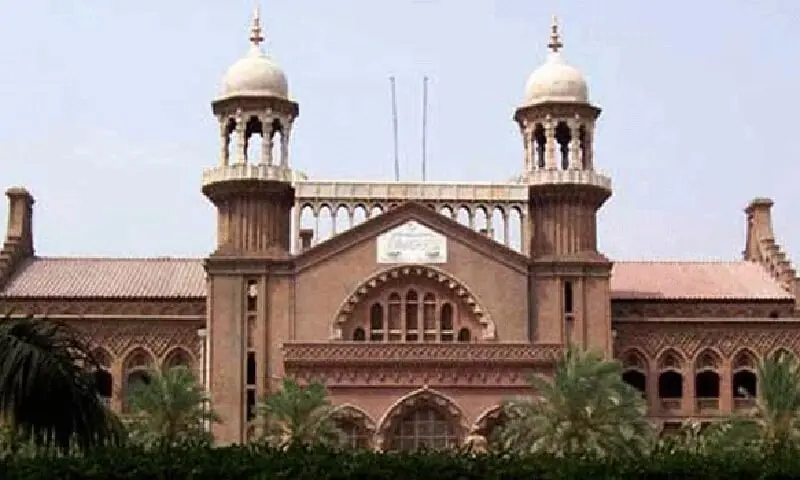

LAHORE: The Lahore High Court (LHC) has urged the legislature to enact a clear law governing the dissolution of marriage when a non-Muslim woman embraces Islam, observing that the absence of such legislation for over three decades has created legal uncertainty and hardship.
In his recent judgment, Justice Tariq Saleem Sheikh referred to the Safia Bibi case of 1997, noting that the Constitution, under its principles of policy, protects the institution of marriage and the family.
He pointed out that Article 35 obligates the state to safeguard marriage, the family, the mother and the child, while Article 36 requires protection of the legitimate rights and interests of minorities.
Building on these constitutional provisions, he said, the LHC in the 1997 decision held that there is a clear constitutional mandate for the legislature to prescribe a procedure for the dissolution of marriage in cases where a non-Muslim woman converts to Islam.
The judge regretted that no such law had been enacted despite the passage of more than 30 years, describing the situation as a legal vacuum.
Verdict issued on Christian woman’s plea against police harassment after marrying Muslim man, conversion
The judge noted that this absence of legislation leads to uncertainty, exposes women to potential criminal liability, and creates confusion for law enforcement agencies and subordinate courts.
While such disputes primarily concern marital status, the judge observed that they can also give rise to related issues such as the legitimacy, custody and lineage (nasab) of children.
Although these concerns did not arise in the case at hand, Justice Sheikh cautioned that they may surface in future cases, particularly where children are born from either a prior or subsequent marriage.
The judge urged the legislature, in consultation with the Council of Islamic Ideology, to consider enacting a uniform statutory framework to regulate the dissolution of marriage upon conversion. He said any such law must carefully balance religious integrity, the constitutional right to religious freedom under Article 20 and the protection of family life guaranteed by Article 35.
The judgement has been issued on a petition of a Christian woman, who approached the court against police harassment following her marriage to a Muslim man after embracing Islam.
In 1999, Kiran Masih and Amir Bhatti, both Christians, married and thereafter lived together as husband and wife and raised a family.
In 2024, the husband pronounced divorce, but the wife subsequently came to know that, under Christian Law, a valid dissolution requires a judicial decree. Therefore, she instituted a petition under sections 7 and 10 of the Divorce Act, 1869, before the civil court, seeking dissolution of marriage on the grounds of cruelty and mental incompatibility.
Her petition was dismissed for non-deposit of the requisite process fee.
Later, she embraced Islam and adopted the name Noor Fatima. She entered into marriage with a Muslim man.
The Christian husband claimed that his marriage with the woman still subsists despite her conversion to Islam. He argued that the petitioner could not remarry without obtaining a decree of divorce from the court.
Justice Sheikh observed that these are disputed questions of fact which cannot be determined in these proceedings before the LHC, particularly in the absence of the Muslim husband, who is not a party to the case.
“Any determination of the validity of that marriage or potential criminal liability would require an appropriate adjudication before a competent forum after affording all concerned persons a fair opportunity of hearing,” the judge held.
The judge disposed of the petition as the police assured the court that the petitioner woman would be dealt with in accordance with the law.
Published in Dawn, February 6th, 2026