Israeli strikes kill three children, 18 others in Gaza


 0
0

• Donors hesitate to fund ‘New Gaza’ project until disarmament, aid management deal
• Officials in Gaza warn of a ‘severe shortage’ of medicines
• Hamas says open to discuss disarmament but no proposal received
GAZA CITY: Israeli strikes killed at least 21 people in the Gaza Strip on Wednesday, as the Israeli military continues to violate a US-brokered truce that entered its second phase last month, according to Palestinian health officials.
The latest strikes occurred days after Israel partially reopened the Rafah crossing between Gaza and Egypt. The crossing serves as the primary gateway for Palestinians to the outside world that does not pass through Israeli territory.
Gaza’s health ministry, which operates under Hamas authority, said 21 people were killed and 38 others were wounded in the series of strikes. Medical officials noted that three children were among the dead.
Aid shortage
The casualties were distributed across several facilities. Three bodies were brought to Nasser Hospital following strikes on homes and tents for displaced persons in southern Khan Yunis, while 14 more bodies were transported to Al Shifa Hospital in Gaza City.
“We also received dozens of wounded. The situation is extremely difficult in the hospitals of Gaza Strip due to the severe shortage of medicines and medical supplies,” said Abu Salmiya, an official at Al Shifa Hospital.
The humanitarian crisis remains acute as Israel continues to scrutinise all aid entering the besieged coastal enclave. The current ceasefire originally took effect Oct 10 of last year, following two years of instability and conflict that intensified in October 2023.
Under reported pressure from the United States, Israel recently allowed the Rafah crossing to open, though passage is currently limited to patients and their companions.
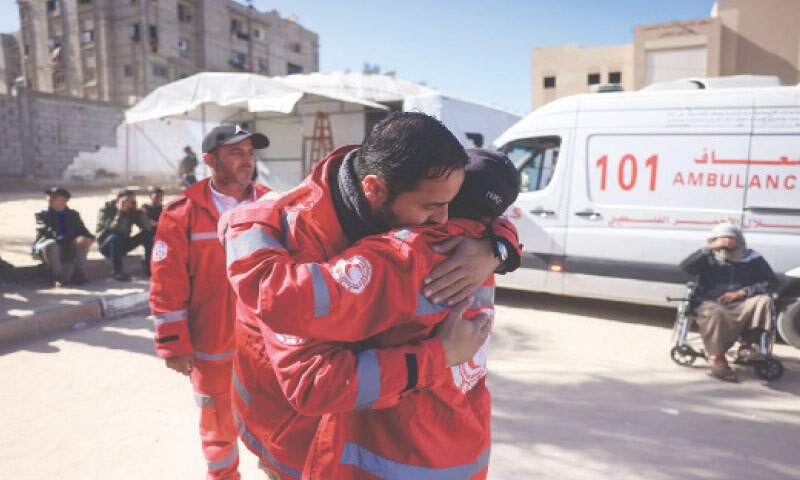
Since Monday, sick and wounded Palestinians have been moving into Egypt for treatment. On Tuesday alone, 45 people crossed into Egypt, while 42 entered the territory, according to the Palestinian Red Crescent Society.
Funding issues
On the diplomatic front, the US has yet to secure funding for its ambitious Gaza reconstruction plan. Potential donors are reportedly hesitant to commit funds, citing concerns that disagreements over Hamas’ disarmament could lead Israel to resume “full-scale war.”
Under the plan proposed by the Trump administration, Hamas is required to lay down its weapons. The proposal calls for a staged Israeli withdrawal as the group disarms, with reconstruction overseen by a “Board of Peace” chaired by the US president.
Sources close to the Board said international contributors are wary of Jared Kushner’s $100 billion “New Gaza” vision, which was unveiled in Davos on Jan 22.
“Countries want to see the funding will go for reconstruction within demilitarised places, and not to throw the money into another war zone,” one source said.
Diplomats noted that many European and Arab states prefer for funds to be managed by the United Nations rather than the US-led “Board of Peace”. European officials cited domestic fiscal constraints and the lack of a broader political solution as barriers to entry.
No date has been set for a formal funding conference in Washington. However, Kushner said in Davos that an event would be held in Washington in the coming weeks “where we’ll announce a lot of the contributions that will be made … from the private sector”.
Hamas ready to discuss disarmament
Hamas has agreed to discuss disarmament with other Palestinian factions, but neither Washington nor regional mediators had presented the group with any detailed or concrete disarmament proposal, two Hamas officials said.
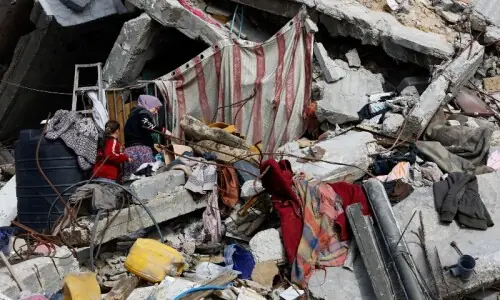
One of the sources with knowledge of the Board’s planning said it would be difficult to secure private sector financing without at least some progress toward disarmament. In the interim, Gaza remains in ruins, with officials estimating that 68 tonnes of rubble must be cleared before the vision of “New Gaza” can begin.
Published in Dawn, February 5th, 2026