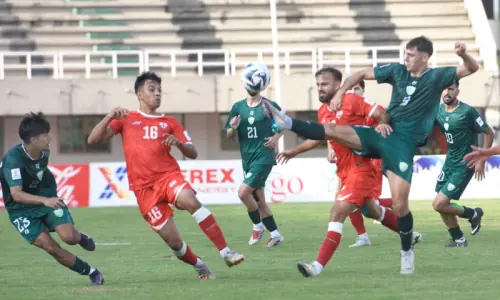
KARACHI: The National Challenge Cup kicks off here on Wednesday, marking a return to domestic activity that Pakistan national head coach Nolberto Solano describes as a “gradual growing process” for a sport long starved of consistent structure.
The tournament, which features 12 teams divided into four groups, will run until Feb 15 at Karachi’s KPT and KMC stadiums.
While the event is framed as a “milestone” by the Pakistan Football Federation (PFF), it arrives at a time when the federation is navigating a complex transition between reviving the traditional departmental model and modernising for international standards.
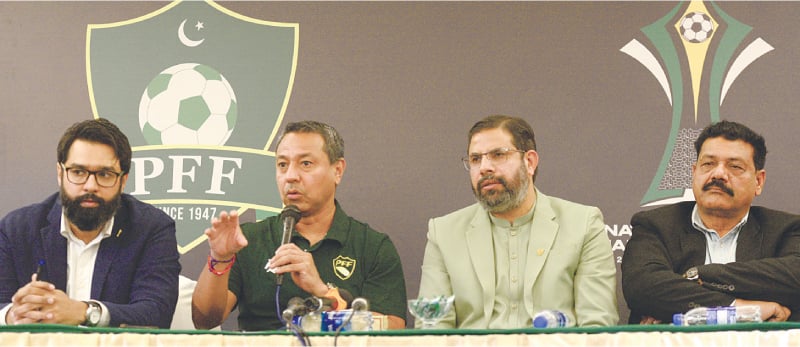
Speaking exclusively to Dawn after a press briefing here at a local hotel on Tuesday, Solano was candid about the “realistic” hurdles facing homegrown talent.
“There are a lot of issues that needed to be fixed,” the former Newcastle United winger admitted. “So what we try to do is help the homegrown talent. It’s a gradual growing process which needs time and patience.”
Solano pointed to the reliance on diaspora players — those of Pakistani heritage playing in European circuits — as a vital bridge for the national team.
“That’s why the diaspora players are very important. Playing with them helps the young talent grow. To play at a high level, you need that support,” he remarked, noting that international leagues provide a level of professionalism that the local circuit currently lacks.
Recalling his own development in Peru, where he joined a club at age 10, Solano lamented the “slow growth” for players in Pakistan due to a lack of opportunities.
“But that’s why we are here, to help the boys and the federation have the same ambition,” he said.
Scouting for Myanmar With an eye on the AFC Asian Cup qualifier against Myanmar on March 31, Solano has mandated a youth first policy. All participating teams are required to include at least three U-20 players in their starting lineups and six in the squad.
“We want the mixture of young and experienced guys on the field,” Solano told reporters. “Hopefully we can scout some good young talent for the upcoming tournament.”
Waseem Raja, Deputy Chairman of the PFF Competition Committee and Executive Member from Sindh, described the tournament’s return to Karachi as a vital development for the sport’s health.
“The revival of domestic events will provide a platform for talented footballers from across the country to showcase their skills,” Wasim told Dawn. He noted that the PFF, under the leadership of president Syed Mohsen Gilani, is focused on ensuring domestic activities become a permanent fixture of the calendar.
Wasim further revealed that the Competition Committee is currently planning new formats for the future, which include the formal registration of new departments and the restoration of those previously disbanded.
“Our goal is to strengthen the structure of Pakistan football and maximise opportunities for our athletes,” he added.
ROAD TO FINAL
The 12-team field is distributed across four groups of three. Group A features Navy, Air Force and Mamsons, while defending champions Wapda headline Group B alongside KRL and Hazara Coal Company.
Group C consists of Army, Railways and International Supply Company, while SA Gardens, PACA and Nimso round out Group D.
PFF vice-president Hafiz Zakaullah defended the focus on departments, citing the financial security they provide to players.
“The local players financially rely on the departments; it gives them a safety net,” Zakaullah said.
This stance comes even as newly appointed Media Director Umaid Wasim confirmed that proposals for a franchise-based Pakistan Premier League are still under “discussion” following a call for expressions of interest.
Beyond the pitch, the PFF is struggling with internal completion.
Zakaullah noted that “hurdles” had delayed the completion of the PFF Congress in December, specifically citing pending elections in Khyber Pakhtunkhwa.
“We are trying our best to get it done so KP can get their deserved right of representation,” he added.
As host Sindh Football Association president Azam Khan pledged to promote a “positive image” through the tournament, the opening day serves as a test of whether this departmental revival can satisfy both the players’ economic needs and Solano’s demand for a “professional future.”
Published in Dawn, February 4th, 2026