Syrian security forces enter Hasakeh under agreement with Kurds


 0
0
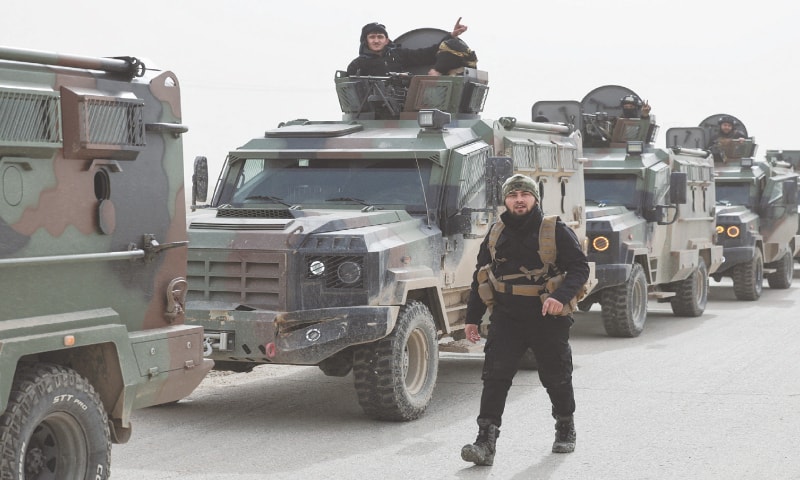

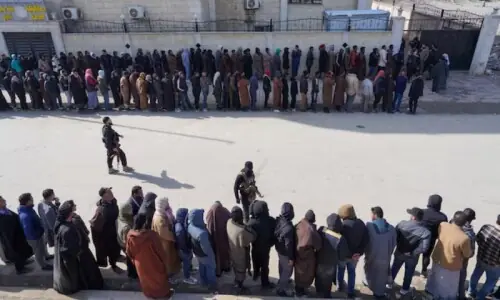
HASAKEH: Syrian government security personnel on Monday entered Hasakeh city, a stronghold of Kurdish forces, under an integration deal agreed with the Kurds last week.
The two sides reached a comprehensive agreement on Friday to gradually integrate the Kurds’ military and civilian institutions into the state, after Kurdish forces ceded territory to advancing government troops in recent weeks following months of tensions and sporadic clashes.
The government’s push to extend its authority across the entire country comes as a blow to the Kurds, who had sought to preserve their de facto autonomy in parts of the north and northeast that they seized while battling the militant Islamic State group during Syria’s civil war.
Turkish President Recep Tayyip Erdogan, whose country is a key backer of the Syrian government and has long been hostile to Kurdish forces in Syria, warned on Monday that anyone who attempted to “sabotage” the deal between Damascus and the Kurds would be “crushed”.
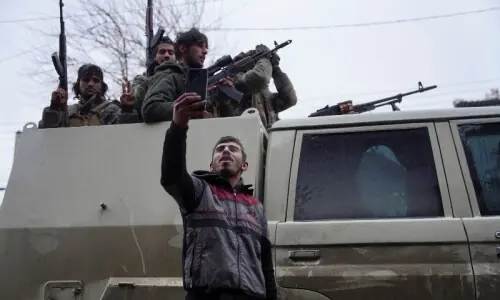
Correspondents saw a convoy of government vehicles cross a Kurdish forces checkpoint on its way into Hakaseh in the northeast, as armed Kurdish personnel stood at the roadside.
Some residents gathered along the road to welcome the government forces, waving Syrian flags as women ululated.
Marwan al-Ali, the government’s recently appointed head of internal security in Hasakeh province, urged the state forces to carry out their tasks “according to the established plans and fully comply with laws and regulations”.
Kurdish security forces deployed inside Hasakeh as government forces entered the mixed Kurdish-Arab city, which was under a curfew until 6pm.
Mazloum Abdi, head of the Kurdish-led Syrian Democratic Forces (SDF), had previously said the deal would be implemented on the ground from Monday, with both sides to pull forces back from frontline positions in parts of the northeast, and from the town of Kobane in the north.
Later on Monday, state media reported that government security personnel entered the countryside around Kobane, more than 200 kilometres (125 miles) from Hasakeh.
Hemmed in by the Turkish border and Syrian government forces, the town has long been seen as a symbol of Kurdish fighters’ victory against IS jihadists.
Syrian state television said a United Nations aid convoy of 20 trucks had reached Kobane on Monday.
Airport, oil fields
Abdi also said a “limited internal security force” would enter parts of Hasakeh and Qamishli, but that “no military forces will enter any Kurdish city or town”.
A curfew is set to be put in place for the city of Qamishli on Tuesday. Friday’s deal “seeks to unify Syrian territory”, including Kurdish areas, while also maintaining an ongoing ceasefire and introducing the “gradual integration” of Kurdish forces and administrative institutions, according to the text of the agreement.
It also appeared to include some Kurdish demands, such as establishing brigades of fighters from the SDF. Erdogan on Monday said the agreement marked “a new chapter” for Syria, adding that he hoped it would be “sustained through peace, stability, development, and prosperity”.
“We hope that the agreement will be implemented in a manner consistent with its spirit, without resorting to cheap calculations such as obstruction, stalling, or foot-dragging,” he said, adding that whoever attempted to “sabotage” the deal would be “crushed”.
The United States, which led a military coalition that backed the Kurds’ campaign against IS, has drawn close to Syria’s new Islamist authorities, recently saying the purpose of its alliance with the Kurdish forces was largely over.
Syrian Information Minister Hamza Mustafa has said the integration deal also includes the handover of oil fields, the Qamishli airport and border crossings to the government within 10 days.
Published in Dawn, February 3rd, 2026