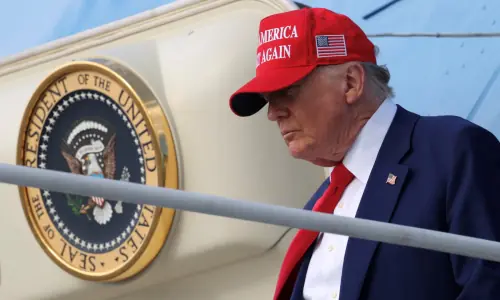
ISLAMABAD:Pakistan must pursue a carefully calibrated and flexible foreign policy to protect its interests in a rapidly fragmenting and increasingly competitive global environment, as the United States’ National Security Strategy 2025 underscores a realist and transactional drive to sustain American primacy, speakers said at a roundtable organised by the Center for International Strategic Studies.
According to a statement issued by the Islamabad-based think-tank on Monday, the discussion brought together senior diplomats and academics to review the priorities and implications of the US National Security Strategy 2025 under President Donald Trump.
Participants observed that the strategy marked a clear departure from values based multilateral engagement, instead emphasising competitive statecraft, a shift with significant implications for regional stability and Pakistan’s foreign policy decision-making.
In his opening remarks, Amb Ali Sarwar Naqvi, executive director CISS, said the strategy had emerged amid an already complex strategic setting shaped by intensifying US-China rivalry, growing militarization in the Asia-Pacific and changing alliance patterns, developments that directly influence South Asian stability, deterrence dynamics and Pakistan’s diplomatic choices.
He added that the focus on technological supremacy, economic leverage and security partnerships highlighted the necessity for middle powers, including Pakistan, to respond with nuanced and well considered policies in an increasingly divided international system.
Former ambassador to the United States Masood Khan said US strategic priorities continued to influence regional alignments, noting that China does not perceive Pakistan as a strategic challenge, reflecting the continuity of their long-standing partnership.
Dr Nouman Sattar of Quaid-i-Azam University said the NSS 2025 encapsulates President Trump’s worldview, grounded in realist thinking and aimed at restoring US preeminence while limiting the drift toward multipolarity. He noted that the strategy places national interest and competition above values led internationalism.
Commenting on the evolving geopolitical landscape, Dr Qamar Cheema said Washington was reviewing certain aspects of its ties with India, however India would remain central to US strategic calculations despite any near-term adjustments.
Wrapping up the discussion, CISS Director Research Dr Bilal Zubair said a major US strategic retrenchment appeared unlikely, with Trump expected to maintain American dominance through a transactional, business-oriented foreign policy focused on tangible returns.
Published in Dawn, January 27th, 2026