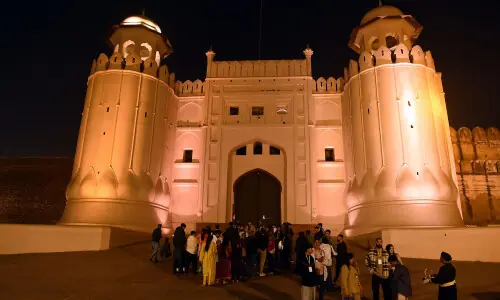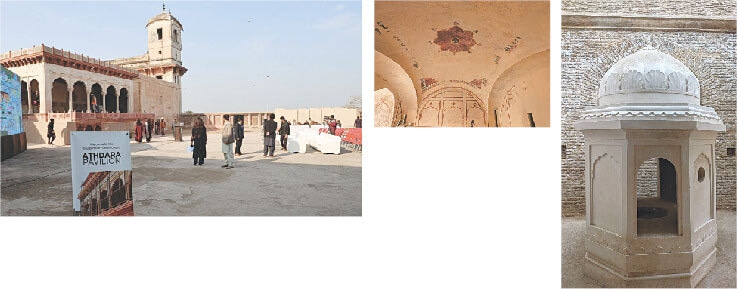
LAHORE: Three monuments–the Sikh-era Hammam, Athdara Pavilion and Loh Temple–were unveiled at the Lahore Fort on Sunday. The ceremony marked the completion of conservation efforts led by Aga Khan Cultural Service-Pakistan, in collaboration with the Walled City of Lahore Authority (WCLA).
The extensive restoration was undertaken as a part of the project titled, “Preservation and Promotion of Cross-Culture Edifices of Lahore Fort,” funded by the US Ambassadors Fund for Cultural Preservation (AFCP). Last year, two other historic structures were conserved under the same initiative, including the Sikh-era temple and the Imperial Zenana Mosque. These sites are included in a wider conservation initiative covering seven key monuments within Lahore Fort.
According to the officials, the initiative aims to celebrate the fort’s rich cross-cultural heritage, reflected in its Sikh and Hindu temples, Mughal mosques and structures from the British period. The fort is further distinguished by artwork bearing symbols of multiple faiths, all existing in close proximity.
The Loh Temple comprises a cluster of interconnected chambers located within the Lahore Fort, near the Alamgiri Gate. Its principal chamber, commonly known as the Temple of Loh, is an open-to-sky space housing a memorial shrine. Edifices revealed in the newly-exposed chambers after the removal of cultural fill are indicative of Hindu and Sikh rituals.
The Athdara Pavilion, located in the northwest precinct of Lahore Fort, within the Shah Jahan Forecourt Quadrangle, is believed to have been constructed during the Sikh period, where it functioned as a public court.
The Sikh Hammam, located at the northeast of the Sheesh Mahal Quadrangle, was, according to historical records, built during Emperor Shah Jahan’s reign and was later converted into a Hammam during the Sikh era.
Punjab Minister for Minorities Affairs Sardar Ramesh Singh Arora attended the event as chief guest which brought together a diverse group of people from the academia, government and the creative industry.
Held at the Shah Burj Forecourt, the event began with the opening remarks of CEO of Aga Khan Cultural Service–Pakistan, Tausif Khawaja.
Pointing towards the Athdara Pavilion behind him, he said, “Raja Ranjit Singh held his court here. and there are paintings which depict that. The small monuments that have been conserved through this important initiative have great potential; they display cross-cultural harmony.”
Referring to the intricate historical artwork of the Sikh Hammam situated right behind the pavilion he shared, ‘Some of the best frescoes at the fort can be seen in the Hammam’, with delicate and colourful patterns.’
Speaking on the occasion, Public Affairs Officer at the US Consulate Lahore, Sandeep Paul, described the completion of the sites as a step forward in the long-term commitment of the US towards the conservation of historic monuments.
“This milestone does not just indicate a significant technical achievement but also the value of focused, responsible cooperation. The US approaches cultural preservation with a clear principle in mind: engagement should deliver real results, uphold accountability, and respect the heritage and expertise of our partners. This project exemplifies that approach,” he said.
WCLA Director General Najamus Saqib reflected on the cultural significance of historic sites and the importance of their conservation.
“The Lahore Fort’s historical timeline covers the Pre-Mughal era and the British era. We as a team are trying to preserve historic footprints of different eras with every era reflecting its distinct style. Emperors such as Shah Jehan, Akbar and Jehangir all had their own aesthetic. We, as a team, are trying to preserve all the historic footprints. It is very important to respect our heritage and we have to preserve it and conserve it for the coming generations,” he said.
The extensive techniques employed as a part of the conservation process was also highlighted at the event through a presentation shared by AKCS-P Director of Conservation and Design Wajahat Ali. He shed light on the site’s initial condition, prevailing issues, and implemented mitigation strategies.
Published in Dawn, January 26th, 2026