MY mother drove a hard bargain. She did so by disarming her opponent — usually a shopkeeper hellbent on his prices. She worked on making a connection with the person. I watched her do this across markets wherever we lived, sometimes using sign language to bargain or sharing a joke that led to prices coming down.
We both preferred markets over malls, not that we had malls when she died in 1996. Our favourite was Bohri Bazaar but we also went to Gul Plaza for household items because back then, we went to Saddar for everything. Gul Plaza’s main attraction then was the crockery but you could also get random kitsch items, things you don’t need. Think Temu finds but in a shop format.
Everything has shifted to this side of the bridge but I returned to Gul Plaza when I was teaching at IBA because of the proximity. You could still buy almost everything household-related, but it had grown to house things like luggage, even puzzles. There was one particular shop that sold vintage Corning Ware (a brand of bakeware) and I was always on the fence about buying them, worried about the lead in the painted designs. The shopkeeper was well-versed in how glass ceramics worked, how heat-resistant the dishes were.
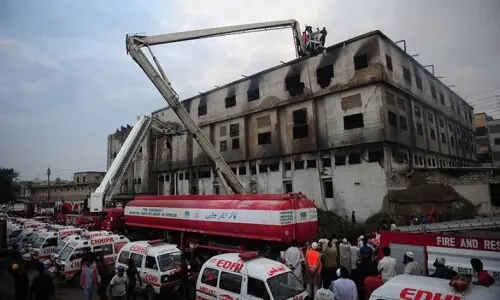
The irony shouldn’t be lost on anyone. All that expertise about heat resistance, and yet none of it mattered against a fire like this.
A building is more than concrete; it is a vessel of layered experience.
Ten days later, I’m thinking of him. His shop couldn’t have survived. There’s another seller I bought from often, discovered through Instagram. A few voice notes, online payment, delivery; it was effortless, though never quite the same as being there. He’s safe, some inventory lost, but working online now, grateful for the social media support that lets him breathe, he said.
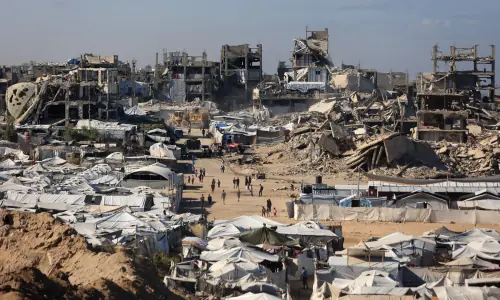
When a building burns, we witness a peculiar violence against time itself. Fire doesn’t merely consume goods and furniture etc; it severs the threads that connect us to our past selves, to the people we’ve loved, and to the futures we imagined unfolding here.
A building is not just concrete; it is also a vessel of layered experience. At Gul Plaza, we started as strangers, then became regulars, then friends, then part of each other’s stories. A building is thus an anchor in a vast web of human connection. The fire didn’t destroy things; it ruptured that continuity of experience.
There’s something truly devastating about this. We understand ourselves partly through our relationship to a place and the things within it. To lose it is to lose an anchor for memory itself. I can remember what happened at Gul Plaza with my mother but I can no longer stand in the actual space where it occurred.
These are not just buildings; they are vessels for the moments we won’t get back; the past becomes harder to retrieve. In my case, I’ve lost another memory associated with my mother. Because she died so unexpectedly and quite young, I’ve sort of grown up in these markets and learned to manage life in them. In many ways, these shopkeepers have been my teachers — “buy this pan for frying” advised one uncle, “buy this material for sari petticoats” said another.
The future also dies in flames — not the future of new buildings, but the specific future that belonged to Gul Plaza. The shops that would have been taken over by grandchildren not yet born are lost. Fire also kills these particular possibilities. The thing is: fire doesn’t understand memory or the significance of a building. The things that matter most burn just as easily as the things that don’t matter at all.
Yet there’s also something revealing in what survives. Once again we’re seeing how ordinary Karachi denizens make ordinary things mean-ingful by caring about them. Yes, Gul Plaza fell to ash, but the resolve of those who built it has not.
How many times must Karachiites rebuild what incompetence burns down? We will do it because we know what stands behind these burned buildings — the will to endure, to rebuild, to continue. Thankfully, that has not been touched by flames.
It takes time for a place to become truly ours, and the Gul Plaza fire reset that clock to zero. What comes next will be built by us but it will rise in the shadow of a truth we have long known, especially in Karachi: no one protects us. The systems meant to prevent such loss are hollow. When they speak of inquiries, of compensating families, of resilience, of rebuilding, we know what they’re not saying — this was preventable, that our loss was their failure, that concrete can be replaced but trust, once burned, takes generations to restore. And we have been burned plenty.
The clock resets for the building. Our faith in government, however, is stuck at zero.
The writer was an instructor of journalism.
X: @LedeingLady
Published in Dawn, January 25th, 2026