Driven to debt by drought


 0
0
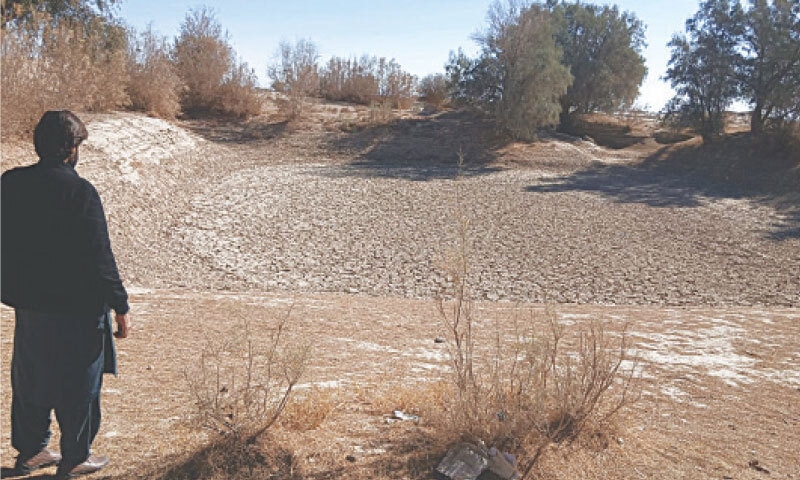

RAMAZAN Mengal looks older than his years, though henna dyes his greying beard. A shepherd from Sangeen in Daak, a cluster of villages along the Pakistan-Iran border in Balochistan’s Nushki district, Ramazan carries the visible weight of decades of drought.
His burden is not only physical but financial. Years of failed rains have forced him into mounting debt that continues to grow. As grazing land dried up and grass vanished, his livestock weakened and many died. With no pasture left, he began buying fodder at prices far beyond his means.
Like many villagers, Ramazan borrows from a trader in Nushki bazaar who lends to much of Sangeen. Frequent borrowing has blurred the exact amount he owes. “I think I have to pay him Rs300,000 or Rs400,000,” he says, seated in his mud-house guest room.
“If we do not take loans, we cannot survive,” he adds. “There is nothing else we can do to make ends meet.” Each trip to the bazaar deepens his losses. “I sell a goat or sheep for Rs20,000, then buy ration and fodder worth Rs60,000. I pay what I can, and the trader writes the rest in his register. This is how my debt has grown in a couple of years.”
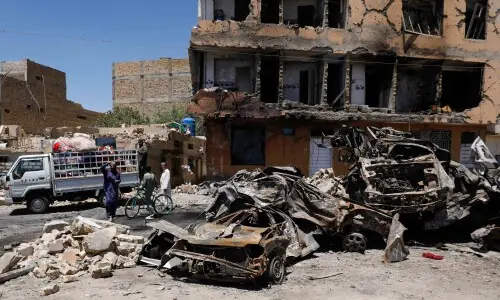
Since 1997, prolonged droughts have emptied villages in Nushki, killed livestock, and trapped families in cycles of debt
The cycle has also weighed on him spiritually. “Despite offering prayers, I have to lie to the trader that I will repay him soon,” Ramazan says, touching both ears in a gesture of seeking forgiveness. “Then I return to ask for another loan.”
A drought that does not end Ramazan’s story is echoed across Daak. Over black tea, villagers recount similar losses — dead livestock, shrinking herds, and rising debt.
According to Ihsan Mir, a researcher from Nushki, drought in the region is long and relentless. “If there is a drought in Daak, it continues for five or six years,” he says.
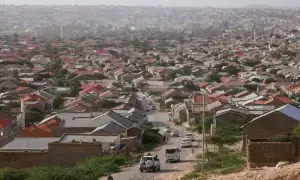
Nushki lies 140km southwest of Quetta, bordering Afghanistan, where mountains, plains and desert converge. Sangeen sits at the edge of the desert, making it especially vulnerable to rainfall failure. Residents say drought existed even before the 1990s, but rarely lasted more than a year or two. That changed after 1997, when dry spells became longer and more frequent, steadily eroding water sources and livelihoods.
The Pakistan Meteorological Department’s Drought Watch 2025 notes that Balochistan has an arid-to-semiarid climate with erratic rainfall and prolonged dry spells. Much of western Balochistan depends on winter rain rather than the summer monsoon. Annual rainfall ranges between 71mm and 231mm, but Nushki receives around 40mm.
Forecasts for December 2025 to February 2026 predict below-normal rainfall and above-normal temperatures, conditions likely to further intensify drought.
Villages left behind
The impact is visible in abandoned settlements. Sangeen’s once-populated area now lies deserted.
“We left our houses after the 2022 floods that wreaked havoc in Nushki,” says Qudoos Mengal, a teenager who guides visitors through the abandoned village.
The floods affected 33 million people nationwide, killed over 1,700, and caused losses worth $30 billion, according to government estimates. But even after the waters receded, drought continued to drive displacement.
“There used to be over 40 households here,” Qudoos says. “Now only 15 remain.”
Water scarcity dominates daily life. Villagers travel 15km to fetch water from Zagarwal. Tube wells exist in places like Sangeen, but the water is saline and unfit for drinking.
“There are two tractors and a couple of donkeys in the village,” says Haji Manzoor Mengal, in his seventies. “Those who can afford it bring water by tanker. The poor fetch it on donkeys.”
During emergencies, tanker water is shared. Cultivation depends entirely on rainfall and is limited to household consumption. “We mostly grow wheat for ourselves,” Haji says.
The village cleric adds quietly: “I am a mullah, and I don’t even have a donkey to fetch water.”
Livelihoods under pressure
Farmers once grew watermelons and muskmelons for sale in Quetta, but prolonged drought has made cultivation unreliable. Many families now sell livestock simply to survive.
Concerns have also grown over the proposed Burj Aziz Dam near Quetta. Tribal elders, led by Sardar Asif Sher Jamaldini, argue that farmers in Nushki and Chaghi depend on seasonal river flows and fear the dam could deprive them of water. In a district already struggling with prolonged drought, residents say the project could worsen their hardships.
Nushki has endured several severe droughts, beginning in 1997, which killed livestock and forced families to migrate. In its aftermath, NGOs began operating in the district. Zahid Mengal, now head of the Azad Foundation in Quetta, has worked in drought-affected areas since the early 2000s.
“Drought recovery requires at least one full year of near-normal rainfall, especially in winter,” Zahid explains. “Sustainable improvement depends on repeated seasonal rains, not isolated events.”
Balochistan receives about 176 millimetres of rain annually, but districts like Nushki and Chaghi receive less than 50mm. “In such arid zones, even small rainfall deficits devastate crops and livestock,” Zahid says. “We’ve seen this pattern for over 20 years.”
Relief without recovery
Relief arrives sporadically. Recently, authorities and the PDMA distributed food supplies in drought- and flood-affected areas, including Nushki. Officials admit the situation is severe.
“The drought situation is worse, not bad, in Nushki,” says Additional Deputy Commissioner Umer Jamali. “Recent rain cannot compensate for the long dry season. Daak and Keshangi are among the worst affected.”
As the visit to Sangeen ends, Ramazan tends to what remains of his herd, his survival dependent on loans and scarce fodder.
His henna-darkened beard hides the grey, not the toll of decades spent battling a drought that never truly ends. For Ramazan and others in Daak, relief comes in fragments, rain in rumours, and recovery remains a distant promise — while debt continues to grow, written into the land itself.
Published in Dawn, January 25th, 2026