KP narcotics law undermines federal powers, FCC told

• Court hears dispute between Centre, province over anti-drugs legislation
• Plea moved by federal govt argues presence of provincial law may ‘add to legal complications’
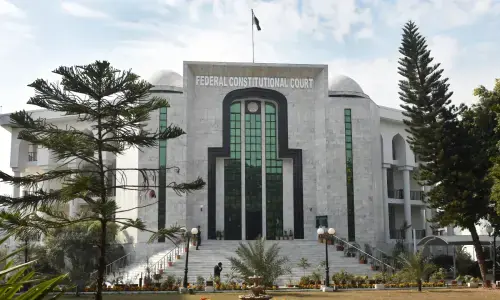
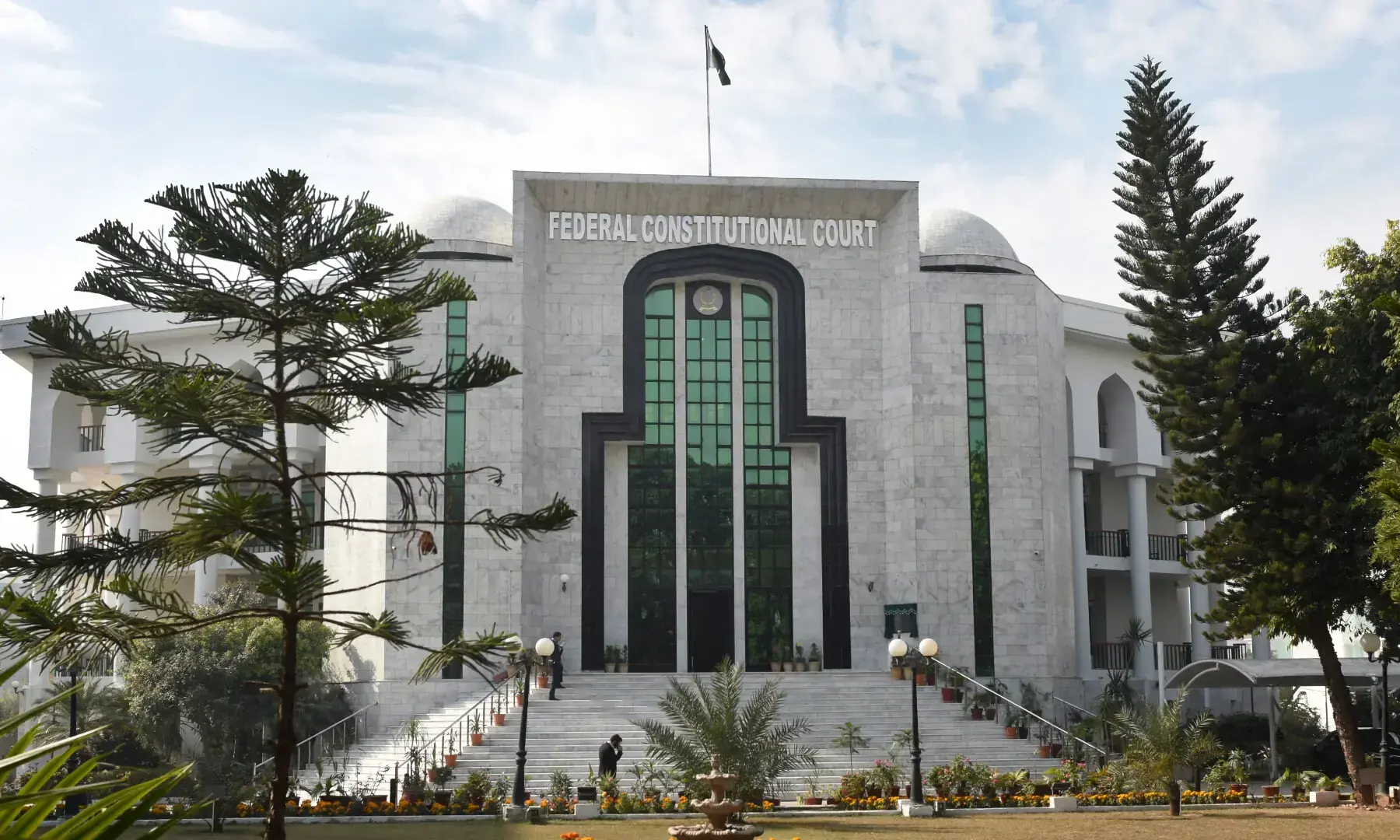
ISLAMABAD: The Federal Constitutional Court (FCC) was told on Thursday that Khyber Pakhtunkhwa’s having its own narcotics law, in addition to the Control of Narcotics Substances Act (CNSA) 1997, would only undermine the federal government’s anti-drug efforts and might add to legal complications.
The arguments were advanced by the federal government before a two-judge FCC bench comprising Justices Ali Baqar Najafi and Muhammad Karim Khan Agha.
The bench was hearing a petition jointly moved by the federal government and the Anti-Narcotics Force (ANF) seeking to set aside the KP Control of Narcotics Substances Act 2019.
The controversy revolves around whether a province can enact a parallel narcotics law in the presence of Section 71 of the CNSA 1997 — a move that the petitioners argue “undermine the federal government’s authority to legislate”.
Filed against the backdrop of KP’s parallel legislation, despite the CNSA 1997 already being in effect, the petition asked the FCC to interpret the executive powers of both the federal and provincial governments under the Constitution.
The petition argued that the federal government played a vital role in controlling and eliminating the narcotics threat in the country, particularly in the processing and trafficking of heroin and charas.
It stated that the federal government had already taken effective measures to combat all aspects of the multifaceted drug problem since long.
‘Not a dispute’
During the hearing, Barrister Syed Ali Zafar, representing the KP government, argued that the matter did not represent a dispute between the federal and provincial governments, as the law was duly enacted by the KP Assembly.
In response, Additional Attorney General (AAG) Chaudhry Aamir Rehman questioned how a provincial law could repeal a federal legislation.
He added that once a province established its own force or agency to implement such a law, a dispute between the federal and provincial governments was bound to erupt.
The FCC adjourned further proceedings until next week.
‘Comprehensive law’
The petition expressed the concern that the provincial law repealed the CNSA 1997 within KP to the extent of cultivation, possession, sale, purchase, delivery, and transportation of narcotics.
It termed the KP law a “mala fide” and “colourable” exercise of power, seeking its declaration as illegal.
It stated that licensing authority for import, export, internal transport, manufacturing, and transshipment of narcotic drugs fell within the purview of the federal government under the CNSA 1997.
The provincial law, the petition contended, would create grave legal and constitutional chaos, including duplication of special courts, overlapping jurisdiction, and conflict of authority with other law enforcement agencies. This, the plea added, could lead to a legal and constitutional crisis.
The petition argued that the CNSA 1997 was a comprehensive law applicable across Pakistan to curb the menace of narcotics as airports, dry ports, seaports, and land borders fell under the exclusive control of the federal government, which exercised its jurisdiction through the ANF.
It contended that as narcotics trafficking was not only a cross-border offence but one with regional and international implications, only a federal agency could effectively deal with the menace, as the jurisdiction of provincial force extended only within its frontiers.
The petition further argued that in the presence of a federal law enacted by parliament within its legislative competence under Articles 90 and 142 and Entries 3, 26, 27, 32, and 58 of the Federal Legislative List, any provincial law would be contradictory and thus void.
Published in Dawn, January 16th, 2026