FCC endorses cooperative federalism in ruling on excise duty tweaks
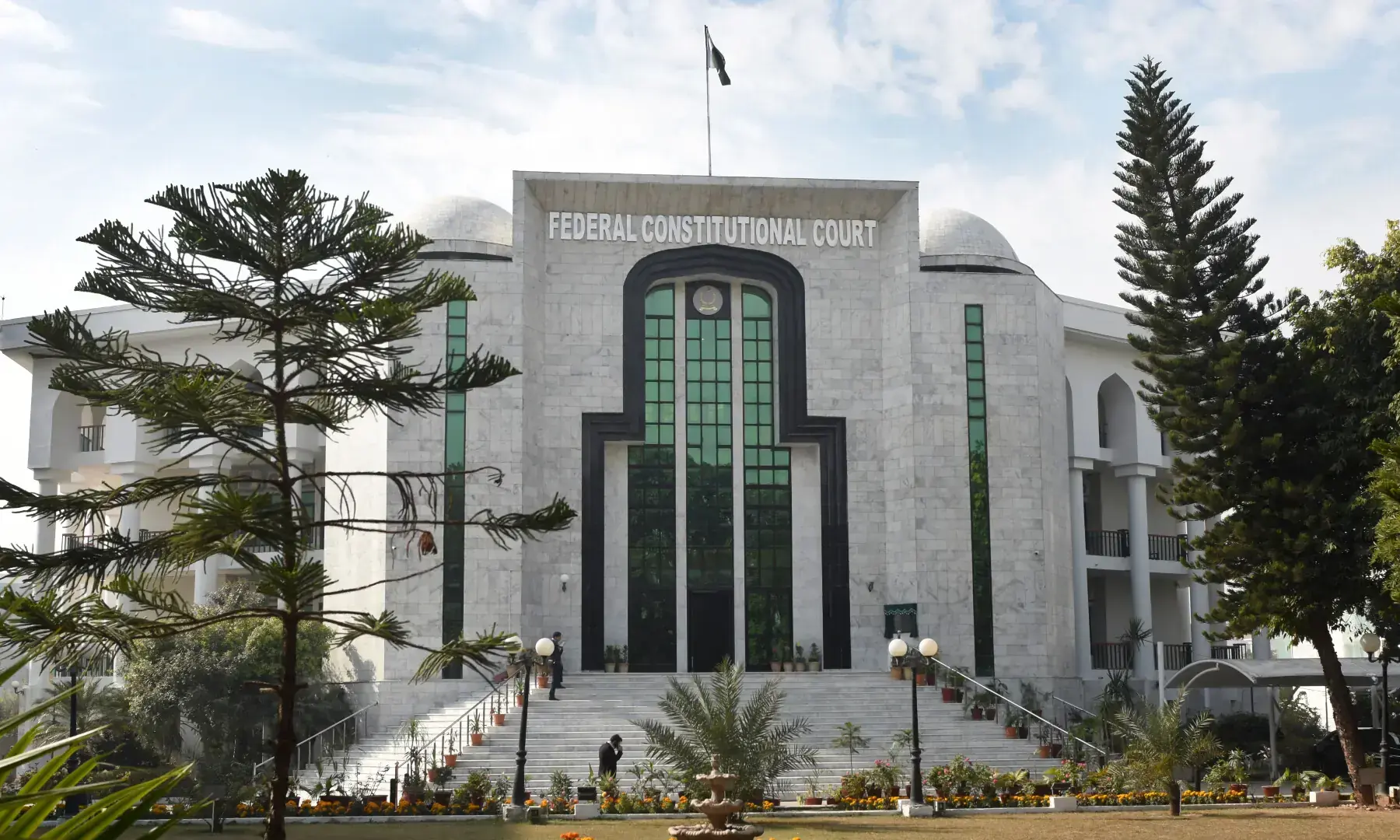

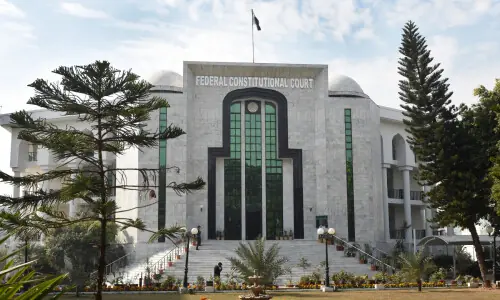
ISLAMABAD: The Federal Constitutional Court (FCC) on Tuesday ruled that a federal law imposing excise duty and a provincial law aimed at advancing labour welfare, though overlapping in scope, do not conflict with each other and instead operate within their respective spheres of legislative competence, rendering both constitutionally valid.
“Both enactments stand on firm constitutional footing, not in conflict but in constitutional harmony, each valid in its own aspect,” observed Justice Aamer Farooq, who headed a two-judge FCC bench that dismissed a challenge filed by Attock Cement Pakistan Ltd against amendments introduced by the Balochistan government to a federal excise law.
In its 15-page verdict, the court explained that while the imposition of excise duty squarely falls within federal legislative competence, the advancement of labour welfare, when viewed from the perspective of public interest, lies well within the provincial domain.
The controversy at hand revolved around a petition instituted by Attock Cement Pakistan Ltd, an entity engaged in the production and sale of cement, with its manufacturing facility located at Hub, Lasbela, Balochistan. The petition challenged a Nov 27, 2023 order of the Balochistan High Court.
Attock Cement’s challenge to BHC verdict dismissed
The petition was initially filed before the Supreme Court but was later transferred to the newly established FCC following the enactment of the 27th Amendment.
On Jan 15, 2021, the factory was served with a notice by the Mines Labour Welfare Department, Balochistan, requiring payment of excise duty on minerals to the Labour Welfare Commissioner, Balochistan, at rates revised pursuant to the Balochistan Finance Act, 2020.
In response, the factory submitted three separate representations to the department, seeking revision of the applicable rates. However, all three representations were declined.
During the hearing before the FCC, counsel for the factory, Khurram M. Hashmi and Noman A. Farooqi, argued that the provincial assembly, by amending Section 3 of the Excise Duty on Minerals (Labour Welfare) Act, 1967 through Section 7 of the Balochistan Finance Act, 2020, had acted without legislative competence. They contended that the imposition of excise duty fell within the exclusive federal legislative domain and that the Balochistan Assembly therefore lacked the authority to amend the 1967 Act, particularly where such amendment effectively altered the rate or nature of excise duty.
However, in the judgement, Justice Farooq observed that the objective of the Labour Welfare Act, 1967 was unmistakably oriented towards the advancement of labour welfare, a domain constitutionally entrusted to the provinces.
The mechanism through which this objective is pursued — the imposition of a duty of excise — is not an end in itself but a means carefully designed to finance a broader public interest. The statute, the judgment noted, does not merely levy a tax; rather, it establishes an administrative framework for the collection, allocation and utilisation of the proceeds, all of which are inextricably linked to the welfare of labour employed in the industry.
Thus, while the recovery of excise duty constitutes the operative mechanism of the Act, its spirit, essential character and constitutional essence lie in the realisation of labour welfare. The excise duty, the court held, is instrumental in achieving this predominant provincial objective, rendering the Act, in its true nature, an expression of social welfare legislation rather than mere taxation.
Even if, by a strict reading of the preamble and operative provisions of the 1967 Act, its dominant character were to be construed as the collection and imposition of excise duty, its underlying purpose could not be ignored. Such a conclusion, the court said, merely reveals an overlap between two constitutional competences: the federal authority to levy excise duty and the provincial responsibility to advance labour welfare.
This incidental overlap, the judgment added, does not justify invalidating the statute. Justice Farooq emphasised that the Constitution (Eighteenth Amendment) of 2010 consciously embraced the ethos of cooperative federalism, wherein legislative fields are not rigid silos but, at times, interacting spheres.
In this constitutional landscape, incidental overlap does not render a statute ultra vires. The court further observed that following the 18th Amendment, the Concurrent Legislative List was abolished, significantly expanding provincial legislative authority, with matters not explicitly listed in the Federal Legislative List falling within the exclusive domain of the provinces.
The FCC also acknowledged the traditional use of the “pith and substance” doctrine in determining legislative competence, noting that courts have increasingly relied on the “double aspect” doctrine, which permits a single subject to be legislated upon by both federal and provincial governments from different perspectives.
In the end, the FCC denied leave to appeal and dismissed the petition filed by the cement manufacturer.
Published in Dawn, January 14th, 2026