‘Perceptual Mirage’ marks a continuation of Waseem Ahmed’s long engagement with the miniature tradition as a critical contemporary language. Rather than approaching painting as heritage to be preserved, Ahmed treats it as a layered visual system, capable of articulating the structural violence, ideological rigidity and historical ambiguity that shape the present.
The exhibition at Karachi’s Sanat Initiative extends concerns that have remained central to Ahmed’s practice for over two decades: the circulation of power through images, the repetition of history, and the uneasy coexistence of beauty and brutality.
Ahmed emerged from the first generation of artists trained at the National College of Arts (NCA), Lahore, who reconfigured miniature painting at the turn of the millennium. As the art historian, critic and curator Virginia Whiles has argued, neo-miniature practice did not signal a return to courtly aesthetics but a strategic appropriation of its discipline, scale and iconography to address contemporary political and social realities.
In this framework, the miniature becomes a site of tension rather than reverence, a form whose authority is interrogated from within. ‘Perceptual Mirage’ situates itself firmly within this lineage. Ahmed neither abandons the grammar of his visual language, nor submits to it — instead, he subjects its visual codes to sustained pressure.
Waseem Ahmed extends his long interrogation of miniature painting as a contemporary critical language rather than a nostalgic inheritance
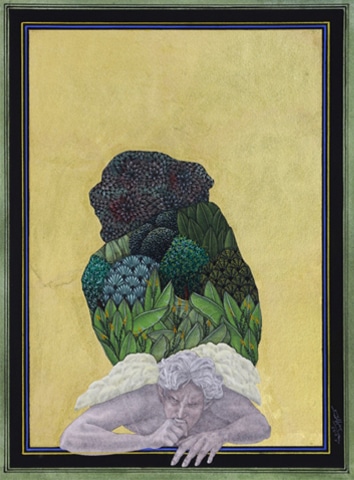
Formally, the works demonstrate rigorous control. Pigment is built on archival wasli, frequently punctuated by gold and silver leaf, recalling divinity, sovereignty and transcendence. In Ahmed’s hands, however, these materials lose their redemptive promise. Their luminosity sharpens the unease of the scenes they inhabit, foregrounding the contradiction between surface refinement and thematic disquiet. The craft is not decorative; it is instrumental, drawing the viewer into images that resist narrative resolution.
A key motif recurring throughout the exhibition is the poppy flower. Rendered with botanical precision, the poppy operates as a metaphor within Ahmed’s work, referring to shared Pak-Afghan history and also the violence that this region has encountered.
More broadly, the poppy becomes a symbol of how violence and religious fundamentalism infiltrate society gradually, not only through overt conflict, but through systems that normalise coercion, belief and control. That these flowers appear embedded within idyllic landscapes suggests that Ahmed wants us to think about how violence arrives, rarely announcing itself as rupture, usually arriving as ornament.
Human figures populate many of the works, often drawn from historical, mythological or religious imagery. Yet these figures are displaced, suspended within environments that feel temporally and psychologically unstable. They do not enact specific events, rather they function as archetypes caught in cycles of recurrence. This suspension reflects Ahmed’s larger concern with history as repetition rather than progress. In his work, the past is not a closed chapter but an active force that continues to structure contemporary violence and belief.
Language, too, is treated as unstable material. Arabic, Farsi and Urdu scripts appear repeatedly, rendered in calligraphic forms that are visually authoritative yet semantically opaque. By emptying language of literal meaning, Ahmed foregrounds its role as image and instrument of power. The scripts evoke sermons, media rhetoric and ideological declarations that circulate endlessly while deepening social fragmentation. What is legible, the artist suggests, is not necessarily intelligible.
Scale further reinforces this conceptual instability. While many works retain intimacy, others elongate vertically, disrupting compositional balance and forcing the eye to search without resolution. This controlled discomfort mirrors the exhibition’s central proposition: perception itself is conditioned by historical, political and religious frameworks that shape what we see and what we fail to see. The title ‘Perceptual Mirage’ is therefore not merely a poetic ascendence, but a conceptual anchor.
Within Pakistani contemporary art, Ahmed occupies a critical position, where his work does not offer moral closure or visual catharsis. Instead, it insists on sustained looking and historical accountability. ‘Perceptual Mirage’ affirms that miniature painting, far from being a relic, remains a potent medium for examining the enduring entanglement of beauty and beliefs, and the contemporary systems that allow them to persist.
‘Perceptual Mirage’ was on display at the Sanat Initiative in Karachi from December 6-16, 2025
The writer is the curator of the Karachi Biennale 2027. She can be reached at noor.b.ahmed@gmail.com
Published in Dawn, January 11th, 2026