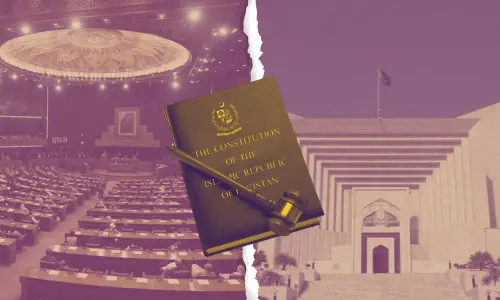
IT has been said at length before, but bears repeating: the 27th Amendment was a monumental mistake. The same has now been underlined by international human rights group Amnesty International, which has described it in its new research report as the “crescendo of a concerted and sustained attack on the independence of the judiciary, right to fair trial, and the rule of law in Pakistan”. That is a sobering assessment, and it should give any well-meaning citizen some pause.
Passed and enacted in a rush this past November, the 27th Amendment was touted as an unavoidable step in enabling the evolution of various institutions of the state. Despite sustained criticism and calls for a considered debate on its various clauses, it was hastened through parliament via force of majority.
But hindsight is 20/20, as they say. Perhaps the time is now more suitable for those who voted for the legislation to start coming to terms with its implications.
A review cannot be put off indefinitely. As Amnesty once again highlighted, and as many concerned citizens had previously pointed out, the law has decisively undermined the judiciary and its institutional independence. The legitimacy of the new and powerful Federal Constitutional Court has been undercut by the fact that the executive was directly involved in its formation and in appointing its judges.
Meanwhile, the Supreme Court of Pakistan has been stripped of its original and advisory jurisdiction in constitutional matters, relegating it to an appellate body for non-constitutional cases. Judges can now be removed on vague grounds like ‘inefficiency’, and shuffled around almost on a whim. This cannot be sustained.
The Amnesty report makes note of the fact that these changes were enforced after several complaints from senior judges regarding interference in judicial affairs. This context will not be ignored or glossed over forever, even if it is inconvenient today to address it.
The human rights watchdog has also raised concern over the decision to grant certain individuals blanket immunity for their lifetime, and warned that “the wide-ranging nature of the immunity violates the fundamental principle of equality before the law enshrined in Article 26 of the International Covenant on Civil and Political Rights.”
Additionally, a number of technical objections have been raised to the immunity arrangement, which must be reviewed by the legislature, given their implications for Pakistan’s standing in the comity of nations. The report explicitly warns that the 27th Amendment is violative of “international human rights law, particularly undermining the independence of the judiciary, right to fair trial and justice and accountability”.
While Pakistan is a sovereign state entitled to legislate as it pleases, parliament must consider if it is worth inviting international opprobrium over a piece of legislation that has demonstrably so little to do with the public interest.
Published in Dawn, January 8th, 2026