Footprints: VIEW FROM THE DOUBLE DECKER
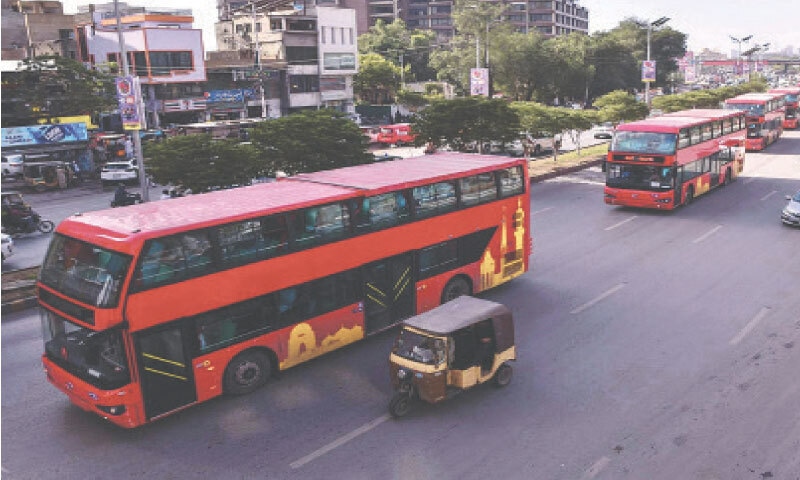
GETTING around Karachi without a car — or at least a bike — is not for the faint of heart. Options are limited; from ride-sharing apps with eye-watering fares to rickshaws that will leave you with a persistent itch in the back of your throat. And then, there are the buses.
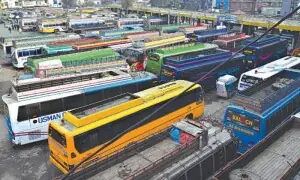
Until recently, taking a bus in Karachi meant embarking on a battered hull adorned with kaleidoscopic patterns that emitted plumes of acrid black smoke — some of which makes its way into lungs of hapless passengers.
This is why the city’s new double-decker buses, which launched on Jan 1, are a breath of fresh air. The Sindh government had announced the initiative in Oct 2024, and on Sunday, it came to fruition.
The towering red buses are an unfamiliar sight – being the hallmark of cities like London and Hong Kong – on Sharea Faisal, but they’ve only been in regular service for three days. Intrigued and always up to try a new mode of transportation, I caught one of the red giants from Press Club Chowrangi — known best for its proximity to Zainab Market — all the way to Malir.
For Rs50, one can get as far on a local bus as Rs80 will get you on the Peoples’ Bus Service. But on the latter, you don’t have to contend with bad hygiene, pickpockets and overcrowding
Earlier, Hussain Mansoor —spokesperson for Sindh Senior Minister Sharjeel Inam Memon — told Dawn that the buses would run between Zainab Market in Saddar and Model Colony.
Stops were designated for double-decker buses along this route at/near Malir Halt, airport, Colony Gate, Natha Khan Bridge, Drigh Road, Nursery, Baloch Colony and the Finance and Trade Centre (FTC), he said.
Boarding the vehicle, one finds the lower deck reserved for women. Upstairs, a collection of men, children and a few whole families populate the two compartments — an enclosed cabin and an open-air space with a retractable canopy.
As children marvelled at the cars driving by below and most adults held up their phones to take photos or videos, the conductor came by to collect the fare — Rs80 for anyone stepping off before the Natha Khan bridge, and Rs120 for everyone traveling further.
After that, we were off, cruising along Karachi’s main thoroughfare as the open canopy let in a cool breeze.
Seated next to me was Khurram, who usually gets around on a bike. Today, however, he was curious to see what the hype was about.
He said the new double-deckers were a significant improvement over local buses — known on the street as Mazdas. “The fare is reasonable, matching that of local Mazdas, but with a smoother ride and a better environment,” he said.
While calling on the government to bring more such buses on the roads, Khurram said that it was the people’s responsibility to take care of them.
Mohammad Ismail, a student who was riding with his friends, said the bus was nice, but the upper deck lacked straps for people to hold on to, should they need to stand while the bus is moving.
Ismail’s friends, Akram and Mohammad Sharif, noted that the fare was higher than local buses. Sharif told me that for Rs50, one can get as far on a local bus as Rs80 will get you on the Peoples’ Bus Service (PBS).
However, they quickly admitted that the new buses were far more comfortable, and devoid of “pickpockets”, at least for now.
Ali Raza, who regularly commutes to work via bus, advised the authorities to extend the bus route from Malir Halt to Gulshan-i-Hadeed in line with the R-1 route of the PBS.
Shabana, who was travelling with her daughter, said she used to take a bus a long time ago, but could see the improvement in the quality of public transport in Karachi.
“We didn’t have many facilities back in the day, but that’s gotten better,” she said, adding, “We have comfortable seats, the drivers cooperate with us, and the main thing is that it’s not heavy on the pocket.”
The pair were seated on the upper deck, so I asked whether they felt there should be more space designated for women. Shabana responded that she didn’t really mind and found the journey comfortable and safe.
Habib, an office worker who drives usually himself to work, said he had lived in Dubai and found Karachi’s new buses comparable to the mass transit system in the Gulf city. He said he and his colleagues would take the bus regularly if they didn’t need to visit clients in different parts of the city.
“Quality-wise, I think everything is okay because it’s just started. Let’s see what will become of them after six months,” he said. Recalling the local buses he had travelled on as a student, some 20 years ago, he said those were neither safe nor hygienic.
Mohammad Nasir, a regular PBS rider, said the double-deckers were better than other buses on the R-1 route because they had ample seating for passengers.
The smaller buses, he lamented, were usually packed to the brim, meaning that those in the back would always have to jostle to get to the door when they reached their stop.
In all, given Karachi’s patchy history with public transportation, any additional services are bound to be welcomed by the populace. But with key projects, such as the Red Line along University Road, facing persistent delays, there is still a long way to go.
Published in Dawn, January 5th, 2026