IF post-2016 were the years when Peca’s misuse against those exercising their right to freedom of speech and press freedom was tested, 2025 was the year when the gaps in the state’s ability to fully abuse the law were filled.
The amendments to Peca were made in an opaque manner and passed by parliament in January 2025 without any consultations, public debate, or even parliamentary debate. Those of us who managed to attend a hearing at a Senate committee were informed that the members had been told to vote for the amendment as it was, with no room for any changes. Senators said that the amended law would not be used against journalists, but like most promises this was also immediately broken as was clear from the intent behind the amendments.
The results of this opaque, undemocratic process have been damaging in terms of the kind of changes made to the law; how cases have been filed against lawyers, journalists, and activists; and the chilling effect this has had on citizens and the media alike.
Wide-ranging procedural and substantive changes in Peca have been highly damaging. The National Cybercrime Investigation Authority (NCCIA) was formed under the law, which is essentially a new name for the FIA’s cybercrime wing, the investigation authority under Peca since 2016. Only 15 reporting centres exist currently with an in-person reporting requirement, which serves as a significant barrier for people to register a complaint leading to a case under Peca. The 2025 amendment undid a December 2023 amendment to Peca that had permitted complaints under the law to be filed at any police station in Pakistan.
Moreover, the 2025 amendment changed the definition of a complainant to be any person “having substantial reasons to believe that the offence has been committed” in addition to the “victim”, which significantly expands the ability to file a case — from an aggrieved person to any third party. The other significant change is that now the complainant does not have to be a “natural person” but can be any organisation, including a government department. Another significant change in definition includes expanding “social media platform” to include “any person that owns, provides or manages online information system for provision of social media or social network service”, which expands the purview of the law to people administering online groups or channels as well.
Peca is being used against lawyers, journalists and human rights defenders.
The amendment further criminalises free speech in the country by introducing Section 26-A that stipulates punishment of three years in jail and/or Rs2 million fine for “false or fake information”, without defining what that entails. The amendment also makes Section 20, which was struck down by the Islamabad High Court in 2022 but continues to be used illegally, cognisable and non-bailable. These two sections are responsible for criminalising free speech on the internet in Pakistan at a time when over 90 countries have decriminalised defamation, something that the IHC tried doing.
In practice, the 2025 Peca amendment has given the state through the NCCIA a free hand to prosecute any person that is seen as critical of state policies. In a constitutional democratic republic, the consequences of this are disastrous. And any constitutional protections that may exist in theory have been blurred after the 27th Amendment where the role of the executive in the appointment of judges has been expanded, with their ability to transfer judges without oversight.
Several journalists have been called in, in 2025, by the NCCIA for inquiries under Peca related to their work. For instance, Farhan Mallick, the founder of independent media platform Raftar, was arrested in February 2025 under Peca charges. Hum News journalist Khalid Jamil was arrested in Islamabad in August 2025 under Peca. Muhammad Aslam from Vehari has a case under Peca for reporting on alleged corruption in a road project. Iftikhar Ul Hassan of Samaa news from Vehari also had a Peca case against him by the municipal authority for a social media post about actions by local administration against a housing society. Muhammad Akbar Notezai of this paper was sent prosecution notices by the FIA for a corruption investigation which the RSF and Freedom Network have highlighted as retaliation against investigative reporting. In July 2025, upon NCCIA’s request, an Islamabad court ordered the blocking of 27 YouTube channels of journalists for “anti-Pakistan” reporting, some of which were later suspended upon appeal.
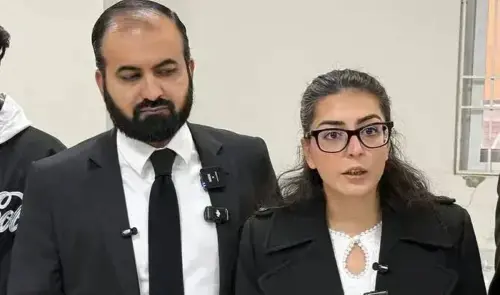
Peca is also being used against lawyers and human rights defenders. For instance, in the case of human rights lawyers Imaan Mazari-Hazir and Hadi Ali Chattha, a Peca case filed by the NCCIA relates to seven tweets from the year 2021 posted by Imaan Mazari on matters of the law, human rights, and enforced disappearances in the country, and Chattha’s supposed crime is reposting these tweets. The Supreme Court had to step in to direct the lower courts in Islamabad to follow due process and procedure in the case where multiple hearings were being held on the same day, and witness statements being recorded in the absence of the accused. During cross-questioning, the NCCIA official stated that government officials are allowed to say the same things that the couple is being prosecuted for saying.
In such an environment, journalists and lawyers are being turned into heroes for simply doing their jobs as that itself has become an act of courage. A parliament that passes laws without deliberation, an executive that arrests its citizens for exercising their right to freedom of speech, and a judiciary that does not protect the rights of citizens that it functions for need a reminder of the notion of fundamental rights and justice.
It is unsustainable for a regime to carry on with such oppression in a diverse republic like Pakistan. It is fundamental that citizens be allowed to express their opinions with the safety of their institutions rather than be victimised them. For that, parliament must undo these draconian amendments and decriminalise defamation.
The writer is director of Bolo Bhi, an advocacy forum for digital rights.
X: @UsamaKhilji
Published in Dawn, January 2nd, 2026