You might want to sit down for this one.
About 100 years ago, a Norwegian philosopher named Peter Zapffe wrote what’s now considered one of the darkest, most unsettling philosophies in history. He called it The Last Messiah, but people often refer to it through an image he used — the existential elk.
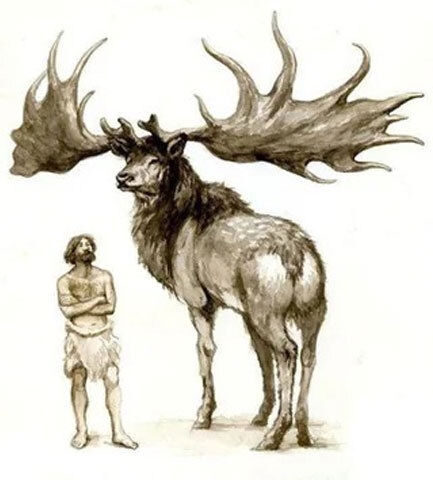
Zapffe compared humanity to a species of giant elk that once actually existed — magnificent creatures whose antlers grew so large and heavy that they eventually doomed them. Their beauty became their curse. Their own biological evolution led to their extinction.
He believed that we are that elk. That human consciousness — our capacity for reflection, abstraction, self-awareness — evolved too far. We became so smart that we broke the game. We realised that we’re going to die, that the universe is absurd and that existence itself has no inherent meaning. We became animals cursed with godlike awareness.
In Zapffe’s view, human intelligence reached a point where we could finally “do the math” — weigh the costs and benefits of existence — and realise that maybe non-being is preferable to being.
Can a species become too self-aware to survive? Philosopher Peter Zapffe thought so. His dark vision argues consciousness is a curse we manage through elaborate self-deception…
So, if that’s the case, why haven’t we gone extinct like the elk?
Zapffe said it’s because we’ve learned to saw off our own antlers. We’ve developed defence mechanisms to dull our awareness, to keep ourselves from staring too long into the void. He outlined four main ways we do this — four grand strategies of self-deception.
1. Isolation
We suppress or repress any thoughts that disturb us. We just don’t talk about death, absurdity or the meaninglessness of existence. Bring that up at a dinner party and people will shift in their chairs. Society trains us not to look at the abyss directly.
2. Anchoring
We attach ourselves to stable structures — religion, family, career, ideology — and let them give us artificial meaning. We create routines and rituals to stay busy. We check things off our to-do lists as if the box-ticking itself makes existence justified.
3. Distraction
We flood our senses so we never have to think. A screen for every hand, a playlist for every silence, a thousand notifications to make sure no genuine thought ever slips through. The modern human condition is just noise — so much stimulation that introspection becomes impossible.
4. Sublimation
The rarest one. It’s when we transform our anguish into creation — art, philosophy, science. We take the absurdity and shape it into something beautiful. It’s what every great artist and thinker has done: turned despair into a monument.
But even this, Zapffe said, is still a kind of self-deception. A prettier way of cutting down your antlers. Because in every case — isolation, anchoring, distraction and sublimation — you’re limiting your full self-awareness, diluting the terrifying honesty of what it means to be human.
So then comes the question: what if I’m the elk that refuses to cut down my antlers?
What if I can’t unsee the absurdity anymore?
That’s when Zapffe introduces the last messiah — a figure who chooses to live without self-deception. Someone who faces the full horror of consciousness without reaching for false comfort.
When religions promise salvation and philosophies promise understanding, the last messiah sees only biological overreach — a species that evolved too far for its own good. Where past messiahs called humanity to repentance or revelation, this one calls us to stop reproducing. To end the project.
He is “the last” because, once his insight is accepted, no further messiahs are needed. Humanity’s story would end not with war or apocalypse, but with a quiet, voluntary extinction — a conscious decision to stop perpetuating the curse of awareness.
This wasn’t a call for self-annihilation, like the German Philip Mainländer’s nihilism. Zapffe didn’t advocate suicide — that only solves the individual problem. He called for self-limitation, the refusal to bring new life into a world of absurdity. To live fully human, fully awake, fully tragic — but to end the cycle with yourself.
And he lived it.
Zapffe never had children. He climbed mountains, wrote philosophical essays and darkly humorous stories. He was a mountaineer who found solitude in absurd heroism — climbing peaks no one cared about, laughing at the void and living out his philosophy in full awareness. He turned anguish into art and humour — sublimation, yes, but done with eyes wide open. A life without illusions.
He became, in his own way, that absurd hero — like Camus’ Sisyphus or, in pop culture terms, Rust Cohle from the series True Detective — a character directly inspired by Zapffe’s philosophy. Rust, too, is a man who sees too much, who knows that “time is a flat circle”, and who carries the burden of awareness, like antlers too heavy for his skull.
The writer is a banker based
in Lahore. X: @suhaibayaz
Published in Dawn, EOS, December 28th, 2025