1
1

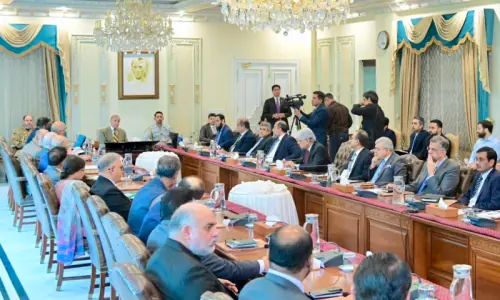
TAKING stock of what remains an incredibly precarious security situation, the military’s top brass on Wednesday resolved to address the “nexus” between terrorism, crime, and “vested political interests”, while also pledging to deal with violent groups working “under Indian tutelage”.
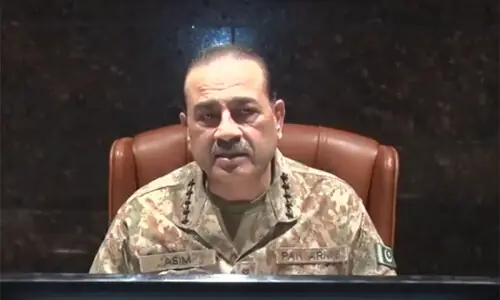
This was the first Corps Commanders Conference Field Marshal Asim Munir chaired after assuming the position of Chief of Defence Forces. The generals reviewed the gamut of the security challenges confronting Pakistan.
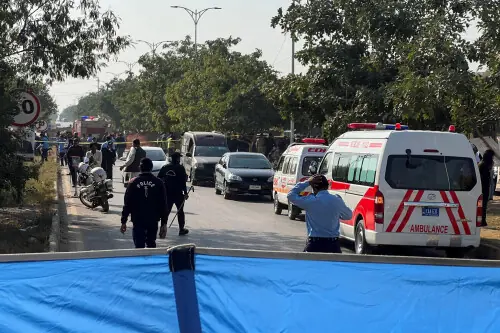
Without doubt, 2025 has been a tough year where militancy is concerned, with KP and Balochistan hit particularly hard by terrorist attacks, while even the federal capital witnessed its first suicide bombing in many years.
In fact, as per statistics, 2025 is said to be the bloodiest year as far as casualties in terrorist incidents are concerned since 2015. Hundreds of security personnel and civilians have been martyred in terrorist attacks, with the latest incident occurring earlier this week as militants targeted policemen in Karak, KP.
Therefore, a resolute counterterrorism plan is needed to neutralise these violent forces, and ensure peace in 2026.
Regarding the “political forces” the generals mentioned, this is widely believed to be a reference to the PTI. However, greater clarity is needed from state institutions regarding the exact contours of this nexus. But as this paper has said earlier, it may be unwise to link the political opposition with hard-core terrorist groups, as this would take the state’s focus away from battling militancy effectively.
The fact is that the banned TTP in KP, and Baloch separatist groups remain the biggest security challenges for the state, and must be dealt with through a multifaceted CT strategy to end the scourge of militancy, and enable the country to focus on development in an atmosphere of peace.
The army leadership discussed the “drivers” of militancy in Balochistan, and appreciated development initiatives and local empowerment efforts in the province. Indeed, along with kinetic actions, addressing genuine grievances of the affected population in Balochistan is essential to counter the separatist narrative. Furthermore, a credible political process is also a must in order to assure the local population that they are the masters of their destiny.
The situation in KP is perhaps more complicated. Here too, as in Balochistan, India is believed to be involved in supporting terrorist groups, while an unfriendly Taliban regime in Kabul is also doing nothing to control cross-border terrorism. The state should, therefore, continue diplomatic efforts to ensure that both Kabul and New Delhi are told clearly that Pakistan will not tolerate destabilising behaviour inside its borders.
Overall, a fresh CT approach is needed to permanently clear areas where militants are active, with minimal suffering of local populations, and to bring down the casualties amongst security personnel.
Published in Dawn, December 26th, 2025