Internal turmoil, diplomatic crisis grip Bangladesh

• Dhaka suspends consular, visa services in New Delhi; Indian centre in Chattogram reciprocates
• Inqilab Moncho threatens to topple interim govt, demands resignations
• 17 held as govt promises speedy trial
• Journalists protest amid death threats, attacks on media
After student leader Osman Hadi’s assassination, crises on both the external and internal fronts have deepened in Bangladesh, which has halted all consular and visa services at its High Commission in New Delhi, while the nation grapples with unrest stemming from arrests, journalists’ protests, and threats of a government overthrow.
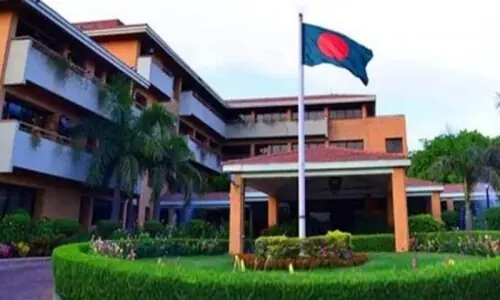
“Due to unavoidable circumstances, all consular and visa services from the Bangladesh High Commission in New Delhi are temporarily suspended until further notice,” a notice posted by the Bangladesh mission said. “Any inconvenience caused is sincerely regretted.”
The move came two days after a demonstration by 20 to 25 people outside the diplomatic mission in New Delhi. Foreign Adviser Touhid Hossain told reporters on Sunday that Bangladesh High Commissioner Riaz Hamidullah received death threats from the protesters.
However, Indian Ministry of External Affairs Spokesperson Randhir Jaiswal said on Sunday there was no attempt to breach the mission’s security and that police dispersed the small group within minutes.
The protesters were demonstrating against the killing of a garment worker, Dipu Chandra Das, in Bangladesh and demanding protection for minorities, he said.
Tensions have been reciprocal. On Sunday, the Indian Visa Application Centre in the Bangladeshi city of Chattogram suspended its operations, citing security concerns at India’s mission there. High commissioners for both countries have been summoned by their respective host governments.
The developments indicated increasing friction between the two nations, as The Daily Star noted that these developments point to diplomatic tensions escalating towards a crisis and advised that both Delhi and Dhaka should work towards reducing the tensions.
Threats to interim govt
The turmoil stems from the killing of Sharif Osman Hadi, a key figure in a pro-democracy uprising last year that ousted former Prime Minister Sheikh Hasina, who has since taken refuge in India. Masked gunmen shot Hadi earlier this month, and he died from his injuries on Thursday.
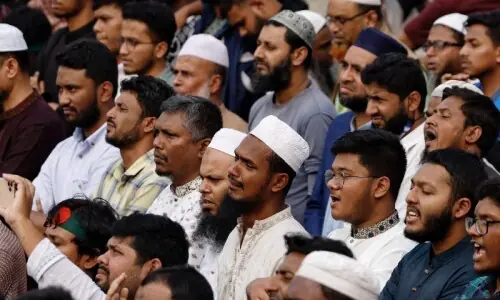
His death ignited furious protests, with mobs setting fire to several buildings, including the offices of The Daily Star and Prothom Alo, two of the country’s leading newspapers, which some protesters perceive as favourable to India.
In response, the student group Inqilab Moncho on Monday threatened a movement to remove the interim government, holding it responsible for Hadi’s death. The group demanded the immediate resignations of the home adviser, his special assistant and the law adviser for failing to provide security.
“Justice must be ensured before the election; no election will take place before that,” Abdullah Al Jaber, member secretary of the group, said at a press conference.
He warned that activists would not leave the streets until Hadi’s killers are brought to justice and would topple the government if their demands were not met.
The group also called for an international investigation by agencies like the FBI or Scotland Yard. Law Adviser Asif Nazrul responded by announcing the murder case would be tried at a speedy trial tribunal, with a verdict expected within 90 days of the police report being filed.
Journalists’ protest
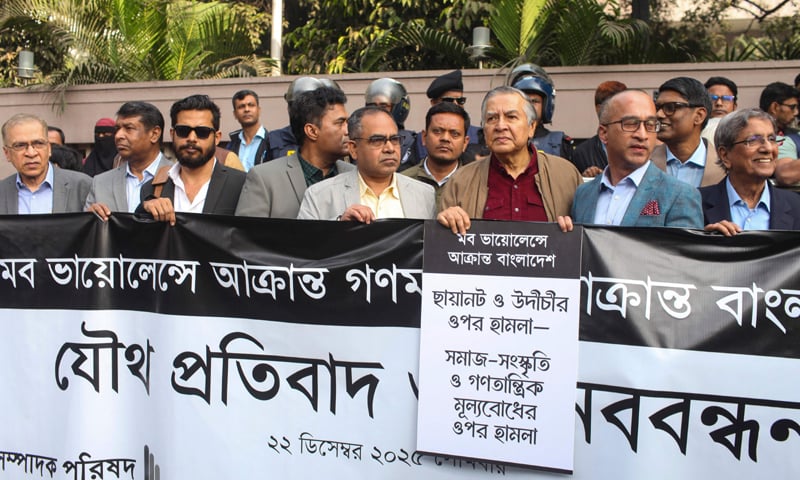
Meanwhile, journalists in Dhaka held a human chain protest on Monday to condemn the arson attacks and threats against the press. Media leaders said threats have escalated from debates over free expression to concerns for their very survival.
“On social media, we have seen messages saying journalists of The Daily Star and Prothom Alo should be hunted down and killed in their homes,” said Mahfuz Anam, editor and publisher of The Daily Star. “This is no longer about opinions. These are murder threats.”
He made the remarks while delivering a solidarity speech at a joint protest titled “Bangladesh Under the Attack of Mob Violence”, organised by the Editors’ Council and the Newspaper Owners’ Association of Bangladesh (NOAB) at a hotel in Dhaka.
Nahid Islam, convener of the National Citizen Party (NCP), today said they believe the attacks involved a section of the government and had political backing. “The whole incident was planned,” he said.
AK Azad said about 28 journalists were trapped inside The Daily Star’s office during the firebombing and claimed that pleas for help were ignored until after the attack was over. He said security forces were present but did not intervene.
He also announced plans to hold a conference in Dhaka for journalists from across the country in mid-January, vowing to continue protests until those responsible for recent arson attacks on The Daily Star and Prothom Alo are brought to justice.
Nurul Kabir, editor of the New Age daily, said the attackers intended to kill. “They set newspaper offices on fire and blocked the fire service from entering,” he said. “This clearly shows they wanted to burn people alive simply because they disagreed with them.”
Arrests and violence
Separately, Police said they have arrested 17 people in connection with the newspaper attacks. Dhaka Metropolitan Police Additional Commissioner SN Nazrul Islam said officers exercised restraint to avoid casualties among the 4,000 to 5,000 protesters.
“The fact that no human life was lost in such a major incident is what we see as our achievement,” he said, adding that social media misinformation had inflamed the situation.
Political figures from across the spectrum have voiced concern over the escalating violence as the country prepares for general elections in February.
“Today, democracy itself has been attacked,” said Mirza Fakhrul Islam Alamgir, secretary-general of the opposition Bangladesh Nationalist Party. “This is the time for all democratic people to unite.”
The broader unrest was highlighted by a separate incident where Border Guard Bangladesh intensified surveillance along the Benapole border after an NCP leader, Md Motaleb Shikdar, was shot and injured in Khulna.
Published in Dawn, December 23rd, 2025