Pakistan crush India, win U-19 Asia Cup
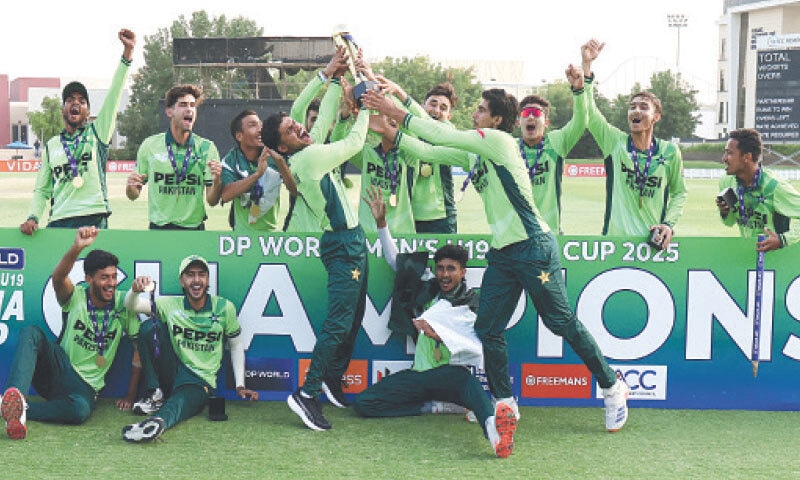


• Opener Sameer Minhas record-breaking 172 powers Pakistan to a mammoth 347; pacer Ali Raza rips through Indian batting with four wickets
• Men in Blue collapse in just 26.2 overs
• Indian team skip the customary handshake
DUBAI: Pakistan produced a dominant all-round performance to thrash arch-rivals India by a massive 191 runs in the final of the U-19 Asia Cup at the ICC Academy Ground on Sunday, claiming the prestigious title in emphatic fashion.
Opener Sameer Minhas lit up the first half of the match with a record-breaking 172 — the highest individual score in a U-19 Asia Cup final — propelling Pakistan to a formidable 347 for 8 after being asked to bat first.
In reply, India’s much-vaunted batting line-up crumbled spectacularly, folding for a paltry 156 in just 26.2 overs as pacer Ali Raza ripped through the order with figures of 4 for 42.
The victory marked a sweet redemption for Pakistan, who had suffered a heavy defeat to the same opponents in the group stage and had entered the final as underdogs against an unbeaten Indian side.
Instead, it was Pakistan who delivered a clinical display, overwhelming India in every department to lift the trophy amid jubilant celebrations.
India captain Ayush Mhatre won the toss and elected to bowl, perhaps hoping to restrict Pakistan on a surface expected to assist the seamers early on.
However, the decision backfired spectacularly as Sameer launched a brutal assault from the outset. After Hamza Zahoor fell early for 18, Sameer combined with Usman Khan (35) and Ahmed Hussain (56) in substantial partnerships — 92 for the second wicket and 137 for the third — to put Pakistan in complete command.
The right-hander brought up his century off 71 balls and raced to 172 off 113 deliveries, studded with 17 fours and nine sixes, before falling to a slower ball from Deepesh Devendran in the 43rd over.
A late flurry of wickets — five falling for 45 runs in the final overs — prevented Pakistan from reaching 400, but their total remained the highest ever posted in a U-19 Asia Cup final.
Khilan Patel was the pick of India’s bowlers with 2 for 44, while Devendran claimed 3 for 83.
Chasing 348, India started explosively, racing to 21 in the first over off Ali Raza, with Vaibhav Suryavanshi smashing a six and four in an over that also included a no-ball and extras.
Suryavanshi continued the onslaught, striking three sixes and a four in his blistering 26 off 10 balls.
But the introduction of spin and disciplined pace turned the tide irreversibly.
Captain Mhatre (2) holed out to mid-off, Aaron George (16 off 9) miscued a pull, and Suryavanshi nicked behind — all falling to Raza and Mohammad Sayyam as India slipped to 49 for 3 in the fifth over.
The collapse deepened. Vihaan Malhotra (7) was bowled attempting a rash pull off Abdul Subhan,
Vedant Trivedi (9) found short midwicket, and Abhigyan Kundu (13) upper-cut to deep third. Kanishk Chouhan (9) and Khilan Patel (19) offered brief resistance, but regular strikes kept India on the back foot.
Lower down, Deepesh Devendran provided late entertainment with a quickfire 36 off 16 balls, including six fours and two sixes, but his dismissal — skying one to point off Raza — ended any lingering hopes.
Subhan (2-29) and off-spinner Huzaifa Ahsan (2-12) chipped in effectively, while Sayyam supported with 2 for 38.
India’s innings lasted a mere 26.2 overs, underscoring Pakistan’s bowling dominance and fielding sharpness after the break.
The margin of victory was the largest in a U-19 Asia Cup final, completing a comprehensive rout.
Man of the Match Sameer was hoisted onto his team-mates’ shoulders as Pakistan celebrated wildly, while India, unbeaten until the final, were left to rue a day when nothing went right.
Meanwhile, neither side took part in the customary post-match handshake during the summit clash, continuing a pattern that began in the group stage, when the gesture was similarly skipped. There was also no handshake following the toss.
The decision reflects a wider trend in encounters between Indian and Pakistani teams.
Earlier this year, during the men’s Asia Cup, Indian players declined to participate in pre- and post-match handshakes in all three meetings between the sides. The same approach was adopted by the Indian women’s team at the Women’s World Cup 2025.
Observers note that the stance comes amid heightened political tensions between the two countries.
Following the Pahalgam terror attack, which claimed 26 lives, India launched a cross-border operation, dubbed Operation Sindoor, against Pakistan without publicly presenting any evidence. Pakistan subsequently retaliated by shooting down multiple Indian aircrafts.
Published in Dawn, December 22nd, 2025