Partial strike as lawyers divided over IHC judge’s removal

ISLAMABAD: A visible split among lawyers in the federal capital on Friday resulted in only a partial strike, as a small group of lawyers observed the call issued by the Islamabad District Bar Association (DBA) to protest the removal of Justice Tariq Mehmood Jahangiri, while the Islamabad High Court Bar Association (IHCBA) played down the verdict that led to his ouster.
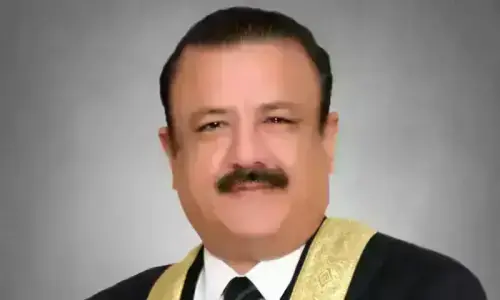
Justice Jahangiri was removed from office through a short order passed by an Islamabad High Court (IHC) division bench comprising Chief Justice Sardar Mohammad Sarfraz Dogar and Justice Mohammad Azam Khan. The bench ruled that his elevation to the high court was “without lawful authority” and that he had “ceased to hold” the office with immediate effect.
The short order was announced at around 3:30pm. However, sources said Justice Jahangiri had left his chamber for his residence approximately half an hour earlier, adding that he may have been informed of the decision before its formal announcement. An official of his court told Dawn that the judge personally met and embraced each staff member before leaving, telling them: “We will meet again if God so wills.”
Following the verdict, DBA President Chaudhry Naeem Gujjar announced a strike to protest the decision. The IHCBA, however, chose not to issue any such call.
IHCBA Secretary Chaudhry Manzoor Jajja told Dawn that the verdict was “like one of the many decisions the IHC passes every day” and said there was no justification for a strike. He added that IHC judges — including Justice Babar Sattar and Justice Jahangiri himself — had previously opposed strikes over what he described as peripheral issues.
As a result of this division within the legal fraternity, the strike had only a limited impact. While routine attendance was reported at the Supreme Court, the Federal Constitutional Court (FCC) and the Islamabad High Court, only a small number of lawyers boycotted proceedings at the sessions courts. A senior sessions court official estimated that fewer than 10 per cent of lawyers abstained from hearings in solidarity with the ousted judge.
Meanwhile, the IHC administration issued a duty roster for the coming week that did not include Justice Jahangiri’s name. Hearings in cases fixed before his bench were cancelled, and the administration is expected to redistribute his caseload among other available judges. Even before the formal de-notification, Justice Jahangiri’s name was removed from the IHC website.
Late on Thursday night, the Presidency confirmed that President Asif Ali Zardari had approved the de-notification of Justice Jahangiri on the advice of the prime minister, in compliance with the IHC order. The move followed a direction in the short written order instructing the law ministry to de-notify him. The ministry forwarded a summary through the Prime Minister’s Office, which was subsequently approved by the president.
The controversy originated from a letter that surfaced on social media last year, purportedly issued by the University of Karachi (KU). During the proceedings, KU Registrar Imran Ahmed Siddiqui submitted records stating that the university syndicate had cancelled Justice Jahangiri’s law degree, alleging that it had been obtained through “unfair means”. He claimed the judge had been found cheating and creating a disturbance in an examination hall in 1988 and was debarred until 1992, but had allegedly appeared in an examination in 1989 under a changed name.
Justice Jahangiri’s counsel, Advocate Muhammad Akram Sheikh, argued that a sitting judge could only be removed through the procedure prescribed under Article 209 of the Constitution, which requires proceedings before the Supreme Judicial Council (SJC). However, amicus curiae Barrister Zafarullah Khan contended that where a judge’s eligibility or qualification was in question, the SJC process was not applicable, citing past judicial precedents.
The bench observed that the qualification to hold the office of a high court judge was personal to the individual and independent of judicial performance. It noted that sufficient opportunity had been provided to Justice Jahangiri to submit his reply and credentials, but he failed to do so.
Published in Dawn, December 20th, 2025