Residents salvage belongings from West Bank ahead of demolitions

• Tel Aviv targets 25 buildings to clear pathways for its military vehicles
• Tulkarm mayor calls the move ‘a full-fledged crime’
• UN says area faces worst displacement crisis since 1967
• Israeli settler kills 16-year-old Palestinian boy in West Bank
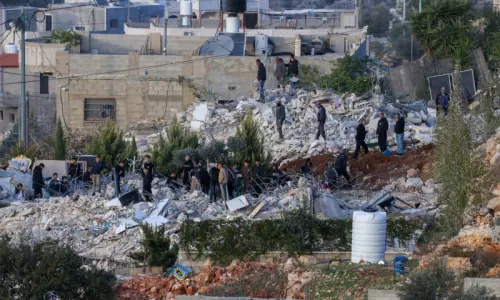
NUR SHAMS: Dozens of residents from the West Bank’s emptied Nur Shams refugee camp returned on Wednesday to retrieve belongings after the Israeli military announced plans to demolish more structures in the camp.
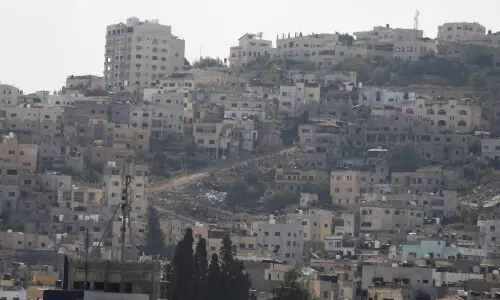
The mayor of Tulkarm condemned the move as “a fully fledged crime”. This follows demolitions in March that displaced thousands of residents to clear paths for military vehicles.
The military has tightened restrictions on movement and carried out sweeping raids in several cities, citing the need to root out suspected militants. Human Rights Watch accused Israel in November of war crimes and crimes against humanity over what it said were forced expulsions in the West Bank. Israel denies committing such crimes.
Dozens of displaced residents of Nur Shams returned to the ravaged camp to salvage what they could from their homes before their scheduled destruction.
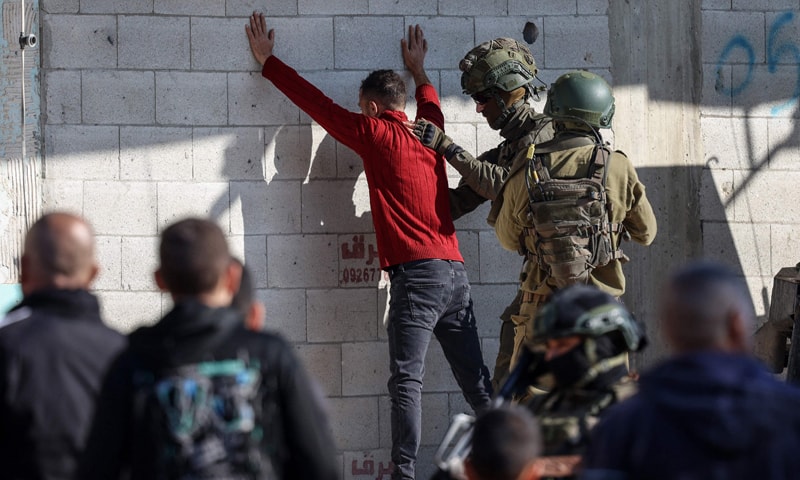
Under the watchful eye of Israeli soldiers, families loaded furniture, children’s toys, and family photos onto small trucks. Troops conducted invasive ID checks and physical searches, permitting entry only to those whose homes were marked for demolition.
Mahmud Abdallah, who was forced to flee the camp, witnessed the scale of the destruction for the first time. “I was surprised to find that there were no habitable houses; maybe two or three, but they were not suitable for living,” he said. “The camp is destroyed.”
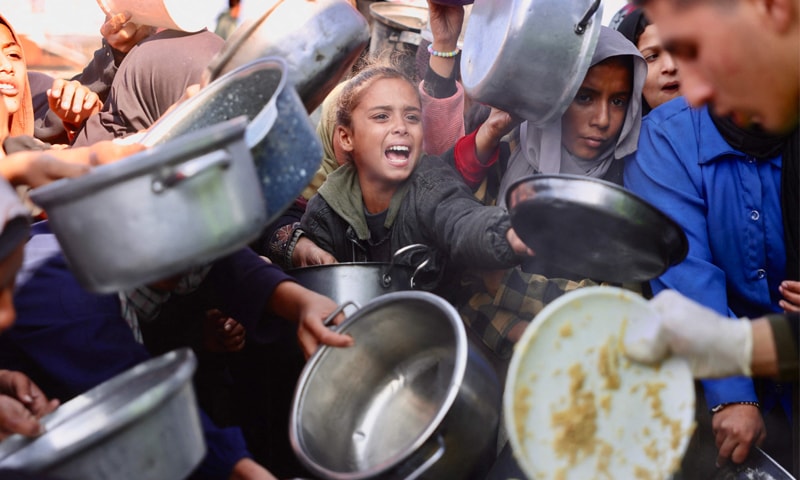
The demolitions targeting 25 buildings and up to 100 families are part of Israel’s strategy of clearing pathways for its military vehicles in the dense refugee camps. According to the UN agency for Palestinian refugees, UNRWA, over 32,000 people have been displaced.
Roland Friedrich, UNRWA’s director for the West Bank, said an estimated 1,600 houses were fully or partially destroyed, creating “the most severe displacement crisis that the West Bank has seen since 1967”.
As Palestinians face this state-sanctioned destruction of their homes and history, their spirit of resistance remains unbroken.
“We ask God to compensate us with palaces in paradise,” said Ibtisam al-Ajouz, a displaced resident whose home was set to be destroyed. “We are determined to return, and God willing, we will rebuild. Even if the houses are demolished, we will not be afraid—our morale is high.”
16-year-old killed
Separately, an illegal Israeli settler shot and killed a 16-year-old Palestinian boy in the occupied West Bank town of Tuqu’ on Tuesday, a horrific act of violence that occurred just after the funeral for another teenager slain by Israeli forces the day before, the town’s mayor confirmed.
The killing of Muheeb Jibril comes amid a brutal escalation of violence by Israeli forces and settlers against Palestinians.
The United Nations reported that October saw the highest number of settler attacks on record, part of a devastating wave of aggression sweeping the territory under Israeli military occupation.
“Today, after the funeral of 16-year-old Ammar Sabah, who was killed yesterday by the Israeli army in the town centre, a number of youths were gathered by the main street when a settler shot 16-year-old Muheeb Jibril in the head,” Tuqu’ Mayor Mohammed al-Badan told Reuters.
The Israeli military killed Ammar Sabah on Monday during a violent raid on the town, according to the Palestinian health ministry. The army, which claimed rocks were thrown at its soldiers, said the incident was under review.
This pattern of deadly force is set against the backdrop of Israel’s illegal occupation and settlement of the West Bank, home to 2.7 million Palestinians who live with limited self-rule.
Hundreds of thousands of Israelis reside in settlements deemed illegal by most world powers, with numerous UN Security Council resolutions calling for an immediate halt to all settlement activity. Israel, however, disputes international law and cites its own historical claims to the land.
While the United States publicly calls for stability, its diplomatic efforts have failed to curb the escalating violence.
“President Trump has been perfectly clear that the United States expects the violence in the West Bank to end, and that the United States will not allow the annexation of the West Bank,” Deputy US Ambassador to the UN Jennifer Locetta told the Security Council on Tuesday.
Published in Dawn, December 18th, 2025