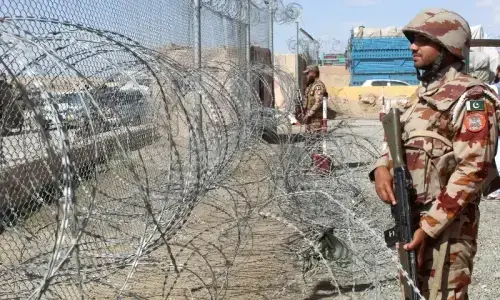
PESHAWAR: The prolonged closure of the Pakistan-Afghanistan border for more than two months has had wide-ranging repercussions on trade, employment, government revenues and regional connectivity, business leaders said on Tuesday.
These views were expressed by senior vice-president of Pak-Afghan Joint Chambers of Commerce and Industry (PAJCCI) Ziaul Haq Sarhadi and former senior vice-president of Sarhad Chamber of Commerce and Industry Eng Manzoor Ellahi in a joint statement issued here on Tuesday.
They said the border closure had paralysed a critical trade corridor worth billions of dollars annually. Prior to the shutdown, bilateral trade between the two countries stood at approximately $2-3 billion per year, with Pakistan exporting high-value goods while Afghanistan depended on Pakistan for essential commodities and exported agricultural perishables in return.
During peak seasons, particularly in agriculture and construction, daily exports through border crossings reached $50-60 million, including cement, sugar, kinnows (citrus fruit), potatoes, medicines and surgical instruments. The ongoing suspension of trade has already caused cumulative losses exceeding $4.5 billion for Pakistan, they claimed.
Business leaders claim trade suspension caused $4.5bn losses to Pakistan
They warned that seasonal exports such as mandarins and potatoes — whose export window runs from December to March — were expected to suffer additional losses of around $200 million if the situation persisted.
The cement industry has been among the worst affected, as Afghanistan remained a major market for Pakistani cement exports. At the same time, the halt in coal imports from Afghanistan has pushed up production costs for industries in Pakistan’s northwestern region, they noted.
Trade in medicines and surgical goods, valued at nearly $200 million annually, has come to a complete standstill, raising concerns over shortages in Afghanistan and significant revenue losses for Pakistani pharmaceutical companies, the business leaders further noted.
On the Afghan side, exports of dry fruits, grapes, pomegranates and other perishables worth millions of dollars have lost access to Pakistani and onward international markets.
This has resulted in spoilage of goods, leaving farmers in border areas facing immediate income losses, they pointed out.
Mr Sarhadi and Mr Ellahi said the abrupt and unannounced closures had triggered a humanitarian ripple effect, rendering tens of thousands of workers jobless on both sides of the border.
Thousands of truck drivers, labourers, clearing agents and porters have been left without work, while more than 8,000 trucks remain stranded at the Torkham and Chaman crossings.
They added that drivers were incurring daily demurrage charges and fuel expenses without any income. In Pakistan, border town economies such as Peshawar and Quetta — heavily dependent on trade-related activities — have witnessed job losses in logistics, transport and warehousing sectors, they said.
Published in Dawn, December 17th, 2025