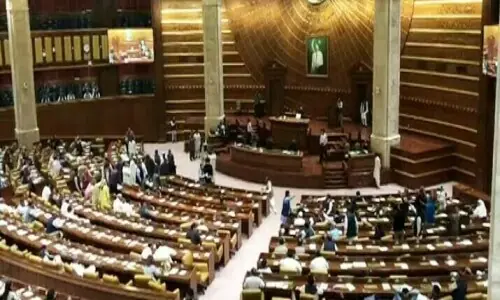
THE resolution adopted by the Punjab Assembly calling for a ban on the PTI and its founder Imran Khan is yet another disturbing escalation in Pakistan’s already fraught politics. The move, which seeks not only to sideline what is arguably the country’s most popular political party and its leader but also disenfranchise the millions who voted for it in the last election, will erode the public’s trust in politics and politicians.
The resolution, sponsored by the PML-N, has framed its arguments in terms of national security, accusing both the PTI and the former prime minister of being “anti-state” and a “tool of the enemy state”.
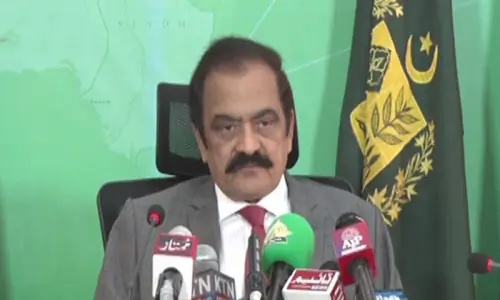
The timing of the move is significant; it comes just days after the ISPR chief assailed the PTI leader, without naming him, for spreading an “anti-army narrative”, insisting that such rhetoric had moved beyond politics into the sphere of “national security”.
This is not the first time a party or politician has faced the prospect of political banishment. Pakistan’s history is replete with such instances. The infamous Public and Representative Offices (Disqualification) Act, enacted under prime minister Liaquat Ali Khan and Field Marshal Ayub Khan’s Elective Bodies Disqualification Order were two early pieces of ‘legislation’ that were used to disqualify political opponents from holding public offices for up to 15 years.
What followed was two decades of massive political instability, two military takeovers, and loss of the eastern wing. Sadly, the consequences of these controversial laws did not deter even an elected leader like Z.A. Bhutto from dissolving the NAP or jailing his opponents.
Today’s coalition partners — the PML-N and PPP — along with other parties too have suffered exile and persecution, allegations of being anti-state and mass disqualifications under generals Ziaul Haq and Pervez Musharraf. Their resilience and comeback underscore the fact that attempts to ban legitimate political entities having public support never work. Even manufactured alliances like the IJI and later the king’s party PML-Q failed to deliver.
If heavy-handed tactics could not eliminate the PML-N and PPP, they are not likely to work against the PTI either. The proposal to exclude a legitimate political force, which dominated the last election despite electoral manipulation and was able to form a government in KP, from politics is a short-sighted manoeuvre driven by the PML-N’s desire to eliminate a strong political adversary in Punjab. Even by suggesting this essentially antidemocratic move, the PML-N has further damaged its democratic credentials.
Only voters, and not the state, should have the authority to consign a political party to the dustbin of history — through the ballot. The state — through the courts — has a right to ban a political entity only if it is involved in violent militancy. It is about time that the politicians understood the lessons of history.
Published in Dawn, December 11th, 2025